






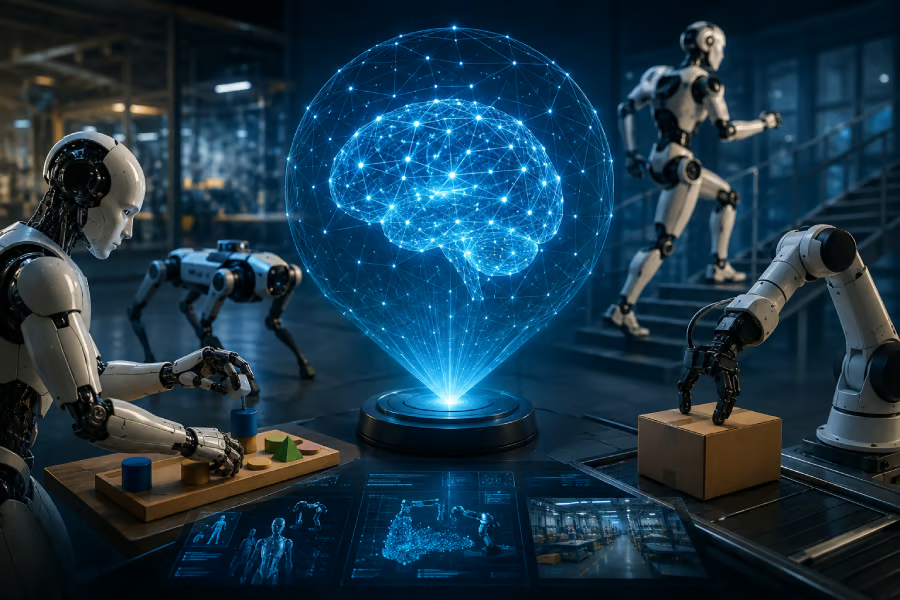


The embodied AI industry is rapidly changing its priorities, with software intelligence emerging as the biggest competitive advantage over hardware improvements.
According to a report by Pandaily, developers unveiled 13 new embodied AI foundation models and world models during June 2026, averaging one release every 48 hours. The pace reflects a growing industry focus on enabling robots to think, reason, and adapt more effectively rather than simply improving their mechanical capabilities.
The shift comes as robotics companies increasingly view AI models as the key technology determining how well humanoid robots and autonomous machines perform in real-world environments.
BAAI focuses on world understanding
Rather than following a single approach, major AI labs and robotics companies are targeting specific weaknesses that continue to limit robots. At the 2026 Zhiyuan Conference, the Beijing Academy of Artificial Intelligence (BAAI) introduced two world-model projects.
The first, Wujie Physis-v0.1, is designed to predict the next physical state of an environment by combining multiple types of sensory information, including video, RGB-D data, 3D point clouds, and force-tactile signals, into a shared latent representation.
BAAI also unveiled Wujie RoboBrain Orca, which functions as a robot brain by combining language and visual information with causal reasoning and multimodal decoding.
Alibaba bets on better model design instead of bigger scale
Alibaba took a different direction with the launch of its Qwen-Robot family on June 16.
Rather than relying primarily on larger datasets and more robot training, the company argued that the diversity of real-world environments cannot be solved through scale alone. Instead, it proposed model-level alignment techniques tailored for different robotic tasks.
The suite includes:
- Qwen-RobotNav, which adjusts visual attention for robot navigation.
- Qwen-RobotManip, which standardizes state and action spaces for manipulation tasks.
- Qwen-RobotWorld, which predicts world dynamics using natural-language action interfaces.
New models target specific robot weaknesses
Several other organizations introduced models aimed at solving individual bottlenecks that continue to limit robot performance.
CasiaHand unveiled Brain-Si 0.5, described as the world's first human-like dexterous manipulation model. It uses a three-layer architecture that combines planning, manipulation capabilities, and physically interpretable models for tasks such as grasping, handovers, bimanual coordination, and human-robot interaction.
GalaxyBot introduced AstraBrain-WBC 0.5, a cerebellum-inspired foundation model for whole-body humanoid control. Built on a GPT-style causal Transformer architecture, it was trained on roughly 2 billion frames of human action data and contains 80 million parameters.
Other releases included RoboScience's Visics architecture, which separates world models from operation models using object trajectory representations; Current Robotics' Curl-0, which approaches whole-body dexterous manipulation through coupled training; and BoundlessPower's MWA world model for modeling long-sequence bidirectional physical causality.
The focus is shifting from capability to reliability
Pandaily noted that despite their different technical approaches, these projects share a common goal. Instead of simply showcasing impressive robot demonstrations, researchers are increasingly trying to understand why robots still struggle with many everyday tasks.
Teams are targeting different bottlenecks, including tactile sensing, whole-body coordination, transferring skills from simulation into the real world, and planning over long sequences of actions. The growing emphasis is on building AI architectures that can overcome these limitations rather than relying solely on improved hardware.
What this means for the AI industry
The June wave suggests embodied AI may be entering a foundation-model phase, similar to the shift that reshaped generative AI.
If these software improvements continue translating into better real-world performance, robots could become more adaptable across manufacturing, logistics, healthcare, warehousing, and service industries without requiring major hardware redesigns. Developers may also find it easier to build new applications by fine-tuning shared robot foundation models rather than creating task-specific systems from scratch.
At the same time, real-world deployment remains difficult. Robots must still operate safely in unpredictable environments, interact with people, and handle situations that differ from their training data. Stronger AI models alone do not eliminate those engineering and safety challenges.
Also read: China’s optical chip breakthrough could make AI inference faster by moving data between chips via light rather than relying solely on larger GPU clusters.