






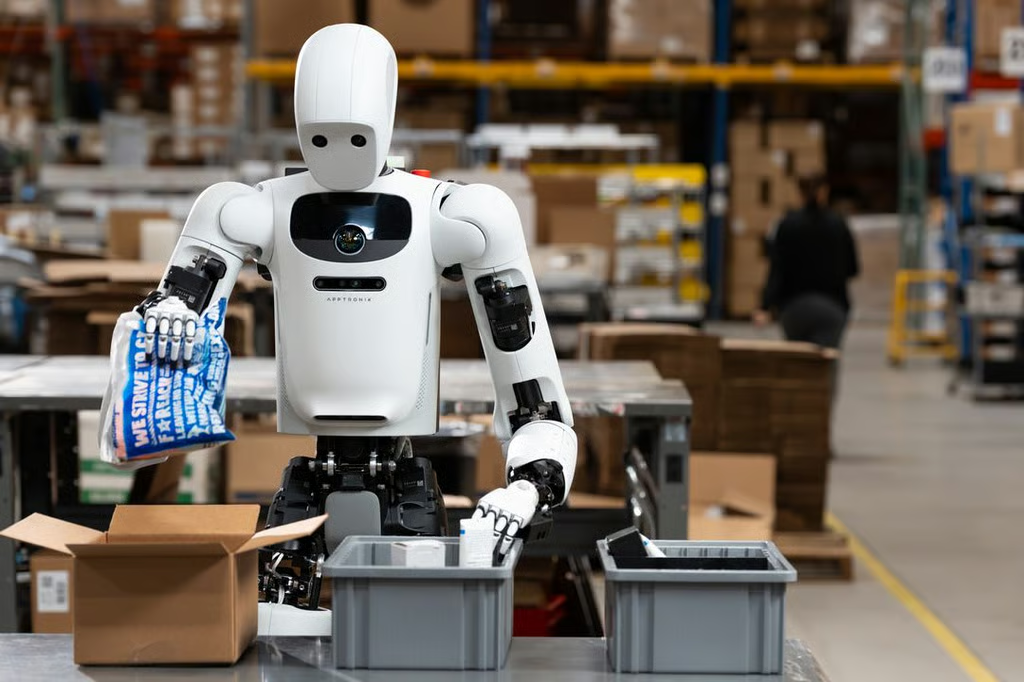


Apptronik wants to solve one of robotics' biggest bottlenecks: collecting enough real-world experience to make humanoid robots genuinely useful.
The Austin startup has opened a roughly 90,000-square-foot Robot Park where fleets of humanoid robots perform industrial work while continuously generating data used to train AI models. The company says the facility serves as a production-scale learning environment rather than a traditional research lab.
The announcement reflects a broader shift across the robotics industry. Companies are increasingly competing not just on robot hardware, but on who can gather the most valuable real-world data to improve AI systems.
Apollo 2 steps into the spotlight
Alongside the facility, Apptronik unveiled Apollo 2, its latest humanoid robot platform.
It comes in two configurations, bipedal and wheeled, designed to handle different operational needs. The wheeled version targets industrial settings where stability and efficiency matter most, while the bipedal version is built for environments closer to human spaces, where walking ability and adaptability are required.
According to Apptronik, Apollo 2 has been operating as a data-collection workhorse for over a year already. The system is now deployed across Robot Park sites and at partner and customer facilities to generate training data for future models.
A key pillar of Apptronik’s strategy is its partnership with Google DeepMind. Data gathered from Apollo 2 is used to advance Gemini Robotics, DeepMind’s foundational AI models for robotics. Apptronik CEO Jeff Cardenas described the system as a feedback loop between real-world operations and AI training.
The company has built what Cardenas called “a factory that produces robots, we also have a factory that produces data,” according to Reuters. He added that Robot Park serves as the engine behind production-grade AI development, linking physical robots directly to model training at scale.
Robots train for real work
The robotics industry has long struggled with a core problem: robots can perform impressive demos but often fail in real workplaces.
Apptronik’s approach aims to close that gap by prioritizing continuous exposure to real environments — logistics, manufacturing, and retail operations — rather than controlled lab demonstrations. If successful, this model could shorten the gap between prototype robots and commercially useful machines that actually perform repeatable work at scale.
What Apptronik is really building
At its core, Apptronik is not just building robots; it is building a data pipeline for embodied AI. Robot Park functions like a manufacturing line, but instead of producing hardware, it produces training data. That data is then used to refine AI models that control future generations of robots.
The partnership with Google DeepMind is especially significant. If Gemini Robotics becomes a widely used foundation model, Apptronik could benefit from early access and integration, but it also raises a long-term question: whether the intelligence it helps train becomes broadly shared across competitors.
The company is also clearly separating roles between its current and future hardware. Apollo 2 is positioned as a workhorse for data collection, while a future system, Apollo 3, is expected to be the first fully commercial, scaled product.
Also read: Japan wants 10 million AI-powered robots operating by 2040 as it expands robotics across manufacturing, caregiving, infrastructure, and disaster response.