







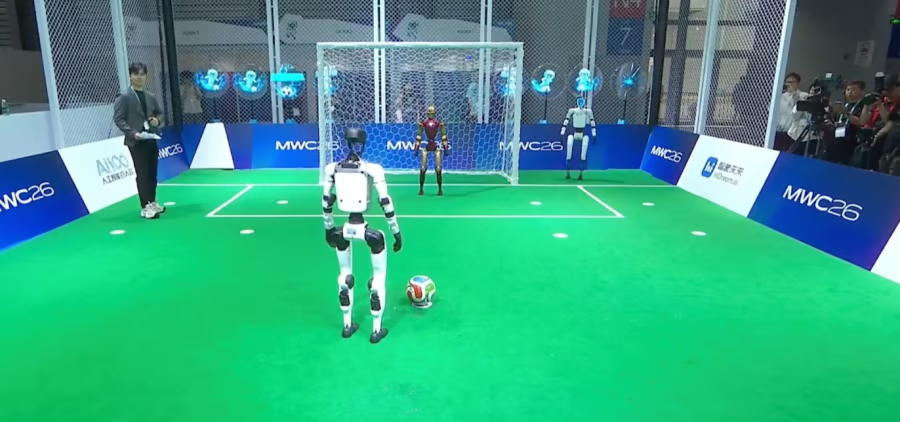
Humanoid robots took turns shooting, defending, stumbling, and recovering in front of a live crowd at MWC26 Shanghai.
Held at the Shanghai New International Expo Centre, the Humanoid Robot Football Penalties Challenge brought robotics developers together to test advances in perception, motion control, balance, decision-making, and networked intelligence. Hosted in the Mobile AI Innovation Frontiers zone, the competition formed part of MWC26 Shanghai, which runs under the theme "IQ Era."
Rather than showcasing carefully scripted demonstrations, organizers required every robot to operate independently. According to event organizers, human remote control and pre-programmed motion sequences were prohibited, forcing machines to locate the ball, judge the goalkeeper, take a shot, defend the goal when required, and recover their balance using only onboard intelligence.
A live test of embodied AI
The challenge served as more than entertainment. It was designed to measure how embodied AI performs under changing conditions similar to those encountered in the real world.
Robots had to interpret their surroundings, calculate angles, respond to goalkeepers' movements, and make rapid adjustments based on sensor feedback under competitive pressure. According to GSMA, the competition offers "a dynamic view of how mobile AI is moving from experimentation to real-world application."
Winners emerge despite missed shots
The event attracted more than 10,000 spectators, according to TechNode, as eight Chinese robotics teams competed through nearly 100 penalty rounds. China Mobile (Hangzhou) Information Technology claimed first place, followed by Tianshu Tanjie (Beijing) Technology and Hangzhou Xingshu Intelligent Robot.
While many penalty attempts missed the target, successful goals drew loud reactions from the audience. The winning robot impressed judges with consistent performance and few vision or balance failures. Engineers cited its combination of low-latency 5G connectivity and edge AI computing as a key advantage, TechNode reported.
Other teams demonstrated strengths in areas such as dynamic balancing, servo control, goalkeeper reactions, and lightweight robot design that improved agility during play.
Why it matters
Using football as a benchmark makes advanced robotics easier to understand while exposing capabilities that matter far beyond sports. Technologies tested during the competition, including autonomous perception, real-time planning, balance recovery, and motion control, are also essential for future service robots, industrial automation, logistics, and other real-world applications.
The event also highlighted the growing role of mobile connectivity and edge computing in enabling robots to make rapid decisions without relying on scripted behavior.
A showcase for China’s robotics ambitions
For Chinese audiences, the competition carried significance beyond the novelty of robot football. It offered a public-facing look at China’s growing ambitions in humanoid robotics, embodied AI, 5G, and edge computing at a time when the country is pushing to turn advanced automation into a visible part of everyday industry and public life.
The all-Chinese field also made the event feel like a showcase for domestic robotics talent. While the missed shots showed that humanoid robots remain far from polished, the public format gave spectators a clearer view of where Chinese developers are making progress and where the technology still needs work.
Progress is real, but so are the limitations
The penalty challenge demonstrated both the promise and the current limitations of humanoid robotics. Many robots still struggle with basic football skills, reinforcing the idea that consumer-ready humanoids remain some distance away.
At the same time, the competition showed measurable progress. Instead of polished promotional videos, developers exposed their systems to unpredictable conditions where failures were visible alongside successes. That makes the event a more meaningful indicator of the industry's maturity than highly choreographed demonstrations.
These public stress tests offer valuable evidence of how embodied AI is evolving. Although humanoid robots are becoming increasingly capable, they are still in the early stages of moving from research projects to practical everyday assistants.
Related reading: For more on China's broader push to accelerate humanoid robotics, read our coverage of the country's expanding robot training facilities and what they could mean for the future of embodied AI.