






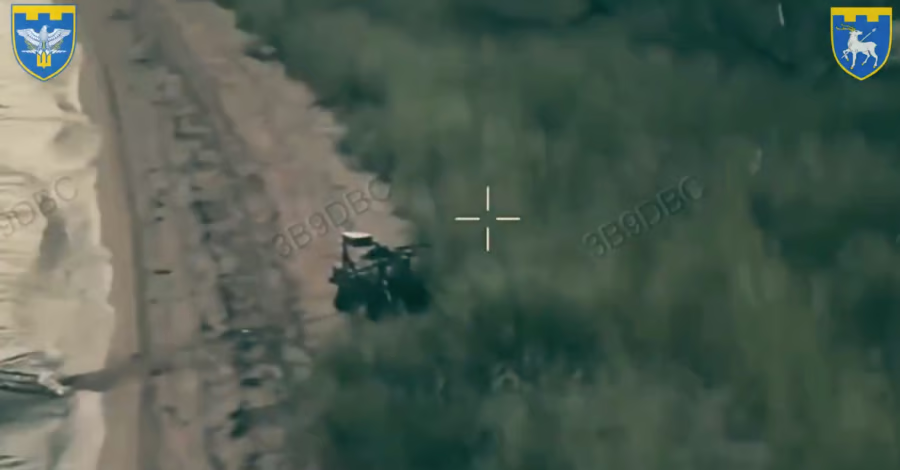


Ukraine says it has completed the world's first fully robotic amphibious combat assault, using an unmanned sea drone to carry an armed ground robot onto Russian-held territory before sending it into battle.
The operation, announced by Ukraine's 123rd Separate Territorial Defense Brigade on July 13, took place on the Russian-occupied Kinburn Spit along the Black Sea. According to the brigade, the mission combined a naval drone, an armed ground robot, and aerial drones in a coordinated operation behind Russian lines.
Ukraine described it as the first known combat mission in which an unmanned maritime platform transported, landed, and deployed a combat robot on an enemy-held shoreline. The brigade said that operators remotely guided a naval drone across the Black Sea before it reached the occupied coastline, where it released an unmanned ground vehicle fitted with a machine gun.
A video shared on social media shows the robot moving across the beach and opening fire after reaching land. Ukraine did not reveal the mission's objective, the identity of the maritime drone, or what happened after the robot began operating ashore.
New details emerge about the combat robot
A day after the announcement, Ukrainian outlet UNITED24 reported that the previously undisclosed robot carried a Wolly 7.62 remotely operated weapon station developed by DevDroid.
According to the company, the system is built around a PKM-pattern machine gun and uses artificial intelligence to assist operators with target acquisition while allowing them to monitor the battlefield and fire remotely. DevDroid said the turret-mounted KT-7.62 machine gun can engage targets at distances of up to 1,000 meters.
The operation was led by Colonel Oleh Makukha, commander of Ukraine's 123rd Separate Territorial Defense Brigade, alongside Major Denys Hipik, who leads the brigade's 1st Unmanned Systems Battalion.
The brigade said: "This is the first combat mission of its kind known to us anywhere in the world: an unmanned ground vehicle was delivered to an enemy-held shore by an uncrewed maritime platform, landed on the occupied territory of our native region, and used to carry out a combat mission."
According to the unit, using robotic systems instead of troops made it possible to operate in an area where sending soldiers would have exposed them to extreme danger.
Part of Ukraine's expanding robotic battlefield
The latest mission builds on Ukraine's growing use of uncrewed systems across land, sea and air.
Naval drones have already been used extensively against Russia's Black Sea Fleet, while ground robots increasingly carry supplies, evacuate wounded troops, lay mines and provide fire support in areas considered too dangerous for soldiers.
Ukraine also announced earlier this year that it had successfully cleared Russian-held territory using only ground robots and aerial drones, highlighting the country's push toward keeping troops farther from the front line. The Kinburn operation takes that strategy a step further by combining multiple robotic platforms into a single assault mission.
What this could mean for future warfare
Although the mission appears to mark a technological milestone, it also highlights the practical limits of today's battlefield robots.
Experts note that unmanned systems can reduce the risk to soldiers during hazardous amphibious landings, particularly in heavily monitored coastal areas such as the Kinburn Spit. At the same time, small robotic platforms cannot transport heavy weapons such as artillery or mortars, limiting these operations largely to reconnaissance, light combat, and specialized missions.
The concept nevertheless demonstrates how militaries are beginning to link autonomous and remotely operated systems across domains rather than using each platform independently. If the approach proves effective, similar combinations of sea, land and aerial drones could reshape how dangerous coastal operations are planned, reducing reliance on traditional troop landings while expanding the role of robotic forces in frontline combat.
Additional news: For more on robot combat, see how Unitree’s new 2026 teaser puts its humanoids in the ring against both robots and humans.