






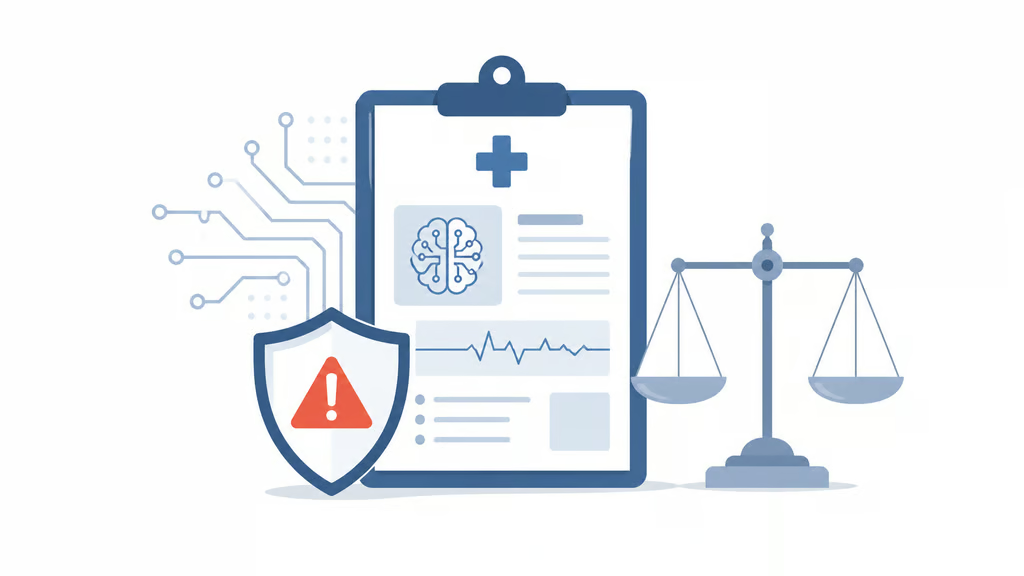


UK doctors and the NHS could face negligence claims over mistakes made by AI tools unless healthcare liability rules are updated, according to a warning from the Medical Protection Society.
The warning comes as the NHS uses AI in more clinical and administrative settings, including scan analysis, X-ray review, consultation summaries, and draft patient letters.
The concern is not that every AI error will become a lawsuit. It is that current rules may leave clinicians and the health service carrying responsibility for systems they did not build.
According to The Guardian’s report on the Medical Protection Society warning, the group told ministers that doctors and the NHS could be sued for medical negligence if AI tools make mistakes in diagnosis or treatment recommendations.
MPS wants AI tools treated as products
The Medical Protection Society said doctors could become a “liability sink” for AI mistakes unless the law changes. The group argues that AI tools and systems should be treated as products under the UK’s Consumer Protection Act 1987, which could make it easier to hold developers or manufacturers responsible when the technology itself contributes to harm.
The Guardian cited two examples raised by MPS: an AI tool missing a lung tumour on a chest X-ray, or wrongly recommending a higher dose of warfarin, a blood thinner. In both scenarios, the patient could suffer serious harm even though the immediate error came from the tool.
The warning focuses on clinical AI, but it fits a broader safety pattern across health technology. Recent research on AI health advice found that ChatGPT Health missed serious medical emergencies in test scenarios, showing how persuasive outputs can still fall short when medical stakes are high.
MPS is not arguing that the NHS should avoid AI. Its point is that doctors should not automatically absorb liability when a tool developed, supplied, or implemented by someone else contributes to harm.
Accountability rules are still catching up
The Department of Health and Social Care said it would review the MPS recommendations. NHS Resolution, which handles negligence claims against hospitals in England, is also drafting guidelines on AI liability.
That leaves doctors in a difficult position while AI adoption continues. If a clinician follows an AI recommendation that turns out to be wrong, they may still face questions about whether they checked it properly.
The same tension has appeared in other healthcare AI rollouts. Google recently killed an AI health feature after safety concerns, a reminder that healthcare AI tools can move quickly from useful experiment to risk case when oversight is incomplete.
For the NHS, the practical question is not whether AI should be used at all. It is how hospitals and clinicians document when AI was involved, who checked the output, and what happens if the tool was wrong. Clearer rules could protect doctors from being blamed for technology failures while still giving patients a path to accountability.
Until those rules are clearer, documented human oversight is the safest baseline: AI can support clinical work, but the final decision requires a named, accountable process.
Also read: 5 diabetes tech gadgets showing how AI is changing glucose monitoring.