







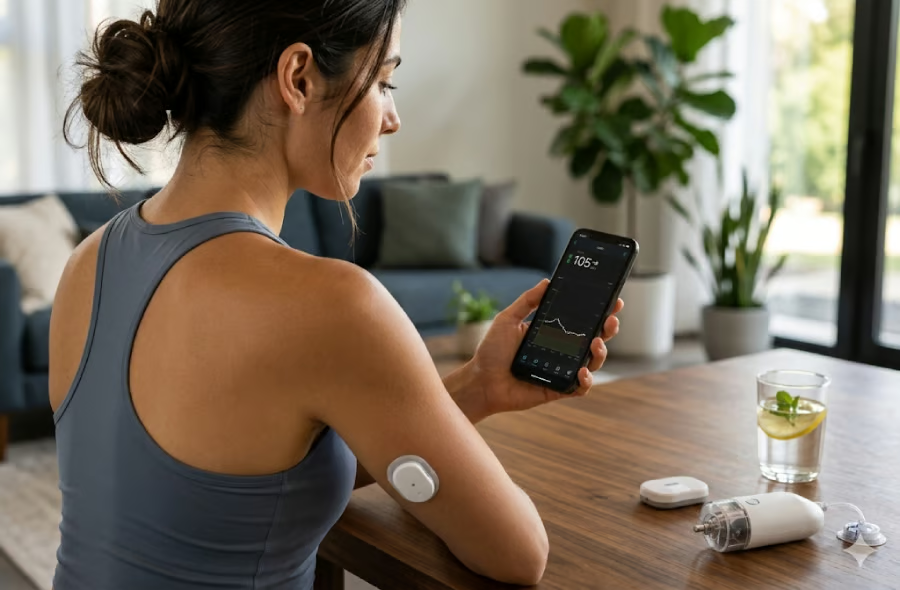
Diabetes monitoring used to be a numbers game. Now it is becoming a game of prediction.
A new generation of glucose sensors, wearable devices, insulin pumps, and app-connected monitors is turning diabetes care into one of the clearest tests of AI in everyday healthcare. The gadgets are not all “AI devices” in the marketing sense. But together, they show where medical technology is moving: from passive tracking to real-time interpretation, early warnings, automated decisions, and personalized feedback.
That shift matters because diabetes management produces exactly the kind of messy, continuous data AI systems are built to analyze. Glucose changes with food, sleep, stress, exercise, medication, and dozens of other variables. The next wave of diabetes tech is trying to make sense of that swirl before it becomes a crisis.
- 1. Dexcom Stelo brings continuous glucose monitoring over the counter
- 2. Abbott Lingo turns glucose tracking into consumer health tech
- 3. Oura Ring plus Dexcom Stelo shows where wearables are headed
- 4. Dexcom G7 15 Day shows the sensor race is still central
- 5. Automated insulin delivery systems bring prediction closer to action
- What diabetes tech says about the future of AI healthcare
1. Dexcom Stelo brings continuous glucose monitoring over the counter
Dexcom’s Stelo is one of the clearest signs that glucose monitoring is moving beyond the traditional prescription-only diabetes market.
The FDA cleared Stelo in 2024, making it the first over-the-counter continuous glucose monitor in the U.S. It is intended for adults with Type 2 diabetes who do not use insulin, as well as people who want greater visibility into glucose patterns.
The AI angle is not that Stelo itself is a tiny doctor on the arm. It is that over-the-counter CGMs create a larger pool of continuous metabolic data, which apps and analytics platforms can use to show users how meals, movement, sleep, and stress affect glucose patterns.
That changes the relationship between the user and the data. Instead of checking a number at isolated moments, users can see patterns over time and start asking a more interesting question: what is my body likely to do next?
2. Abbott Lingo turns glucose tracking into consumer health tech
Abbott’s Lingo is another sign that glucose monitoring is drifting into the broader wearable market, though it should not be treated as a replacement for prescribed diabetes monitoring or medical guidance.
The device is marketed as a consumer biowearable rather than a traditional diabetes-management device. In 2025, Abbott expanded Lingo into Walmart stores, making continuous glucose tracking more accessible to people who may not have qualified for insurance-covered CGMs.
That retail expansion matters because it puts metabolic tracking alongside smartwatches, rings, sleep trackers, and fitness bands. The long-term AI opportunity is not just glucose tracking. It is context.
A glucose reading may mean more when users can compare it with sleep, meals, exercise, stress, and other behavioral signals. Healthcare AI becomes more useful when it can help identify patterns across behaviors rather than staring at a single number in isolation.
The risk, of course, is that more data does not automatically mean better health. Without careful design, consumer glucose tracking can become another anxiety dashboard. The companies that win this market will likely be the ones that translate data into useful, restrained guidance instead of turning every sandwich into a red alert.
3. Oura Ring plus Dexcom Stelo shows where wearables are headed
Oura’s integration with Dexcom Stelo may be the most obvious bridge between diabetes monitoring and AI-powered consumer wellness.
In 2025, Oura added glucose tracking and AI-powered meal logging, letting users pair Dexcom’s Stelo CGM with the Oura app. The feature brings glucose data into the same environment as sleep, stress, activity, and other biometric signals.
That is the health-tech dream in miniature: one app looking across multiple streams of body data and offering a more complete picture of what is happening.
It is also where AI becomes more plausible. A glucose reading alone can show a spike. A connected wearable system could help users compare that spike with other signals, such as sleep, activity, stress, or meal timing, to look for recurring patterns.
The distinction matters. Smart rings and smartwatches are not the same thing as CGMs, and the FDA has warned consumers against using unauthorized watches or rings that claim to measure or estimate blood glucose without piercing the skin. For now, the more credible path is integration: wearables adding context around CGM data, not replacing medical-grade glucose sensors.
The most useful AI in healthcare may not look like a chatbot giving medical advice. It may look more like a quiet pattern engine that helps people notice what their own data has been trying to say for weeks.
4. Dexcom G7 15 Day shows the sensor race is still central
AI needs data. In diabetes care, that means better sensors.
Dexcom’s G7 15 Day system received FDA clearance in 2025, extending wear time to up to 15.5 days for adults with diabetes. Longer-lasting CGMs may sound like an incremental hardware upgrade, but for AI-enabled healthcare, reliability and continuity are everything.
The fewer data gaps, the better future systems can detect patterns, forecast glucose dynamics, and support automated insulin delivery. Every extra day of reliable sensing helps build a fuller picture of how someone’s glucose behaves across meals, exercise, stress, sleep, illness, and medication changes.
This is why CGMs are becoming more than monitors. They are a data infrastructure for diabetes care.
Recent early research points in the same direction. Preprint models such as CGM-LSM and GlucoFM are being developed to analyze continuous glucose data and improve prediction across different patients and settings. These are research systems, not consumer gadgets or validated clinical tools, but they show why sensor quality matters: AI cannot predict what it cannot reliably observe.
5. Automated insulin delivery systems bring prediction closer to action
The biggest leap in diabetes technology is not just knowing glucose levels. It is using those readings to help adjust treatment.
Automated insulin delivery systems, sometimes called artificial pancreas systems, connect CGMs with insulin pumps and algorithms that adjust insulin delivery based on glucose readings. Medtronic’s MiniMed 780G, Tandem’s Control-IQ systems, Omnipod 5, and Beta Bionics’ iLet Bionic Pancreas all point toward the same future: diabetes devices that respond to data in near real time.
These systems are not fully autonomous replacements for clinical care. Users still need training, oversight, and, in many cases, meal announcements or other inputs. Because insulin delivery devices carry direct safety risks, readers should also check current FDA recall notices and manufacturer advisories before relying on a specific system.
But the direction is clear. The device is no longer just recording glucose. It is helping decide what to do next.
That is where diabetes monitoring becomes a preview of AI healthcare more broadly. The most important question is not whether a device has an AI label on the box. It is whether the system can use real-world data to make care more adaptive, less burdensome, and safer.
What diabetes tech says about the future of AI healthcare
Diabetes monitoring is becoming one of the most practical proving grounds for AI in medicine because the problem is continuous, personal, and data-rich.
The future will not be defined by one gadget. It will be defined by connected systems: sensors that gather better data, apps that interpret it, algorithms that predict risk, and devices that can safely act on those predictions.
That future still needs guardrails. Glucose data can be confusing. Consumer health apps can overstate what they know. Automated insulin systems must be held to a far higher standard than wellness dashboards. And people using these tools should rely on clinicians, not app nudges alone, for medical decisions.
Still, the larger signal is hard to miss. Diabetes monitoring is shifting from “what is my glucose right now?” to “what is likely to happen next, and what can I do about it?”
That is the real AI healthcare story hiding under the sensor patch.
As diabetes monitoring shifts toward predictive analytics and connected care, the bigger challenge may be ensuring the AI behind those insights is trustworthy. For a deeper look at that issue, read our coverage of why reproducible analytics is becoming a critical foundation for AI in healthcare and life sciences.