








Ford is bringing a new kind of intelligence to your car.
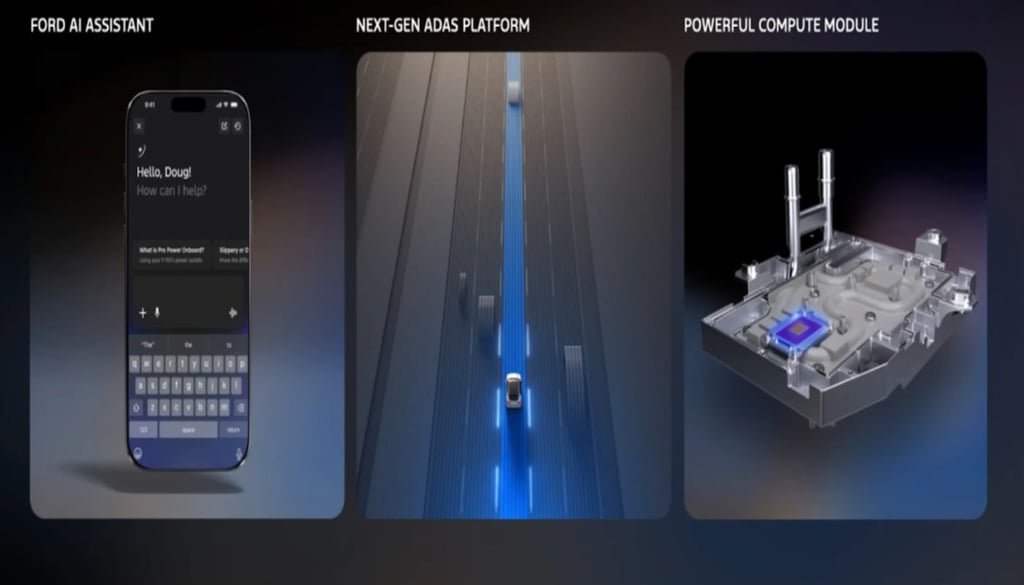
The automaker announced Wednesday at CES 2026 that it will launch an AI assistant designed to understand both the driver and their specific vehicle, first through the Ford and Lincoln apps in early 2026, and later embedded directly into vehicles in 2027.
Unlike standard vehicle assistants that handle simple commands like opening the sunroof or adjusting the AC, Ford’s AI assistant promises deeper integration. Mike Aragon, president of integrated services at Ford, said the assistant is “a deep, personalized intelligence that knows your specific vehicle, understands your unique needs, and anticipates your desires on every journey.”
The AI can perform tasks as practical as helping drivers load their truck beds. For instance, users could take a photo of firewood or mulch and ask the assistant how much fits in their truck. Ford says the system analyzes the image and responds with an answer tailored to the exact bed size and configuration.
Sammy Omari, head of Ford’s Advanced Driver Assist Systems, told Business Insider, “We’re not going to be directly competing with a Google or an OpenAI or a Meta. But what we do is we take an LLM that’s available and then basically make it our own by giving it access to all the relevant information about the person’s vehicle.”
Eyes-off driving by 2028
The AI assistant is just the opening act for a much larger play: Level 3 autonomous driving. Ford announced that it will launch an “eyes-off, hands-off” version of its BlueCruise technology by 2028.
Unlike current systems that require you to keep your eyes glued to the pavement, this next-gen tech will allow drivers to legally look away while the car handles the highway. It will debut on Ford’s new “Universal Electric Vehicle” (UEV) platform, a specialized architecture being developed by a “skunkworks” team in California.
The first vehicle to get this “brain” will be a mid-sized electric pickup truck launching in 2027 with a target price of around $30,000.
To keep these features from becoming “luxury-only” items, Ford is bringing the development home. Rather than relying on outside suppliers, the company is building its own computer modules and software architecture.
By building a more unified “vehicle brain” that is 44% smaller and 30% cheaper than current systems, Ford hopes to make “eyes-off” driving a reality for the masses, not just the elite.
“By designing our own software and hardware in-house, we’ve found a way to make this technology more affordable,” Ford’s chief officer for EVs and software, Doug Field, wrote in a blog post, emphasizing that the assistant aims to serve all customers, not just those buying new models.
Also read: Nvidia’s thinking self-driving car points to a future where vehicles can explain the decisions they make.