






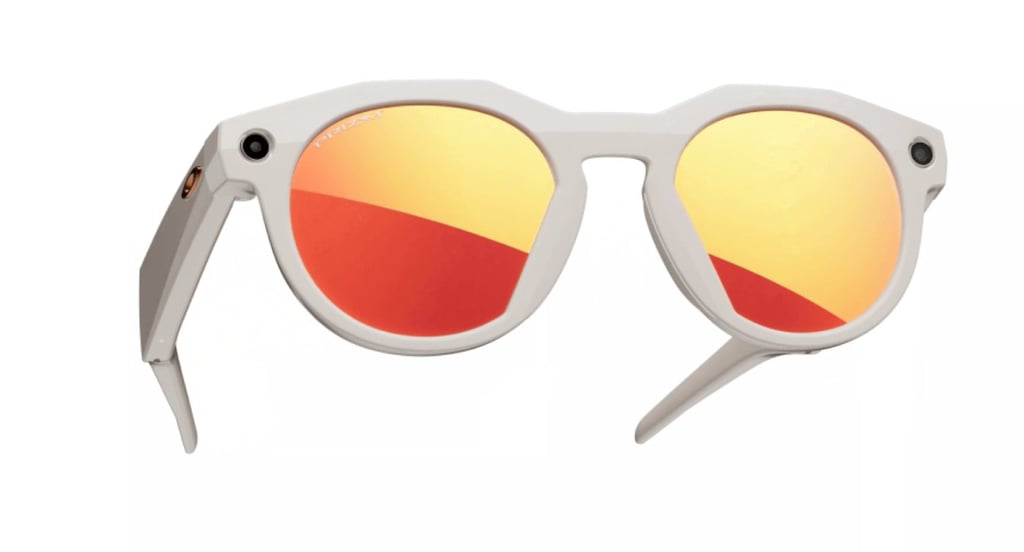


Meta has reportedly invested $3.5 billion in EssilorLuxottica, the eyewear company that owns Ray-Ban and Oakley. The two companies have been in partnership since 2020, collaborating on glasses featuring artificial intelligence technology.
Mark Zuckerberg’s company now holds an almost 3% stake in the manufacturer, anonymous sources told Bloomberg, and is considering increasing it to 5% with additional investments.
“This represents another step in Meta’s commitment to the smart-glasses category,” analysts from research firm Bernstein said in a note, seen by the publication.
Meta’s history with smart glasses
Meta’s partnership with EssilorLuxottica began in 2019. The following year, it launched Project Aria, a research initiative into non-commercial, AI-powered smart glasses, introducing its first prototype, Aria Gen 1.
In 2021, Meta, then still Facebook, released Ray-Ban Stories, its first consumer smart glasses, which allowed users to listen to music, make calls, and capture photos and short videos; however, they lacked any augmented reality capabilities.
In 2023, the company released the second-generation Ray-Ban Smart Glasses, featuring a higher-resolution 12MP camera, two extra microphones, improved speakers, and deeper integration with Meta AI, the company’s in-house conversational AI assistant. Subsequent updates to Meta AI enabled real-time translation and multimodal interactions.
In 2024, Meta unveiled Project Aria Gen 2, designed specifically for academic and industrial researchers working in robotics, AR, contextual AI, and machine perception. Just last month, Meta and EssilorLuxottica released a pair of Oakley smart glasses designed for athletes, offering real-time sport-specific insights such as wind speed for golfers and wave height for surfers.
In January 2025, Bloomberg reported that Meta was preparing its first pair of AR glasses, Artemis, for release in 2027.
Meta’s racing against Apple and Google
Meta is not the only tech giant entering the AI eyewear market.
Apple plans to launch its own smart glasses by the end of 2026, offering smartphone-like functionality at eye level and positioning them as direct competitors to the Ray-Ban Smart Glasses. It is also reportedly developing chips for a separate pair of AR glasses that will overlay digital content onto the real world, providing an immersive experience.
Google is also on the trail, having recently partnered with Kering Eyewear, Warby Parker, and Gentle Monster to develop AI-powered glasses featuring Android XR. It is looking to distance itself from Google Glass, the company’s ill-fated early attempt at consumer AR eyewear. The product was discontinued in 2015 due to widespread privacy concerns and a negative public reception, resulting in bans in various settings.
Meta’s shifting focus from social media to AI
While Meta started as Facebook and retains an almost too strong grip on the social media landscape, the company has been shifting its focus to AI since approximately 2013. It also cemented its commitment to virtual reality with its 2021 rebrand and continues to invest in the space, driven by Zuckerberg’s belief that headsets and the metaverse are the next frontier in consumer technology.
However, Meta has not seen much success with AI in the post-ChatGPT era, struggling to keep pace with OpenAI and Google. Its latest Llama models have underperformed, its AI chatbots have earned a seedy reputation, and top engineers have been leaving the company.
One of Zuckerberg’s plans to keep afloat has involved funneling money into a new division focused on superintelligence, or creating AI models that outsmart humans. He was reportedly offering $100 million signing bonuses to engineers from companies including OpenAI to tempt them to join his team.
His other AI side project is smart glasses, which could reduce Meta’s dependence on smartphone makers, often criticised for monopolising digital services, by allowing Meta to distribute its offerings through its own hardware. By partnering more closely with EssilorLuxottica, it gains essential expertise in manufacturing and mass distribution. At the same time, the eyewear giant stands to benefit from a slice of the potentially extremely lucrative AI pie.
Curious where Meta’s AI journey goes next? Learn about its move into humanoid robotics.