







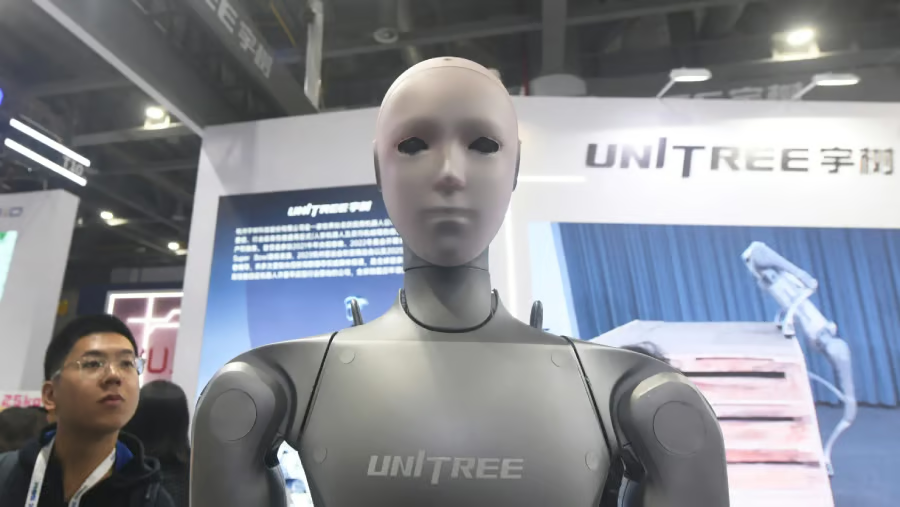
Hangzhou-based Unitree Robotics has passed the review stage for its initial public offering (IPO) on Shanghai's STAR Market, clearing one of the final hurdles before its shares can be offered to investors.
The approval from the Shanghai Stock Exchange's listing committee marks a significant milestone for one of China's best-known robotics companies and highlights growing investor interest in humanoid robots and embodied artificial intelligence.
According to the company's prospectus, Unitree plans to raise 4.2 billion yuan (about $616 million) through the offering. The funds are expected to support research into robot models and hardware, new product development, and the construction of a manufacturing base.
Unitree filed its IPO application in March and became one of the first companies to benefit from China's pilot pre-review mechanism for technology firms seeking STAR Market listings, according to People's Daily Online.
Revenue growth accelerates
The company has experienced rapid growth over the past three years. Its prospectus shows that revenue climbed from 159 million yuan in 2023 to 393 million yuan in 2024, then surged to over 1 billion yuan in 2025.
Unitree also expects first-half 2026 revenue to range from 1.052 billion yuan to 1.128 billion yuan. The company forecasts net profit attributable to shareholders, excluding non-recurring gains and losses, of between 236 million yuan and 283 million yuan during the same period.
According to SCMP, Unitree generated 1.7 billion yuan in revenue last year and recorded the highest profit among its major peers, reporting net income of 590.8 million yuan.
Unitree’s rise is happening in an increasingly crowded field. Global competition now includes Tesla’s Optimus program, as well as Chinese automakers and electronics companies entering the humanoid robotics space. This has intensified pressure on pricing, margins, and technological differentiation.
While Unitree currently leads in production scale and motion control systems, industry analysts say the real competition is shifting toward AI “brains,” the software systems that determine how robots perceive and interact with their environment.
A market testing the future of physical AI
Unitree’s IPO is widely seen as an early stress test for investor appetite in humanoid robotics. The outcome could help set the tone for dozens of other companies preparing to list in the sector, especially as capital markets begin assigning real valuations to embodied AI systems.
For now, the company sits at a turning point: already profitable by robotics standards, but under growing pressure to fund the next leap in intelligence, scale, and global competition.
Also read: Nvidia, Unitree, and Sharpa launched a humanoid robot reference platform for academic robotics research.