






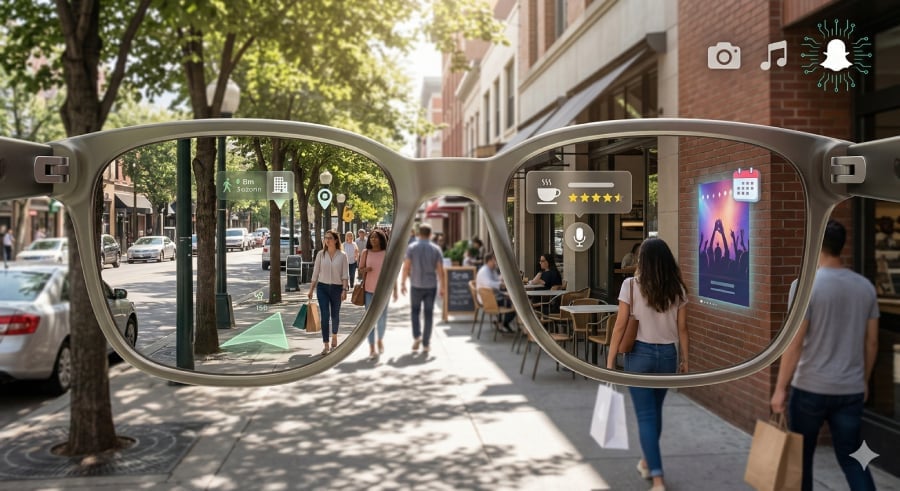


Snap has signed a multi-year agreement with Qualcomm to be the primary chip supplier for the company’s augmented reality (AR) glasses subsidiary, Specs.
The announcement comes ahead of the long-awaited launch of Snap’s next-generation smart glasses, which are expected later this year. Specs will feature Qualcomm’s Snapdragon XR platform, built for augmented and virtual reality devices. It will reportedly be the first version aimed at a general audience, rather than professional creators and developers.
The smart glasses are arriving at a critical time for the market, with many vendors viewing glasses as the most promising form factor for AI. Snap plans to add on-device AI, allowing users to interact hands-free, with the system designed to be contextually aware of its surroundings. The company has already experimented with AI on the Snapchat app, adding a chatbot and an “Imagine” lens to generate visuals from text prompts.
The glasses are also expected to feature both gesture and voice control, allowing users to play music, take photos, and record videos. In its announcement establishing Specs as a subsidiary, Snap said it wants the glasses to reduce screen time by doing more for users, and to replace physical items like whiteboards, instruction manuals, televisions, and toys with augmented alternatives.
Snapchat has been one of the biggest drivers of AR adoption through its filters and lenses. It entered the hardware space with the launch of its fourth-generation Spectacles, which allowed users to view digital lenses in the real world. While it gained an early foothold, it struggled to commercialize Spectacles for consumers.
Meta has since moved ahead with its own smart glasses, reportedly shipping 7 million units in 2025.
Smart glasses look set to be a hot market in 2026
Alongside Snap, several vendors are preparing to launch AR glasses or build on early momentum. Market leader Meta has shifted focus from the metaverse to smart glasses and AI, seeing the two as closely linked.
Tech giants Apple and Google are also ramping up efforts. Google first introduced AR glasses with Google Glass in 2014, but the product never moved beyond developers and limited enterprise use. It is now reportedly working on new glasses powered by Gemini on the Android XR platform. Apple, meanwhile, is said to have accelerated its timeline for smart glasses, potentially launching as soon as this year after scaling back other hardware efforts.
Like with smartphones, the smart glasses market is likely to remain fragmented for several years as vendors test which features resonate with users. AI appears to be the central hook, offering voice-driven interaction and real-time understanding of surroundings. This echoes the original pitch for Google Glass, such as identifying an event poster on the street and adding it to a calendar, or providing turn-by-turn directions to a nearby bookstore.
It remains to be seen how these companies differentiate their AI offerings, particularly if consumer demand falls short of expectations. Amazon, for example, envisioned Alexa as a tool for ordering groceries, products, and flights. In practice, for most users, it became little more than a smart jukebox.
Also read: Concerns over wearable AI privacy are growing after reports that Meta AI glasses footage was reviewed by human contractors, including intimate moments.