






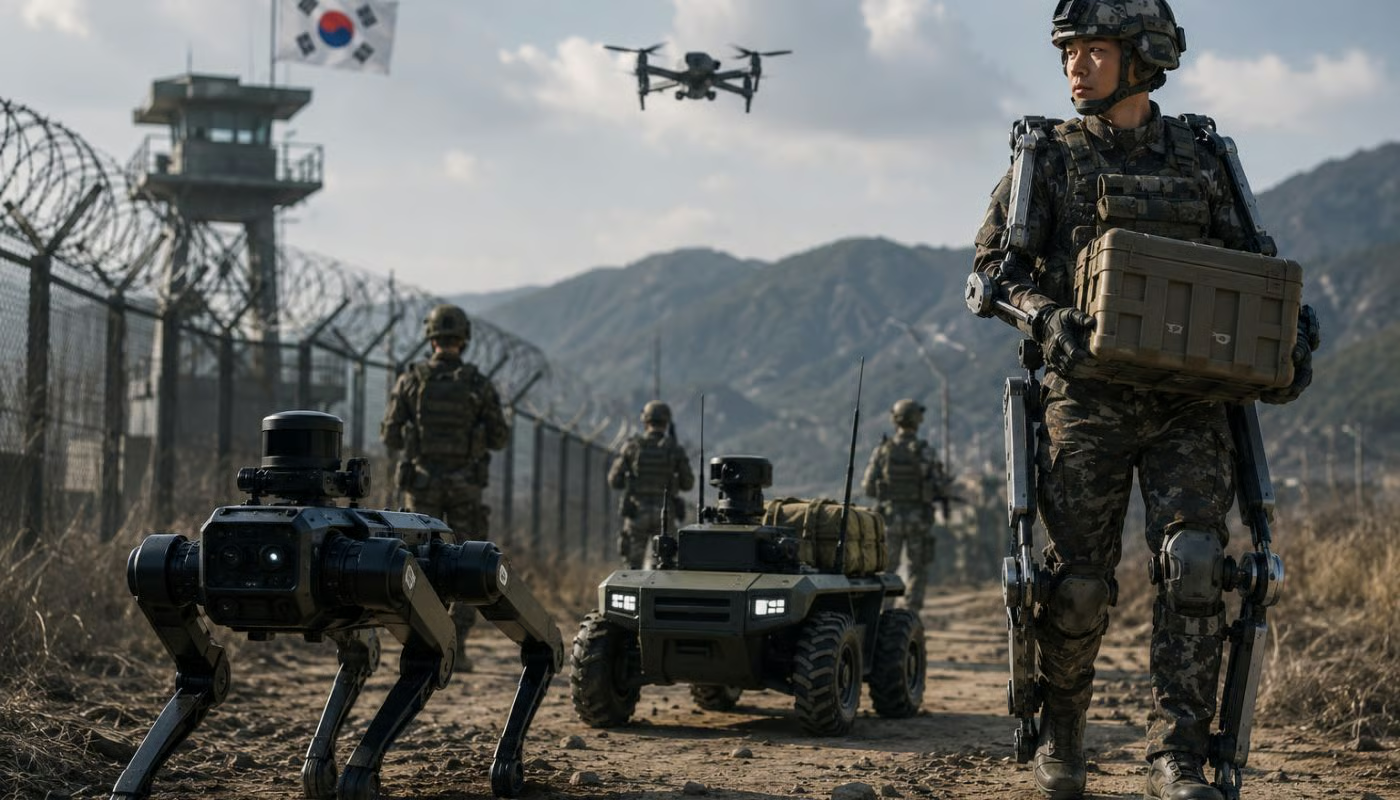


South Korea’s Defense Ministry is exploring a partnership with Hyundai Motor Company to deploy robots in military operations.
The discussions are still early, but the focus is already becoming clear: Rather than armed humanoid fighters, the military is studying how machines could help with surveillance, reconnaissance, logistics, and other support work that normally requires large numbers of troops.
The move comes as South Korea faces a worsening demographic crisis. The country’s standing military force has dropped by about 20% over the past six years, falling to roughly 450,000 personnel. The Defense Ministry expects that number to slide further to around 350,000 by 2040.
Officials told Bloomberg the military is trying to build what it described as a “high-tech, science-driven force” as battlefield conditions evolve and manpower becomes harder to replace.
Robot dogs, droid platforms, and wearable tech
Bloomberg, citing Korea Economic Daily, reported that the military is considering robots for noncombat duties such as surveillance, reconnaissance, and logistics support.
Among the technologies reportedly being reviewed are Boston Dynamics’ four-legged Spot robot, Hyundai’s MobED mobile platform, and the X-ble Shoulder wearable exoskeleton designed to reduce strain during heavy lifting.
The systems are not expected to carry weapons. Instead, the focus appears to be on reducing the burden on human personnel and handling repetitive or dangerous work. Spot could be used for perimeter patrols and reconnaissance missions, while MobED may assist with surveillance operations. The X-ble Shoulder, originally built for industrial workers, could help soldiers carry equipment more efficiently.
A manpower problem becomes a robotics test case
The discussions also highlight how automotive and robotics technologies are increasingly crossing into defense applications.
“Robotics is a field without legacy constraints. Robots can leverage the electric and electronic technologies established in autonomous vehicles, allowing for very rapid proliferation,” Samsung Securities analyst Esther Yim told Bloomberg.
Hyundai has steadily expanded beyond cars into automation, AI, and industrial robotics. The company has already deployed firefighting robots through Korea’s National Fire Agency and is testing AI-powered humanoid systems in industrial settings such as shipyards and factories.
Bloomberg noted that deploying Spot robots near the Korean border would mark a significant milestone for the company’s robotics business beyond factory and commercial use.
A defense contract of any scale would represent a meaningful expansion beyond the commercial robotics market for Hyundai and a test case closely watched by other governments facing similar demographic squeezes.
Also read: Robot dogs for data center security are giving operators another way to patrol facilities, inspect equipment, and respond to incidents.