







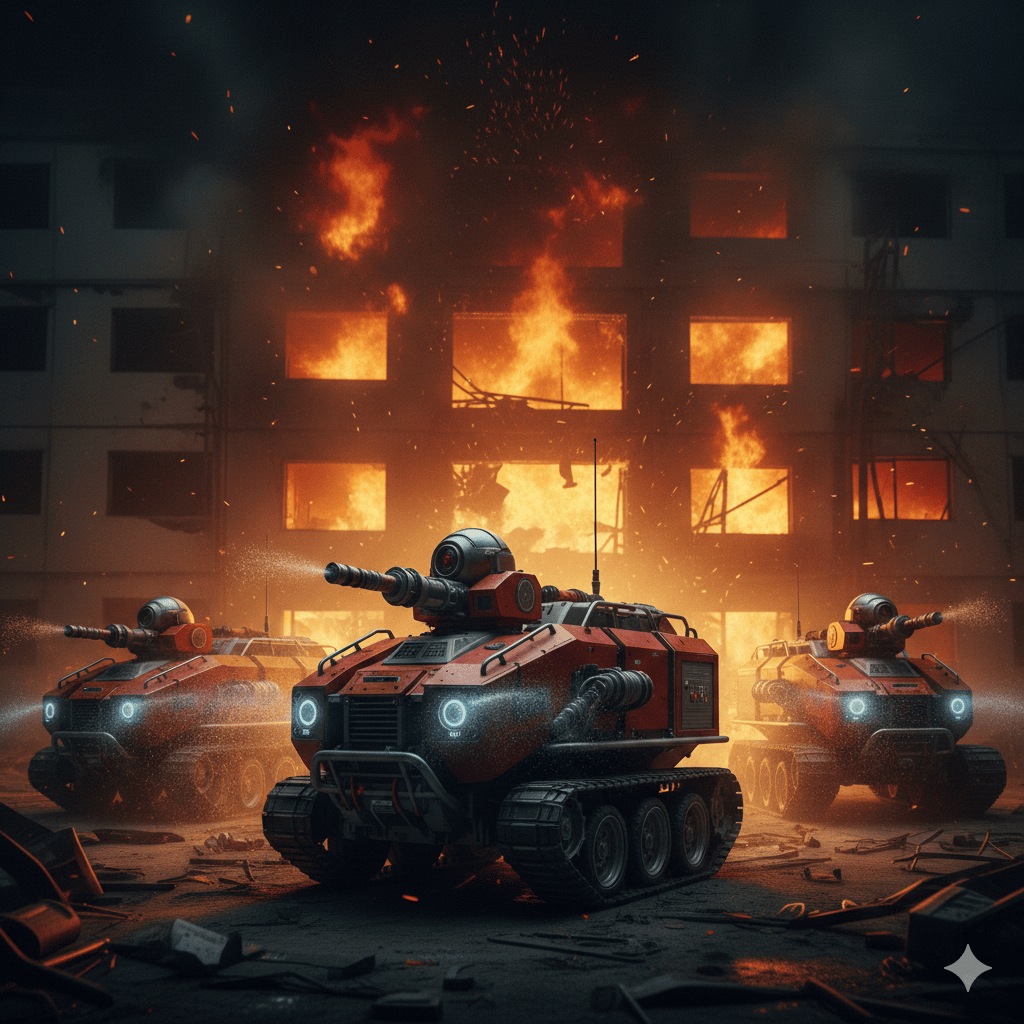
Firefighters rushing into burning buildings may soon have backup that never tires, never panics, and never needs to catch its breath.
Hyundai Motor Group says it donated four unmanned firefighting robots to South Korea’s National Fire Agency, designed for remote fire suppression and search work in “high-risk environments.” If they perform as intended, the robots could help keep more firefighters alive by taking on early-stage tasks when smoke, heat, and structural uncertainty are at their worst.
What the robots are built to do
Hyundai says the robots are based on Hyundai Rotem’s electrified HR-Sherpa multi-purpose unmanned vehicle platform.
The company says each unit includes a front-mounted water cannon and a self-spraying “water curtain” cooling system, plus an infrared sensor-based camera to improve visibility through smoke and flames. The robots can be remotely operated with real-time video and use a six-wheel independent drive system for rough conditions.
Hyundai also says the cooling system can help the platform maintain 50 to 60°C in environments reaching up to 800°C. Two units are already deployed with the Capital and Yeongnam 119 Special Rescue Units, with two more heading to the Gyeonggi Provincial Fire Headquarters (Hwaseong) and Chungnam Provincial Fire Headquarters.
Why it matters
Hyundai cites Korea’s National Fire Agency as saying 1,802 firefighters were injured or killed in the line of duty over the past decade.
That’s the case for putting a remotely operated system into the most punishing part of a response — while firefighters focus on command decisions, coordinated suppression, and rescues that still require human judgment.
The pattern is familiar across robotics: jobs too dangerous for humans are usually first in line for machine backup. It also fits Hyundai’s wider robotics portfolio, including the AI-powered MobED robot and industrial work tied to the Atlas humanoid robot.
Also read: Unitree’s 20,000-humanoid shipment target puts a number on how quickly robot manufacturing ambitions are scaling.