






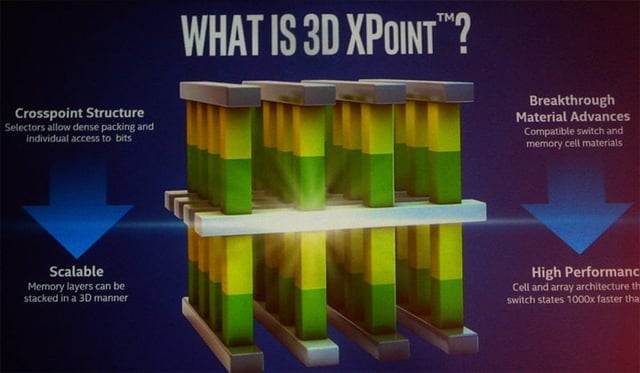

Micron and Intel, who have had their differences in their joint 3D XPoint (pronounced crosspoint) development deal, have agreed to end their partnership to design and build the solid-state processors. The project is expected to be finished in the first half of 2019.
Development of the chips beyond the second generation of 3D XPoint chips will be pursued independently by the two companies in order to optimize them for their respective product and business needs, Micron said.
In other words, Intel and Micron could not agree on further development together of the powerful chips, in which silicon layers are stacked vertically instead of remaining flat on the die.
Intel is moving the focus of its 3D NAND flash storage-class memory business to a relatively unknown Chinese company, Tsinghua Unigroup, by providing the company with its chips, according to the Nikkei Asian Review.
Tsinghua’s UNIC storage memory technology division would use the flash chips to create microSD cards and solid-state disks. The supplies could help push UNIC, which became a registered company last summer, to becoming a major market player alongside Samsung, Toshiba and Western Digital’s SanDisk, industry analyst DRAMeXchange said in a media advisory.
The move could help Intel gain better access to the Chinese market. Intel ranks sixth globally among NAND memory chip manufacturers.
3D Xpoint is NVMe (Non-Volatile Memory Express), a scalable, high-performance PCIe Gen3 direct connect to NVMe devices, designed for client and enterprise server systems using SSDs.
Three years ago, 3D Xpoint was hailed as potentially the biggest advancement in solid-state processors since the advent of Toshiba’s NAND flash chips in 1989. Since the introduction of 3D XPoint in 2015, the product has been selling in modest numbers, but issues developed involving heat and other factors that stalled advancement of the product.
Nonetheless, the joint project has resulted in the development of an entirely new class of non-volatile memory with lower latency and exponentially greater endurance than NAND memory. A lot of lessons were learned inside this project.