




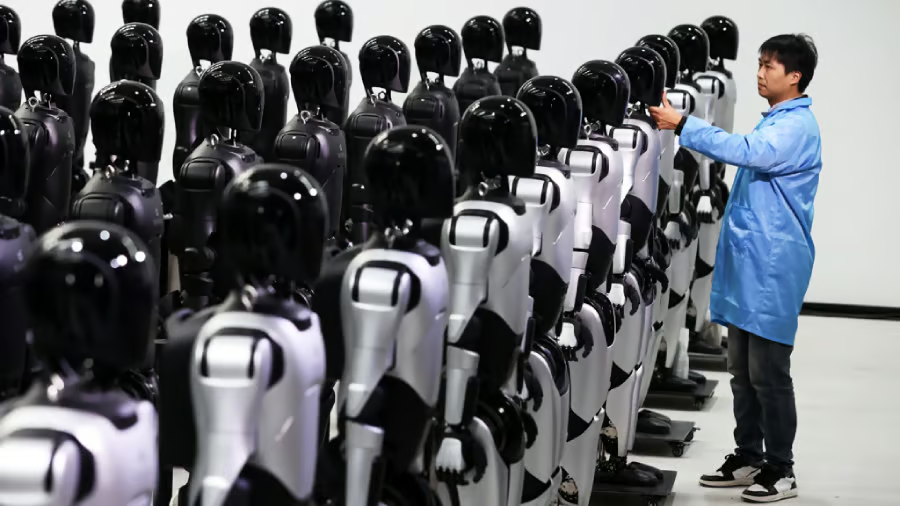
The Federal Communications Commission has added advanced robotic devices and connected power inverters made in foreign countries to its Covered List, blocking new models from receiving FCC authorization unless they receive an exemption.
The move, announced Tuesday, targets technologies the US government says could become critical to the country’s artificial intelligence infrastructure, manufacturing base and national security operations.
The FCC said advanced robots, including humanoid robots, quadrupeds and other mobile robotic systems, create security concerns because they collect large amounts of data through sensors such as cameras, LiDAR, thermal and acoustic systems.
“These devices could create supply chain vulnerabilities that could disrupt US economic and national security and could create a cybersecurity risk that threatened American critical infrastructure,” the FCC wrote in a statement. FCC Chairman Brendan Carr added that “The FCC will continue to do our part to secure America’s critical supply chains.”
The restrictions also cover connected power inverters, which are used to connect renewable energy systems, batteries and other power sources to electric grids and data center equipment.
Washington’s AI strategy moves beyond chips
The decision reflects a broader US effort to secure the hardware foundations behind AI growth. While semiconductor restrictions have focused heavily on advanced chips, officials are now turning attention to the machines and infrastructure that could power future AI-driven industries.
The FCC said the US needs an independent robotics supply chain because advanced robots are expected to play a role in manufacturing, critical infrastructure protection and military operations. The agency warned that foreign-made robots could create cybersecurity risks, including the possibility of data theft, remote control or manipulation of robotic systems.
The FCC cited past security incidents involving foreign-produced robots, including vulnerabilities that allowed remote access to cameras, microphones and maps collected from consumer devices.
Chinese companies face uncertainty
Although the FCC rule applies broadly to foreign-produced advanced robotic devices, the restrictions are expected to hit Chinese manufacturers most directly.
The policy could affect companies such as AgiBot, UBTECH Robotics, DEEP Robotics, and Unitree, one of the leading humanoid robot makers globally. The company has gained attention for developing low-cost humanoid and quadruped robots and recently partnered with Nvidia to use its Blackwell AI chips.
Chinese companies also dominate the global inverter market. Firms including Sungrow Power Supply and Huawei have built major positions supplying equipment used in renewable energy systems. The FCC said foreign producers can apply for Conditional Approvals, allowing them to continue receiving authorization while working to move manufacturing to the US and address security concerns.
Beijing pushes back
China criticized the move, saying the US was using national security concerns to restrict Chinese companies. China’s commerce ministry said Beijing would “resolutely retaliate” if Washington continued with what it called discriminatory measures, Reuters reported.
China’s embassy in Washington also urged the US to “stop smearing Chinese companies and threatening them with sanctions.”
Chinese analysts argued that restricting access to foreign technology could slow innovation. The Global Times reported that some experts warned the measures could increase costs for American companies and limit access to global robotics development.
The innovation bottleneck
While national security agencies view the ban as essential protection against foreign espionage and supply chain leverage, the policy exposes a severe friction point in America's AI buildout: hardware availability.
By walling off cost-effective Chinese hardware, Washington is forcing American tech firms to build inside a protectionist ecosystem before local supply chains can fully catch up. Inverters are the literal plug between renewable energy sources and power-hungry AI data centers. Excluding dominant suppliers like Sungrow could inflate grid-connection costs and slow down data center construction.
Similarly, shutting out leaders like Unitree—which held nearly a fifth of the global humanoid robot market—forces US research labs and factories to rely on domestic alternatives that are often far more expensive or behind on mass-production scaling. In the short term, American firms face higher capital expenditures and longer deployment timelines, trading rapid speed-to-market for state-sanctioned operational security.
Read more: China Warns of Retaliation as US Weighs Sanctions on Chinese AI Firms.