







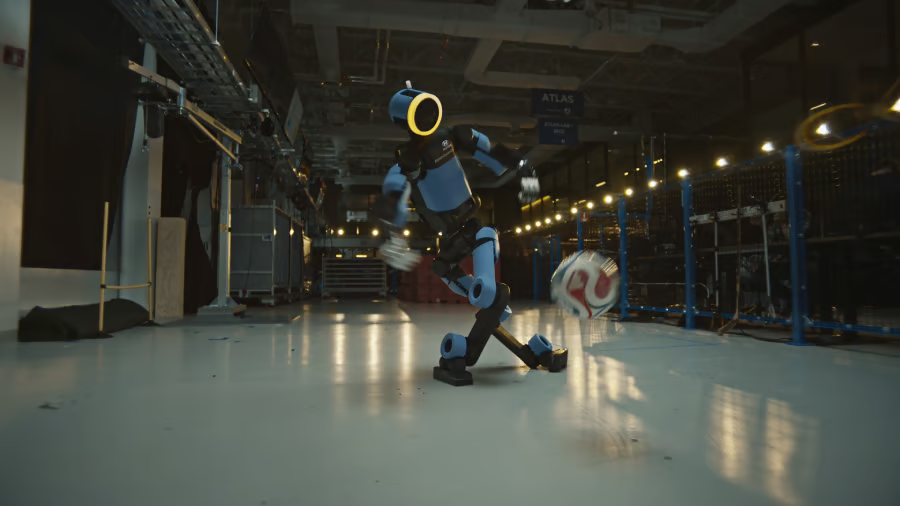
Boston Dynamics is getting its flagship humanoid robot, Atlas, into the spirit of the upcoming FIFA World Cup 2026.
Through a joint project with parent company Hyundai Motor Company called the "School of Football," engineers have successfully trained the bipedal machine to master advanced soccer skills, including an intricate trick shot known as the "Ghost Rabona."
The project, which is part of Hyundai’s "Next Starts Now" campaign, serves as a rigorous testing ground for physical intelligence. The Ghost Rabona is a complex, multi-step maneuver that forces the robot to walk toward the ball, fake a shot with its left leg, and quickly cross its right leg behind the standing leg to strike the ball.
According to Roberto Shu, senior staff research engineer, and Yeuhi Abe, manager of controls and reinforcement learning at Boston Dynamics, the move requires massive power, agility, and split-second timing.
"Atlas needs to move fast for a convincing fake," the researchers explained. "It needs power and agility to fully take off from the ground and land again, while still remaining balanced to complete the kick. This combination of different skills pushes the limits of physical intelligence."
The training process: A year of practice in 24 hours
To teach the machine to move like an elite athlete, the engineering team recorded the movements of real soccer players using an optical motion-capture system.
Because a robot's mechanical joint structures and ranges of motion differ fundamentally from human anatomy, the team used a conversion process called "retargeting" to map the human kinematics onto Atlas's unique metallic chassis.
Once the baseline data was set, Atlas didn't train on a physical grass pitch. Instead, the robot was dropped into an AI-powered digital simulator. By running thousands of virtual trials simultaneously across a cloud graphics processing unit (GPU) environment, Atlas achieved approximately a full year’s worth of human physical trial-and-error and adjustment in just 24 hours.
Through thousands of virtual repetitions, the machine independently learned to actuate its motors, manage its weight distribution, and optimize its balance. When the finalized software policy was uploaded to the physical hardware, the results were seamless.
Why football matters for robotics
Researchers say football is more than just a creative training environment; it is a full-body coordination test. The sport requires balance, timing, running, and the simultaneous precise manipulation of a ball. That combination, they argue, mirrors real-world robotic challenges in factories and logistics environments.
Boston Dynamics says the football experiment is part of a wider push toward general-purpose humanoid robots. While Atlas is designed for industrial use, the company believes training in dynamic environments like sport helps build more flexible, adaptable machine behavior.
Related: Unitree’s G1 humanoid robot also recently skated, spun, and flipped in a new demo, underscoring how quickly humanoid mobility tests are becoming more athletic and ambitious.