






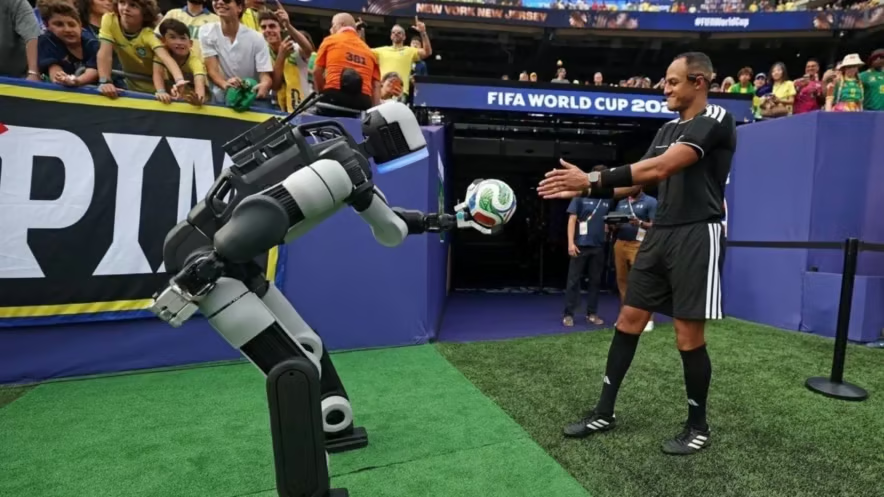


A six-foot robot walked onto the World Cup stage, copied football stars’ celebrations, and handed over the match ball.
Before Brazil faced Norway in the Round of 16 at New York/New Jersey Stadium, Boston Dynamics’ Atlas humanoid robot delivered a moment never seen before in FIFA World Cup history: The robot walked onto the pitch at halftime, performed celebrations inspired by players such as Harry Kane and Son Heung-min, then handed the official match ball to the referee.
Atlas was presented by Hyundai Motor, which owns Boston Dynamics and has sponsored FIFA for 27 years. The company used the event to showcase how its robotics technology is moving from research environments into public demonstrations.
“By placing Atlas at the heart of football’s most sacred ritual, we made a statement no commercial ever could,” Sungwon Jee, Hyundai Motor Company’s executive vice president and global chief marketing officer, told Fortune.
A robot that learns instead of following fixed instructions
Unlike traditional industrial robots that repeat programmed movements, Atlas relies on training techniques that allow it to adapt to changing conditions.
“It used to be programmed,” Alberto Rodriguez, Boston Dynamics’ director of robot behavior, told Fortune. “Now it’s no longer programmed—it’s learned.”
Engineers trained Atlas by studying football movements through professional footage, motion-capture recordings, and computer simulations. The robot practiced millions of variations in simulated environments, allowing it to adjust when conditions changed.
According to Boston Dynamics, the system learned complex football movements within about 24 hours of simulation training, tasks that could take humans much longer through physical repetition. The World Cup appearance also introduced challenges not found in controlled factory environments. Grass surfaces can create unpredictable problems because robots may slip, sink slightly, or get their feet caught.
“Grass has that interesting property where sometimes you slip, but sometimes your feet can get caught on it,” Rodriguez said. “We’ve had to change the training regime for how Atlas learns to walk and run to make sure that it can do it well on concrete, but also on complex surfaces like grass.”
Why this matters beyond football
Atlas’ World Cup appearance was designed to show that humanoid robots may eventually operate in unpredictable real-world environments rather than only in structured workplaces.
The technology could have implications for manufacturing, logistics, inspections, and other industries where robots need to navigate changing environments. However, the demonstration also highlights current limitations.
Boston Dynamics acknowledged that Atlas is still far from replacing human athletes or handling complex social interactions. The company said robots still need major advances before they can safely perform alongside people in everyday situations.
Labor concerns also remain a challenge. As companies explore humanoid robots for factories, workers and unions have raised questions about automation’s impact on jobs. Atlas’ appearance was not just a marketing moment; it was a test of how far humanoid robotics has progressed. By performing on a football pitch rather than inside a lab, Boston Dynamics showed improvements in balance, adaptation, and mobility.
Still, the path from impressive demonstrations to widespread workplace use will depend on reliability, safety, cost, and whether businesses can prove robots deliver value beyond existing automation systems.
Related: Factory workers are now wearing head-mounted cameras to help train the next generation of AI-powered robots. Here's why the practice is raising concerns about privacy and automation.