







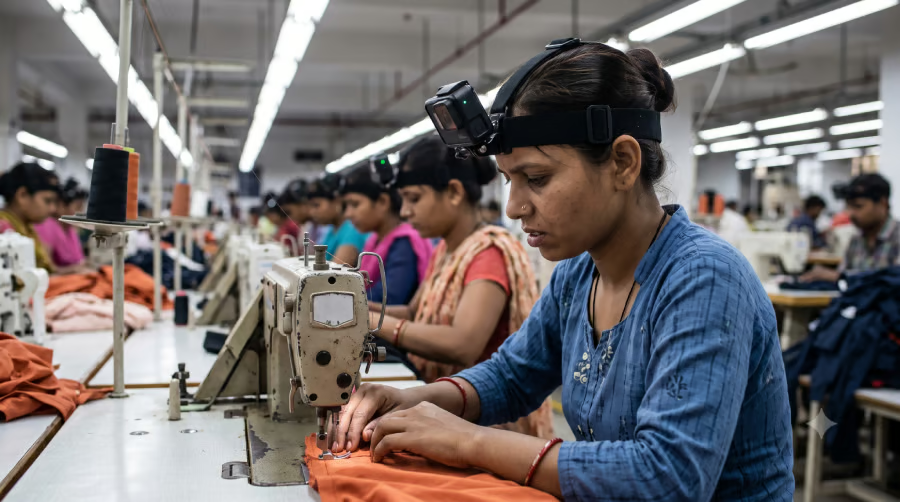
Sweatshop workers are now pulling double duty: sewing clothes by day and training their own robotic replacements without even knowing it.
Manufacturing facilities across the Global South have begun requiring assembly line workers to wear forehead-mounted cameras and smart glasses during their shifts. While these devices naturally double as an aggressive form of surveillance that keeps assembly lines quiet and focused, their primary economic objective is to harvest millions of hours of egocentric data.
Egocentric data consists of first-person, point-of-view recordings of physical tasks. Unlike large language models that train on internet text, industrial AI and humanoid robots require visual demonstrations of physical work to master real-world tasks.
By feeding thousands of hours of this human footage into vision-language-action AI models, technology companies teach neural networks to predict, mimic, and ultimately replicate intricate hand movements and fabric manipulation.
India has rapidly emerged as a primary pipeline for this data extraction, driven by a vast ecosystem of tech firms, including EgoLab, Humyn AI, and Scale AI. These data aggregation operations feed global robotics developers whose automation strategies rely heavily on humanoid robotics to drive future corporate value.
The offshore economics of automation
Cost advantages drive the surge in tracking manual workflows. Collecting physical data in the Global North is an expensive bottleneck, often costing upwards of $30 an hour.
By striking data-collection deals directly with factory management in developing economies, robotics companies can acquire high-density human datasets for less than a sixth of that cost, often without paying any direct compensation to the individual laborers producing the footage, according to The Guardian.
Data aggregation firms report that attempts to introduce direct worker payouts face heavy resistance from factory owners. Management routinely argues that absorbing additional data-collection costs would compress thin profit margins, threatening the immediate viability of the factories themselves.
Surveillance risks and the erosion of privacy
This data collection method introduces immediate risks regarding labor rights, digital tracking, and personal privacy. Beyond training robots, factory operators are actively repurposing this footage to generate granular productivity assessments.
Software tools analyze the video to rank employees based on active execution time, calculate financial losses from "idle" periods, and log exactly when and where workers pause to socialize, The Guardian reported.
Serious privacy and safety concerns have also emerged. Because the tech firms compiling these pipelines secure permissions entirely through factory management rather than individual workers, strict consent is effectively absent.
In precarious workplace environments, laborers cannot realistically refuse to wear the recording headgear without risking immediate termination. Plus, workers frequently forget they are wearing active, head-mounted lenses during personal breaks, creating severe, unaddressed privacy hazards on factory floors.
The extraction of bodily assets
This paradigm represents a structural shift in how industrial labor is valued and exploited. Historically, manual laborers sold their time and physical output for a wage. In the AI era, tech conglomerates are treating the worker’s body itself as a resource to be mined.
What these cameras truly capture is "bodily knowledge," the precise reflexes, muscle memory, and problem-solving instincts developed through years of human experience. Once recorded, cleaned, and annotated, this human intuition is permanently uncoupled from the worker. It becomes a licensed digital asset that can be replicated infinitely across global supply chains.
This trend is not isolated to apparel or manufacturing assembly lines. The same data pipelines are actively expanding into the informal economy, where contractors pay street vendors, delivery workers, and construction laborers small micro-wages to record their daily tasks.
A parallel shift is also occurring in white-collar IT firms, where companies leverage employee interactions with internal software to optimize systems designed to systematically reduce future headcount.
While technical hurdles mean humanoid robots are still years away from completely replacing human dexterity on the factory floor, the current data-harvesting trend ensures that low-wage workers are actively funding and constructing the infrastructure of their own economic obsolescence.
Also read: Apptronik opened a 90,000-square-foot Robot Park to collect real-world data for training humanoid robots with Google DeepMind.