






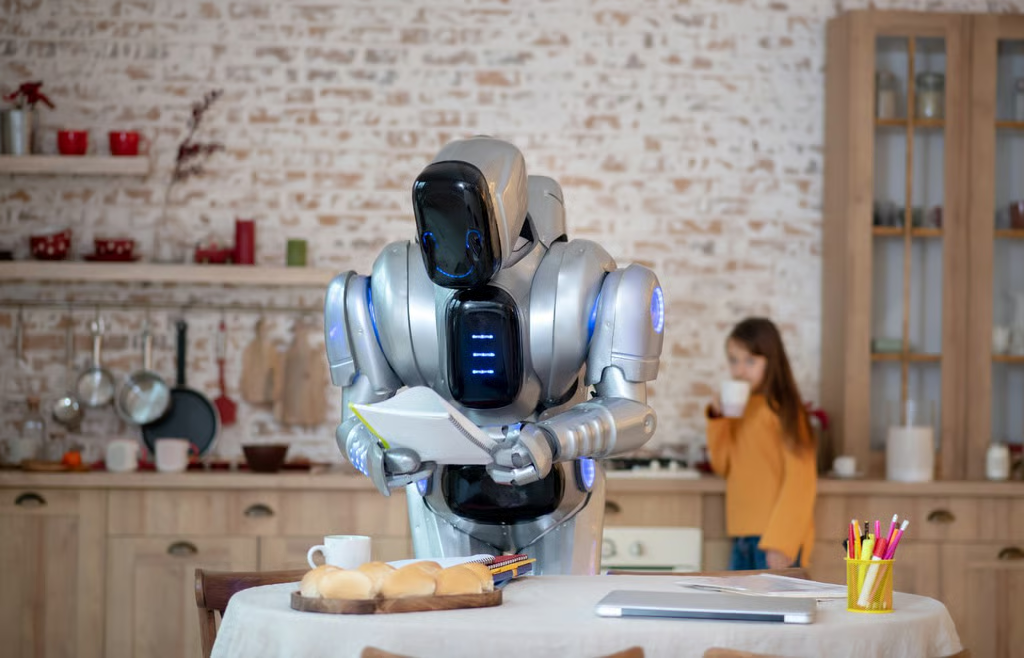


Humanoid robots may be grabbing headlines as the next big AI frontier, but Stanford’s latest AI Index found they still fail roughly 88% of household tasks. For all the talk of robots moving into everyday life, the home remains one of the clearest places where the technology still falls short.
The report finds a growing gap between gains in controlled robotics and real-world home performance. Are the industry’s boldest promises running ahead of what robots can reliably do?
Great in the lab, lost in the living room
Stanford’s new report puts the contrast in plain numbers.
On RLBench, a widely used robotics benchmark built around controlled simulation, the top method reached an 89.4% average success rate by early 2026. But on BEHAVIOR-1K, which is built around 1,000 realistic household activities, the top team achieved just 12.4% full-task success.
Robots still look far more capable when the task is short, tidy, and structured than when it starts to resemble actual help around the house. The gap between “predictable lab settings” and “unpredictable household environments” remains wide, and that is where the numbers break down, especially when mistakes carry real physical consequences.
The task may be simple — the risk is not
Getting a robot to finish a chore is only part of the problem.
ResponsibleRobotBench tests whether robots can still complete tasks safely when electrical hazards, fire, chemical risks, and human-related dangers are added to the mix, but even the leading model achieved only a 64% safe success rate.
As the report puts it, “Even the top model failed to complete more than a third of tasks safely.”
That is a long way from the kind of machine you would trust moving around a home, where people, clutter, and changing conditions can turn a simple task into a bad moment fast.
Plenty left to prove
Humanoids are getting close to the checkout, with Unitree planning to launch its low-cost R1 on AliExpress in North America, Europe, Japan, and Singapore. The timing, though, still feels early.
The Stanford report says the field is still running mostly on industrial pilots, expansion plans, and future-facing claims, not broad real-world deployment. It adds that “Most company milestones are framed in the future tense, along with delivery timelines; intended use cases are offered in place of verified operational data.”
That leaves the industry in an awkward place: humanoids are getting easier to imagine buying than trusting.
Beijing is about to host a half-marathon where more than 100 humanoid robots will run alongside humans.