






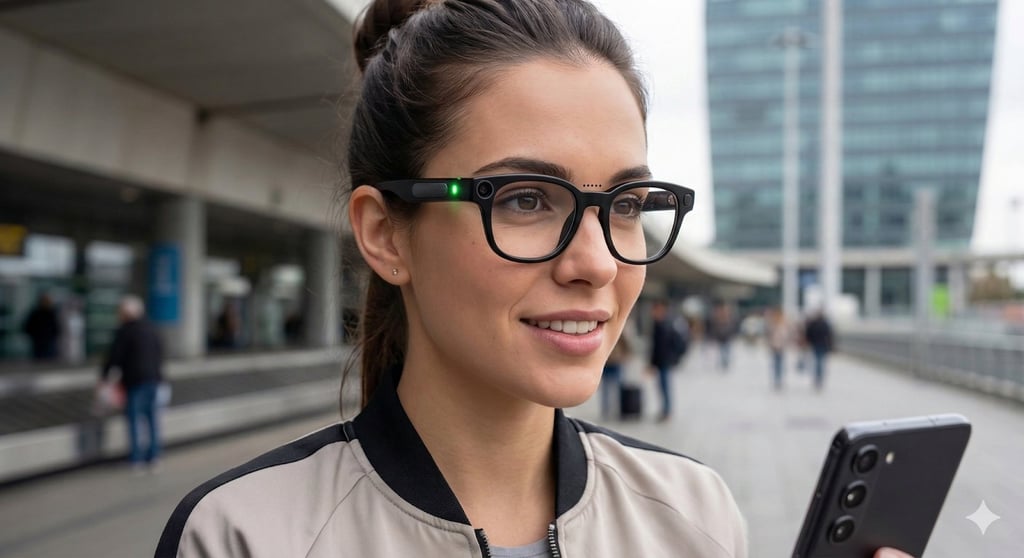


Samsung is stepping into the fast-growing AI smart-glasses race with its upcoming “Galaxy Glasses,” a camera-equipped wearable designed to challenge Meta, Apple, Google, and a wave of emerging competitors.
At Mobile World Congress in Barcelona, the company confirmed its first AI smart glasses will arrive later this year.
Jay Kim, executive vice president of Samsung’s mobile division, said the glasses feature a single eye-level camera and a tight tether to the wearer’s smartphone for all the heavy AI lifting, courtesy of Qualcomm chips and Google’s Android XR platform, a partnership that has been in the works since 2023.
CNBC broke the specifications on March 6, fleshing out a timeline the company first teased during its January earnings call.
For Samsung, the move is both defensive and opportunistic. Meta’s Ray-Ban Meta glasses currently hold 82% of the global market share, according to Counterpoint Research, while Google, Xreal, and Apple are all racing to ship more powerful AI wearables.
As Kim told CNBC, while Samsung’s Galaxy XR headset launched last year, headsets won’t be a “mass scale business” compared to the universal, everyday appeal of glasses.
Samsung’s pragmatic first step
Samsung is positioning the debut pair as “AI Glasses,” equipped with a camera, microphones, speakers, and neural processing, but no built-in display.
Need visuals? Kim said users can simply glance at their Galaxy phone or watch. However, Google’s newly published Android XR design docs and follow-up reporting by SamMobile point to a “Display AI Glasses” follow-up that could arrive in 2027 with a tiny augmented-reality screen. SamMobile detailed how dual touchpads, a camera button, and LED privacy indicators will work across both generations.
By pushing processing to the connected phone, Samsung can keep frames lighter and extend battery life — two pain points that doomed early AR attempts like Google Glass. It also sidesteps the need for custom silicon in the glasses themselves, shrinking time to market.
Qualcomm CEO Cristiano Amon told CNBC this approach mirrors the early days of smartphones. Just as phones evolved from a handful of apps to thousands, he predicts smart glasses will improve rapidly as developers build more agentic AI applications.
Rivals already have skin in the game
Meta’s latest Ray-Ban glasses may look like classic Wayfarers, but a recent Swedish investigation revealed that user-recorded clips, including intimate moments, can end up in the hands of human data annotators. That privacy stumble gives Samsung an opening to tout its Knox security pedigree.
Google, fresh off a $150 million funding commitment to Warby Parker and a parallel design collaboration with Gentle Monster, showed off prototype Gemini glasses at MWC that overlay turn-by-turn directions and live object recognition. Early testers, including reporters at Android Police, say the UI feels more polished than anything on the market.
Apple, meanwhile, is reportedly fast-tracking dual-camera glasses to pair with a revamped Siri and next-gen AirPods, targeting a 2027 debut.
Other tech giants and startups are piling on too. Alibaba’s Quark S1 dual-display glasses went on sale in China late last year, and YC-backed startup Pickle promises its Pickle 1 will be a “soul computer” that remembers your life, targeting a Q2 2026 delivery for its first batch of preorders.
What this means for enterprises and consumers
Real-time, hands-free AI is about to change how we work and navigate.
Amazon is already testing out Amelia smart glasses to help delivery drivers find your front door faster. Samsung is aiming for a similar vibe, focusing on what it calls agentic tasks. Picture walking out of baggage claim, telling your glasses to grab you a rideshare, and just waiting for the car to show up while your phone handles the logistics in your pocket.
Of course, the privacy concerns are massive. Meta is currently under fire from UK regulators over how it handles user data, and Samsung is going to step into that same minefield. People still remember the creepy camera stigma of the early 2010s. If hardware makers want to avoid that reputation this time around, they have to include obvious recording lights and ironclad opt-out policies.
For everyday buyers, the appeal is pretty straightforward. Glasses are lighter than a VR headset and keep you from staring down at a screen all day. If Samsung actually pulls off a design that is comfortable, secure, and doesn’t die in two hours, 2026 might finally be the year these things break out of the sci-fi realm — and Meta’s shadow — to become something we actually wear.
And while nearly every big tech name scrambles to put AI on your face, OpenAI is reportedly building a $200–$300 camera-equipped smart speaker that can “see and hear,” signaling its own hardware play for the living room instead of the lens.