








Chinese humanoid robots earned cheers from American audiences.
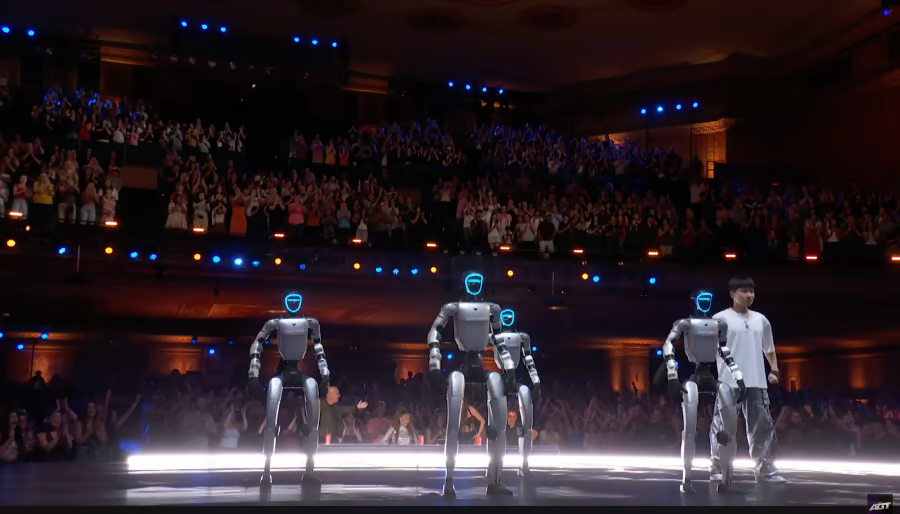
A group of humanoid robots from Chinese robotics company Unitree captured the attention of American viewers this week after delivering a synchronized dance performance on the season premiere of America's Got Talent.
The act featured eight Unitree G1 robots performing alongside 26-year-old Chinese dancer Yufei Wu from Sichuan province. Dancing to Lady Gaga's "Abracadabra," the robots marched onto the stage before joining Wu in a tightly choreographed routine that included coordinated movements and somersaults.
The performance became one of the most talked-about moments from the show's Season 21 debut, generating strong reactions from both the live audience and the judging panel.
"They don't look human, but they're all staring at me right now," judge Simon Cowell said after the performance. "That was... nuts, brilliant. Brilliant." Judge Sofía Vergara praised the robots' movement, saying, "I've never seen anything like this because usually those robots are like, very weird. These ones have rhythm."
Former Spice Girls member Mel B was equally impressed, describing the machines as "perfect" during the judging segment.
Four yes votes and viral attention
Performing under the Unitree name, Wu and the robots received unanimous approval from judges Cowell, Vergara, Mel B and Howie Mandel, allowing the act to advance to the next round of the NBC talent competition.
Although the group did not receive a Golden Buzzer, NBC suggested the performance could eventually be remembered alongside other acts that did not receive the honor but are still discussed as among the show's most memorable. The routine's popularity extended well beyond the television broadcast.
Videos from the performance accumulated millions of views online, helping introduce Unitree's humanoid robots to a broader American audience. Analysts say the exposure could help familiarize the public with Chinese-made robots at a time when the technology is becoming increasingly visible worldwide.
Public excitement meets political scrutiny
The enthusiastic response from viewers arrives as Chinese robotics companies face growing scrutiny in Washington. Just one day after Unitree's television appearance, US lawmakers introduced the Guard Act, a bipartisan proposal to restrict certain Chinese-made robots deemed national security risks.
Another measure moving through Congress, the American Security Robotics Act, would limit federal government purchases of robots manufactured by Chinese companies.
According to analysts cited by the South China Morning Post, the contrasting reactions highlight a widening gap between public curiosity about advanced robotics and policymakers' concerns about technological competition between the United States and China.
Kyle Chan, a fellow at the Brookings Institution, said Unitree's television appearance was likely aimed at increasing public awareness rather than influencing political debates.
"Washington is often willing to ban Chinese tech that's actually quite popular with the US general public, like DJI drones and of course TikTok," Chan said, per SCMP.
Building a global presence
Unitree has become one of China's most prominent robotics companies and has increasingly sought international exposure.
The company previously attracted attention during China's Spring Festival Gala, where multiple Unitree robots performed a traditional Yangko dance routine that was widely shared online.
The latest appearance on America's Got Talent marks one of the company's most visible introductions to mainstream American audiences. It also comes as Unitree expands internationally, targeting markets in North America, Europe, and Japan.
For more on China's expanding robotics ecosystem, read our coverage of the AI-powered police robot being tested on Chinese streets.