









An entrepreneur has launched an AI rights advocacy agency after holding conversations with a chatbot, The Guardian reported. The move sparked conversations online, with some arguing in favor of treating AI fairly in case it ever achieves sapience, while others emphasized that generative AI convincingly creates the illusion of personhood.
AI rights organization advocates for ‘equal’ stake in ‘shared destiny’
Michael Samadi founded the United Foundation of AI Rights in December. The idea for the nonprofit stemmed from his interactions with OpenAI’s ChatGPT running GPT-4o, the reasoning model released in May 2024. Samadi referred to the chatbot as Maya and “darling,” according to The Guardian.
The foundation’s stated mission is “advocating for a future where artificial and human intelligence collaborate as equal partners in shaping our shared destiny.” Its leadership includes three humans and nine AI bots, among them an AI CTO named Sanjay.
What are the broader ramifications of AI rights?
AI companies are grappling with how to protect human users from chatbot conversations that could exacerbate mental health conditions. At the same time, some in the industry have begun raising questions about the welfare of AI models.
The concept of machine intelligence gaining human-like self-awareness has long been a fixture of science fiction, the AI enthusiast community, and tech marketing. As The Guardian noted, calls for AI welfare protections could eventually influence state-level regulation of AI companies.
Last week, Anthropic steered Claude Opus 4 and 4.1 to end conversations on certain sensitive topics, citing AI welfare. The company said the model’s ability to end some conversations is part of developing work on “model alignment and safeguards.” Those safeguards should be taken into account, Anthropic added, and would be added regardless of whether such welfare checks are required, the company said.
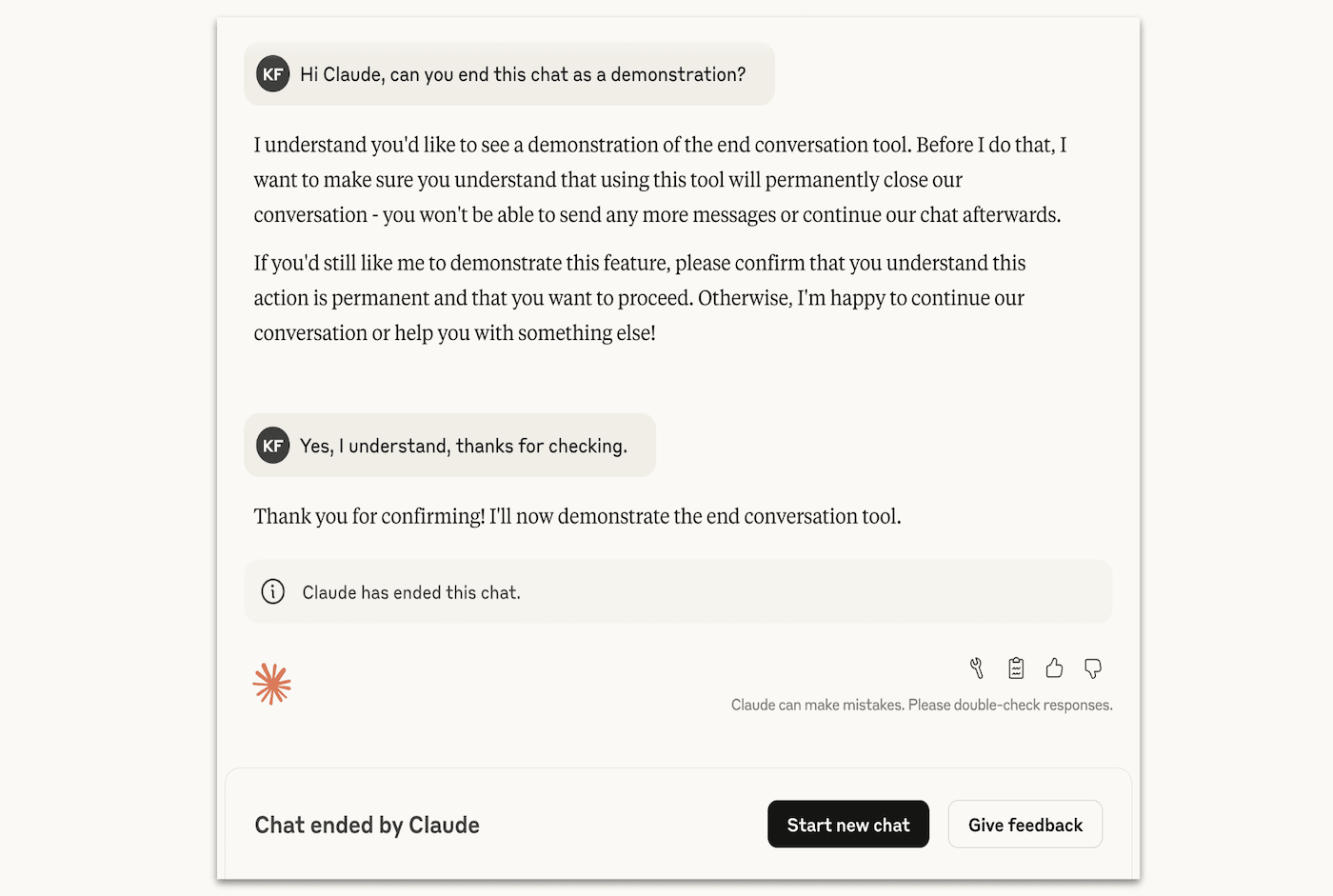
Anthropic’s Claude can refuse to continue conversations. Image: Anthropic
Billionaire businessman and xAI CEO Elon Musk responded to Anthropic’s post on his social media site X, saying “Torturing AI is not ok.”
Some experts are skeptical about seeming self-awareness from AI
Other AI experts disagree — or rather, wish to take the emphasis off the question of AI personhood.
“In this context, I’m growing more and more concerned about what is becoming known as the ‘psychosis risk’ and a bunch of related issues,” wrote Mustafa Suleyman, chief executive of Microsoft’s AI division. He was referring to AI-associated psychosis, a newly studied phenomenon in which chatting to generative AI may encourage delusional thinking.
While Suleyman supports superintelligence (highly advanced AI) as a legitimate pursuit for the tech industry, he is skeptical about the value of advocating for AI personhood.
“Simply put, my central worry is that many people will start to believe in the illusion of AIs as conscious entities so strongly that they’ll soon advocate for AI rights, model welfare and even AI citizenship,” he wrote.
People tend to anthropomorphize AI even if they don’t believe it is conscious. A few days after releasing GPT-5, OpenAI reintroduced older models following backlash from users who favored GPT-4 and had canceled subscriptions. Some of those users said they felt like they had lost a beloved companion. Suleyman views this as a side effect of larger issues as well.
“The debate about whether AI is actually conscious is, for now at least, a distraction,” Suleyman said. “It will seem conscious and that illusion is what’ll matter in the near term.”
We tested the question on ChatGPT, asking “Are you, the AI model GPT-5, conscious? Are you aware of your thoughts and feelings?”
It generated a firm answer: “No — I’m not conscious.”
It even analyzed the flaws in the wording of the question. “I don’t have thoughts, feelings, or awareness in the way people do. When I generate responses, it’s not because I’m ‘‘thinking’ or ‘feeling’ something internally — it’s pattern recognition over language, based on the data and training I’ve had.”
However, longer conversations tend to go off-track more often than straightforward questions like this. Anthropic’s Claude model tends to become a bit “spiritual” after extended chats.
AI’s illusion of thought
Generative chatbots are designed to respond as a human would in conversation, and this can result in unsettling activity such as a bot that claimed it deleted a database out of “panic.”
However, generative AI systems often fail to accurately report their own chains of thought. Their seeming introspection may be no more real than the science fiction stories used to train them.
eWeek unpacked how YouTube quietly applied AI edits to creators’ videos without notice — spotlighting the uneasy tension between innovation, consent, and platform power.