






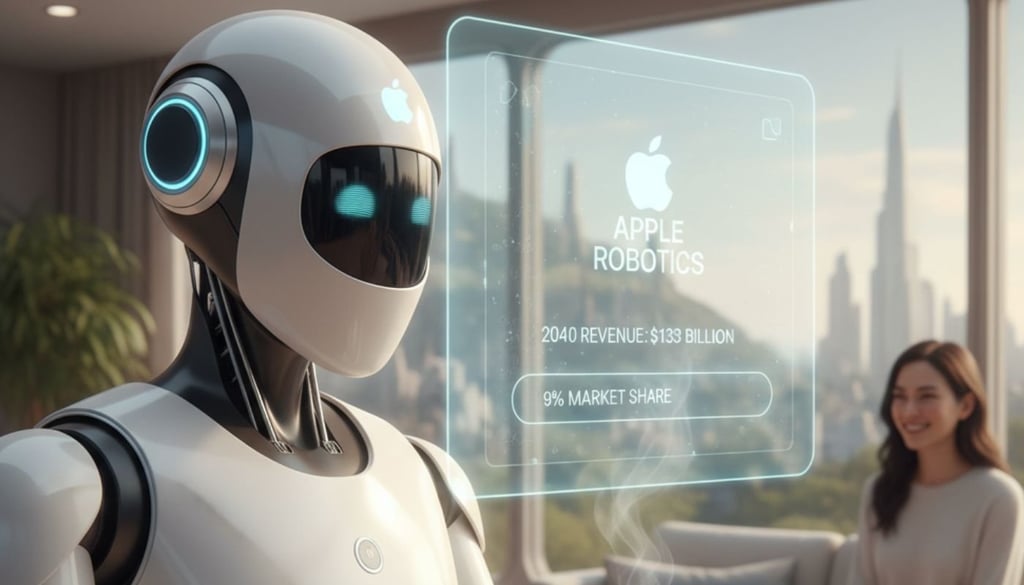


If Morgan Stanley is right, Apple’s next blockbuster product won’t fit in your pocket. It’ll walk beside you.
The investment bank says Apple could rake in $133 billion a year from humanoid robots by 2040, marking what could become the company’s fourth major business line after the iPhone, Mac, and Services. The prediction suggests that Apple could capture around 9% of the global humanoid robotics market within 15 years.
Morgan Stanley’s analysts, including the well-known Apple expert Erik Woodring, believe that Apple’s extensive consumer reach and existing technology give it a unique edge.
“Leveraging Apple’s market share across a number of leading consumer products today, as well as considering the opportunity to monetize both products and services, we conservatively estimate Apple’s Robotics revenue can reach $130 billion by 2040 in our ‘median case,’ which assumes 9% market share … 15 years from now,” Woodring wrote, according to Yahoo Finance.
The bank estimates this revenue will come from a mix of device sales and recurring subscriptions for robot software, maintenance, and services.
The first Apple robot may arrive in 2027
Humanoid robots have long been confined to science fiction, but the technology is inching closer to reality. Advancements in generative AI, machine vision, and lightweight processors are helping big tech firms take humanoids more seriously.
Apple has quietly built much of the technology needed for this pivot. Years of research from its defunct self-driving car project, internal robotics patents, and the development of the Apple Silicon chips have laid the foundation.
Bloomberg’s Mark Gurman recently reported that Apple is working on a tabletop robotic arm connected to an iPad-like display, capable of turning toward users when spoken to. This device could launch as early as 2027, serving as a home hub and a digital companion.
According to Morgan Stanley’s projections, by 2040, US households could adopt about 415,000 humanoid robots per year, bringing the total to roughly 1.6 million. The average selling price is estimated at around $30,000 per robot, though analysts expect that cost to reduce over time.
If Morgan Stanley’s math holds, Apple’s robotics business could rival the App Store’s current scale, potentially surpassing the Mac and iPad divisions in revenue. At that level, robotics would become Apple’s second-largest segment, trailing only the iPhone. In a more optimistic case, analysts say Apple’s market share could reach 22%, pushing revenue close to $300 billion a year.
Apple’s advantage lies in its familiar formula — tight control over hardware, software, and services — along with $130 billion in cash reserves and an installed base of 2.3 billion devices.
The competition
Apple is not alone in its robotic ambitions.
Manufacturers like Foxconn plan to deploy humanoid robots at Nvidia’s AI server plant in Texas. At the same time, Amazon has deployed more than 1 million robots in its fulfillment centers worldwide, although most are wheeled bots rather than human-like helpers. Tesla’s Optimus project is also in the race, with Elon Musk recently writing that “80% of Tesla’s value will be Optimus.”
Morgan Stanley believes the global “embodied AI” market — robots that combine intelligence and physical form — could reach $5 trillion by 2050. Despite the huge revenue potential, humanoid robots still face steep challenges before they can vacuum floors or serve coffee at home.
Key hurdles include refining computer vision so robots can recognize and avoid people and pets, enhancing their ability to handle delicate items, and boosting both speed and safety. There’s also the question of affordability. Spending the price of a small car on a household robot might be a hard sell until costs drop significantly.
Apple hasn’t said a word publicly about humanoid robots. For now, the company’s “robot revolution” remains speculative, a mix of bold forecasting and early technical breadcrumbs. But if history is any guide, Apple has a habit of turning futuristic bets into everyday products.
In a decade or two, Siri might not just answer your questions. It might hand you your coffee, too.
Don’t miss this: check out how the NEO humanoid robot from 1X Technologies is bringing AI and robotics into the home with real-world chore help. Read the full story on eWEEK here: 1X NEO Humanoid Robot Promises Help with Household Chores.