






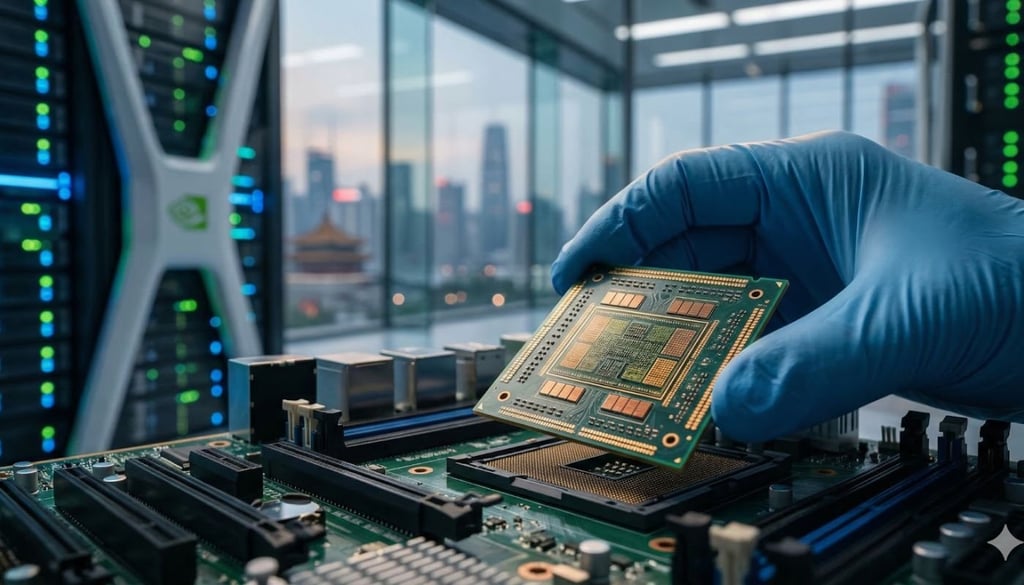


After months of regulatory hurdles and geopolitical tension, Nvidia is preparing a significant return to China’s artificial intelligence chip market.
CEO Jensen Huang recently suggested the company is now positioned to restart production and prepare deliveries to Chinese customers, potentially reopening a market worth tens of billions of dollars. The AI chip giant confirmed this week that it has received multiple US government licenses and new purchase orders from Chinese customers, allowing it to restart manufacturing of certain chips after earlier production pauses.
The development marks a major shift from just weeks earlier, when Nvidia executives were still expressing uncertainty about whether meaningful sales to China would resume.
“We’ve been licensed for many customers in China,” Huang said, adding that Nvidia’s supply chain is now ramping back up after delays.
Regulatory shifts open the door
Speaking at Nvidia’s annual GPU Technology Conference (GTC) in San Jose, Huang stated that Nvidia’s supply chain is now “getting fired up” after production had previously been paused due to regulatory delays and uncertain demand.
The renewed push comes after nearly a year of shifting US policy toward AI chip exports to China. The Trump administration had previously banned exports of advanced AI chips to China over national security concerns, but later allowed limited sales under strict conditions. One unusual provision required Nvidia to share 25% of the revenue from certain China chip sales with the US government.
Meanwhile, Beijing responded by restricting the use of American AI chips in government and state-backed organizations. Despite the technological rivalry between the two countries, recent licensing approvals suggest both sides may be willing to allow limited commercial activity to continue.
As recently as February, Nvidia executives were still unsure whether sales would resume meaningfully. CFO Colette Kress noted during an earnings call that while some shipments had been approved, the company had not yet generated revenue due to uncertainty about whether the products would ultimately be allowed into the country.
China remains a critical growth market
Even with all of the political risks, China remains too large a market for Nvidia to ignore. The company generated an estimated $12 billion to $15 billion in revenue from China in 2024, the last full year before the restrictions took full effect. Huang has previously estimated the Chinese AI chip market could eventually reach $50 billion, underscoring why Nvidia has continued to pursue access despite political complications.
Chinese technology giants such as Alibaba and ByteDance could benefit from renewed access to Nvidia’s AI chips if import approvals are granted. However, shipments will still depend on Chinese regulatory approval, meaning the situation remains subject to political and regulatory developments. Still, the company appears determined to regain its footing.
Product strategy focuses on compliance and competition
To navigate export restrictions, Nvidia is focusing on selling modified or older-generation chips that comply with US rules. One example is the H200 processor, which is based on Nvidia’s older Hopper architecture and is reportedly a generation behind its most advanced offerings but remains powerful enough to support many enterprise AI applications.
Meanwhile, Nvidia is also investing heavily in AI inference chips, which run trained AI models in real-world applications, and these chips are becoming increasingly important as companies shift from building AI models to deploying them.
The company recently strengthened its position in this space by acquiring inference-related assets from startup Groq and introducing its new Groq 3 inference chip at GTC.
Financial impact and industry implications
Financially, renewed sales in China could provide an additional boost to Nvidia’s already strong growth outlook. Analysts have projected the company could generate roughly $368 billion in revenue over the next year, representing about 70% growth. Any incremental revenue from China could push those forecasts higher.
At the same time, Nvidia must continue to balance business opportunities with political realities.
A balancing act ahead
For Nvidia, the reopening of China represents both a commercial opportunity and a balancing act. The company must navigate export controls, political pressures, and intensifying competition while maintaining its dominance in the global AI hardware race.
At the same time, US policymakers continue to debate how to balance national security concerns with the need for American companies to remain globally competitive. Future trade discussions between Washington and Beijing could further shape the rules governing AI chip exports.
If the latest approvals translate into sustained shipments, Nvidia’s return to China could become an important part of the evolution of AI’s global supply chain and the technological competition shaping the future of artificial intelligence.
Also read: Nvidia’s push into physical AI is expanding beyond data centers, with new robotics models and simulation tools aimed at factories, hospitals, and logistics systems.