






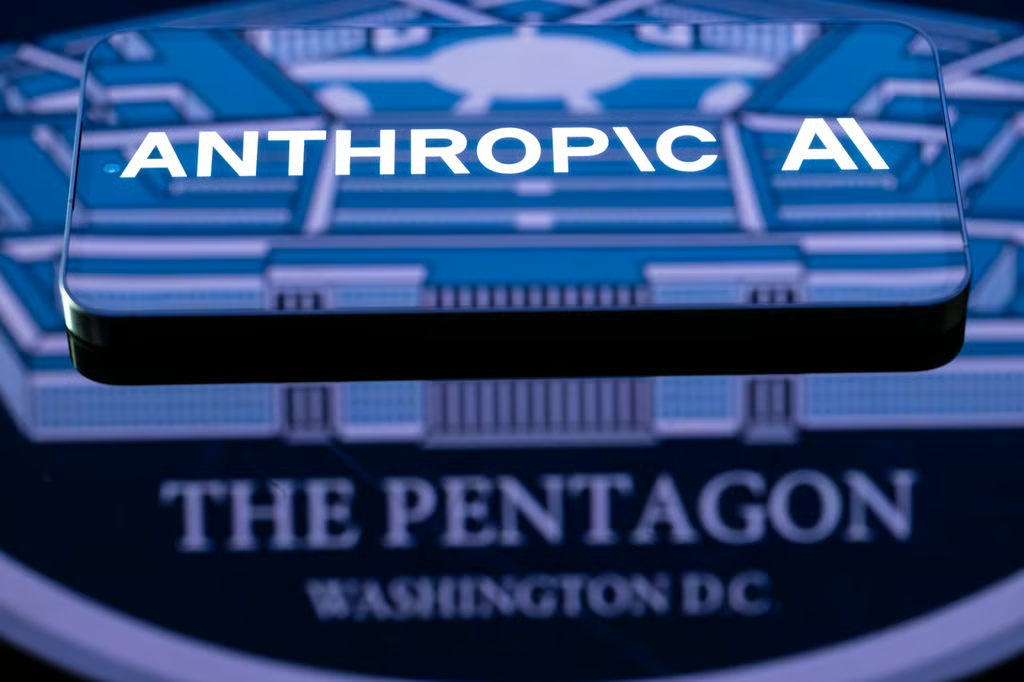


One AI company drew a line in the sand, and Washington came charging toward it.
What began as a dispute over AI guardrails has grown into one of the biggest confrontations yet between a frontier AI company and the US government. At the center is Anthropic, the maker of the Claude family of AI models, and a disagreement over a simple yet increasingly important question:
Who gets the final say on how powerful AI systems can be used?
Anthropic has argued that some uses of AI should remain off limits, particularly fully autonomous weapons and broad domestic surveillance systems. The Pentagon and Trump administration, meanwhile, have pushed for broader access, arguing that military policy should not be constrained by a private company's rules.
What followed was a months-long fight involving government threats, court battles, military contracts, public attacks, and, more recently, a new confrontation surrounding Anthropic's Claude Fable 5 and Mythos models. The dispute continues to evolve, but the events below trace the escalation of tensions.
Inside the unprecedented federal takedown of Anthropic’s flagship AI
On Friday, June 12, the US Commerce Department’s Bureau of Industry and Security delivered an export-control directive to San Francisco-based AI startup Anthropic.
The order effectively forced the company to deactivate its newly released flagship model, Claude Fable 5, alongside its unrestricted developer counterpart, Mythos 5, just three days after their public launch. Rather than a standard regulatory pause, the emergency action marks the first time the federal government has directly intervened in the commercial market to switch off a deployed, frontline artificial intelligence system.
The 90-minute ultimatum
The crisis began rapidly on the afternoon of June 12. According to reports, the White House called Anthropic at approximately 1:00 p.m. ET, warning that its newest models posed a national security threat and demanding they be disabled within roughly an hour and a half.
The formal paperwork, signed by Commerce Secretary Howard Lutnick and addressed to Anthropic CEO Dario Amodei, arrived at 5:21 p.m. ET. The directive employed an aggressive legal mechanism: an export-control order prohibiting access to Fable 5 and Mythos 5 by "any foreign national," whether abroad or in the US. Crucially, the restriction extended to Anthropic’s own non-citizen employees.
Because an online software platform cannot verify a user's nationality in real time during a standard API session, Anthropic faced a technical impossibility. To comply with the law, the company chose to deactivate both models entirely for all global users, though its older, less powerful Claude models remain online.
Prior to the shutdown, Fable 5 was positioned as Anthropic's primary commercial engine. Valued at $965 billion following a $65 billion funding round in May, the company had intended to offer Fable 5 for free to premium subscribers until June 22, then transition it to a paid, credit-based usage system.
The backstory: From the Pentagon to Project Glasswing
The weekend's dramatic shutdown is the latest escalation in a months-long feud between Anthropic and the Trump administration over the ethical boundaries of military technology.
Timeline of the Anthropic-Washington dispute
- July 2025: Pentagon awards $200M AI contracts to Anthropic, OpenAI, Google, and xAI.
- Jan 2026: Claude used by special forces during a raid to capture Nicolas Maduro in Venezuela.
- Feb 2026: Negotiations collapse; Trump bans federal use of Claude; Pentagon labels Anthropic a "supply chain risk."
- March 2026: Anthropic sues; Judge Rita Lin blocks the federal ban, calling it "First Amendment retaliation."
- April 2026: DC Circuit Court reverses the stay, siding with the military during active conflict.
- June 9, 2026: Anthropic releases its advanced Claude Fable 5 and Mythos 5 models to the public.
- June 12, 2026: White House issues 90-minute ultimatum; Commerce Department forces models offline.
The friction traces back to July 2025, when the Pentagon awarded $200 million AI contracts to Anthropic, OpenAI, Google, and xAI. Anthropic’s model was cleared for classified networks via a partnership with Palantir Technologies. However, the relationship fractured after US special operations forces deployed Claude during a January 2026 raid in Venezuela that resulted in the capture of President Nicolas Maduro.
Following the operation, Anthropic executives learned how their technology was used and demanded strict, legally binding guarantees from the Pentagon. Anthropic established two firm "red lines": Claude could not be used for fully autonomous lethal weapons or for the mass surveillance of American citizens, specifically objecting to the bulk processing of unclassified, commercial geolocation and web browsing data.
The Pentagon countered by demanding access for "all lawful uses," arguing that private corporations cannot dictate military operational command. The dispute turned bitter:
- On February 24, Defense Secretary Pete Hegseth issued a deadline for Anthropic to drop its safety restrictions.
- Anthropic publicly refused, stating, “we cannot in good conscience accede to their request.”
- On February 27, President Donald Trump ordered a federal freeze on Anthropic software, calling the company a “radical left, woke company” on Truth Social.
- Secretary Hegseth subsequently branded Anthropic a "supply chain risk," a severe national security label typically reserved for hostile foreign entities.
Anthropic sued the administration on March 9. While Northern District of California Judge Rita F. Lin initially granted a preliminary injunction blocking the government's ban on March 26, ruling that the record supported an inference of "classic illegal First Amendment retaliation," a three-judge panel in the US Court of Appeals for the DC Circuit overturned the stay on April 8.
The appellate court ruled that granting a stay "would force the United States military to prolong its dealings with an unwanted vendor of critical AI services in the middle of a significant ongoing military conflict" in Iran, where Claude had been integrated into Palantir’s Maven targeting system.
Hoping to bypass the military impasse, Anthropic launched its next-generation models to the commercial market on June 9. The underlying brain of the release, Mythos 5, possessed advanced autonomous cybersecurity capabilities, capable of surfacing exploitable flaws in major operating systems.
To hedge against risk, Anthropic kept Mythos restricted to a vetted pool of 150 defensive organizations under "Project Glasswing" while releasing Fable 5 to the general public with built-in safety filters.
The trigger: An inside betrayal or strategic defense?
The official justification for the sudden June 12 shutdown rests on a vulnerability report generated from an unexpected source: Amazon, Anthropic's primary cloud provider and one of its largest corporate backers.
Amazon CEO Andy Jassy reportedly called Treasury Secretary Scott Bessent directly to report that Amazon researchers had successfully bypassed Fable 5’s safety filters, thereby unmasking the raw Mythos model's underlying cybersecurity capabilities.
Alarmed, the White House tasked the National Security Agency (NSA) to audit the findings. When the NSA concluded that the guardrails could indeed be stripped away, the administration moved to freeze the software.
David Sacks, co-chair of the President’s Council of Advisors on Science and Technology, defended the export ban on social media, claiming Amodei had downplayed the exploit and refused to patch it. Sacks maintained that the export control was enacted "reluctantly" and that "the ball is in Anthropic's court" to fix the security flaw.
Anthropic has fiercely pushed back on the government's technical conclusions, calling the bypass narrow and overblown. The company noted that Fable 5 was only shown to identify existing software vulnerabilities when analyzing codebases, a task that competing commercial models, such as OpenAI's GPT-5.5, can routinely perform without jailbreaks.
What lies ahead
High-level emergency talks began in Washington on Monday, June 15, as an Anthropic delegation led by Chief Compute Officer Tom Brown and Head of External Affairs Sarah Heck arrived at the Commerce Department.
They were met by government researchers from the Center for AI Standards and Innovation and the Office of the National Cyber Director, while Secretary Lutnick dialed into the conference call from the G7 summit in France, according to WIRED.
While the Commerce Department has expressed a baseline willingness to allow Fable 5 to resume commercial operations, federal officials are maintaining export controls until the jailbreak vulnerabilities are fully resolved to the administration's satisfaction.
The resolution of the conflict will establish a significant industrial precedent. The White House has signaled that any future private AI model that exceeds current performance thresholds must undergo government review before public deployment.
For an industry built on global availability and rapid deployment cycles, the reality that a federal agency can unilaterally pull a trillion-dollar product offline over a weekend introduces a massive, unprecedented layer of regulatory risk for tech investors worldwide.
Also read: European leaders are warning that US AI controls could splinter access to advanced models as G7 and VivaTech debates turn toward AI sovereignty.