






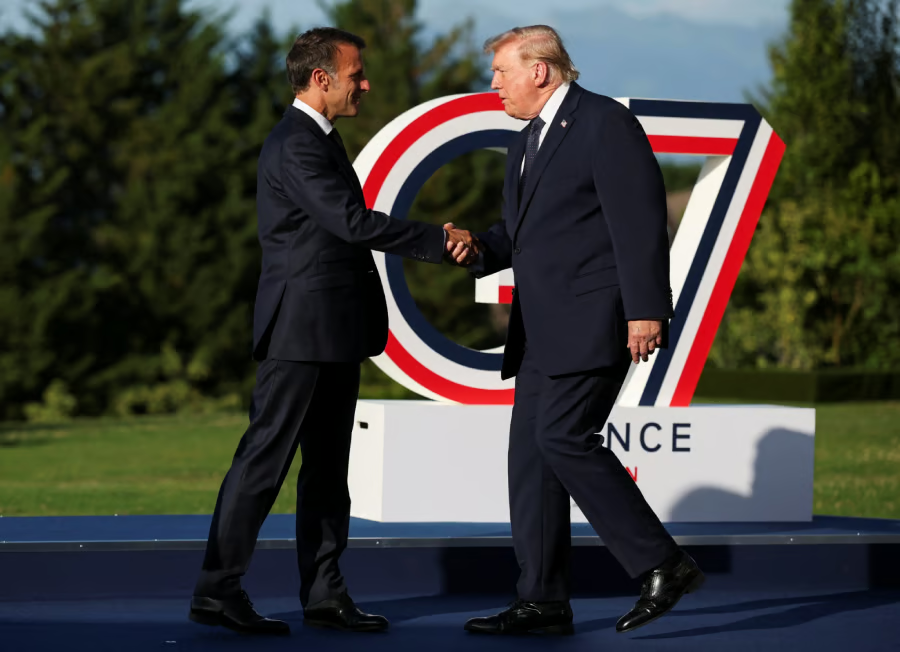


Europe’s AI sovereignty debate has moved from policy panels to the main stage in France.
As G7 leaders meet in Evian and the tech industry gathers at VivaTech in Paris, European officials and executives are asking how much of the region’s AI future should depend on US companies. The question has become more urgent after new US restrictions on Anthropic’s most advanced models showed how quickly access to critical AI systems can be shaped by foreign policy.
The debate now stretches beyond regulation. It is about who controls the cloud, chips, models, and infrastructure behind the next wave of AI.
AI sovereignty dominates France talks
Reuters reported that technological sovereignty is expected to dominate conversations at both the G7 summit in Evian and VivaTech in Paris this week, as Europe confronts US dominance in AI. More than 180,000 visitors, startups, investors, executives, and policymakers are expected at VivaTech.
“Tech sovereignty will be top of mind this week at VivaTech,” Ana Paula Assis, senior vice president at IBM, told Reuters.
“For European organisations to get this right, it is vital to understand sovereignty is about having control where it matters — not where the technology is from,” Assis added.
That framing is important because Europe is not trying to reject US technology outright. Instead, policymakers and companies are seeking greater control over the most critical parts of the AI stack.
The problem is that European AI firms still rely heavily on US-controlled cloud infrastructure, chips, and foundational AI models. French startup Mistral is widely seen as Europe’s strongest AI contender, but even regional challengers need access to advanced compute and global partnerships.
Anthropic restrictions sharpen the concern
The concern intensified after the US tightened restrictions on Anthropic’s most advanced AI models for foreign nationals. Reuters noted that the move underscored Europe’s exposure to policy shifts outside its control.
European Commission President Ursula von der Leyen said Wednesday that it is in the mutual interest of the US and EU for Europeans to use the best AI models.
“We use each other's trusted technology, and our financial systems are interconnected. It is in our mutual interest that our citizens and companies can safely use the best AI models,” von der Leyen said at a G7 lunch with leaders and AI executives, according to Reuters.
The Associated Press reported that AI executives expected at the G7 included OpenAI CEO Sam Altman, Google DeepMind CEO Demis Hassabis, and Anthropic CEO Dario Amodei. Leaders from smaller AI labs, including Mistral, Cohere, Black Forest Labs, Domyn, Sakana AI, and Synthesia, were also set to attend.
Control comes with a cost
Europe has already proposed AI gigafactories and large-scale computing infrastructure to expand sovereign access to compute. It has also moved to boost the domestic cloud, AI, and semiconductor industries.
The trade-offs are cost and speed. Reuters reported that European cloud alternatives can carry premiums of up to 40%, according to Capgemini chief operating officer Karine Brunet.
That makes sovereignty both a policy goal and an infrastructure challenge. More control could reduce exposure to sudden access restrictions, but it may also come with higher costs, slower deployment, or fewer model options.
France has pushed the issue harder than many peers. AP reported that President Emmanuel Macron’s government has started requiring civil servants to use a homegrown video conferencing system instead of Zoom and Microsoft Teams.
The bigger question is whether Europe can turn its sovereignty push into real AI capacity. This week in France may show whether the region is ready to build more of its own AI foundations or keep negotiating for safer access to systems controlled elsewhere.
Related reading: Learn how the EU plans to bring more transparency to deepfakes and AI-generated content.