






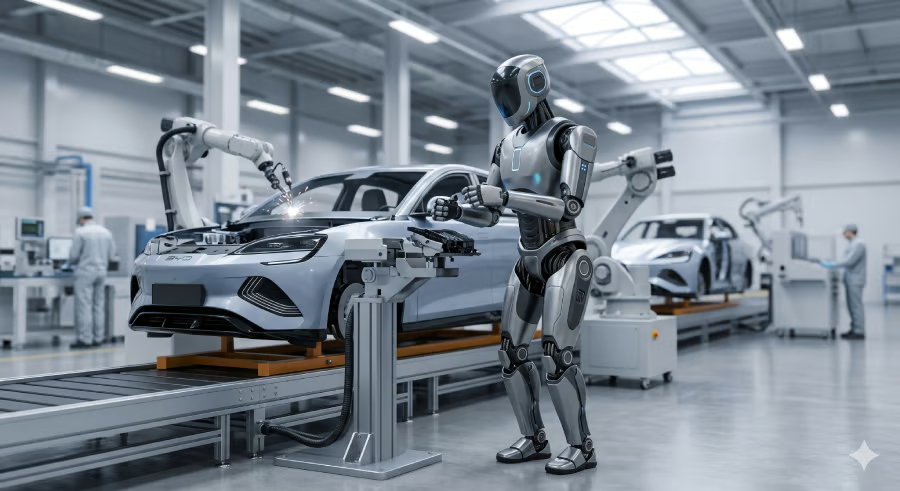


The company that famously overtook Tesla in electric vehicle sales now wants to stand on two legs and sell you a robot.
China's largest new-energy vehicle manufacturer, BYD, has confirmed that it is developing its own humanoid robots. Operating under the codename "Yao-Shun-Yu," the secret initiative has been stealthily running for four years, marking a massive push by the automaker into the fast-emerging field of embodied AI.
The project first came to light during a recent interview with BYD Executive Vice President Li Ke. According to reports from Pandaily and 36Kr, the initiative was launched in 2022 under BYD's 15th Business Unit, which handles electronic integration and intelligence.
In her interview, Li Ke offered a blunt critique of the current global state of robotics development to explain BYD's entry into the market.
"The fundamental challenge in this space is that China's robots lack a brain, while US robots have strong brains but weak limbs," Li Ke said, according to Pandaily. "BYD aims to produce robots that excel in both dimensions."
BYD plans to bridge this gap by leaning on its extensive cross-industry manufacturing footprint. The company intends to leverage its existing expertise in batteries, motors, electronic controls, precision manufacturing, and chips. Furthermore, the robot project will draw from BYD’s massive automotive intelligence ecosystem.
The push also fits BYD’s home turf.
The company is headquartered in Shenzhen, a southern Chinese tech hub where robotics, EV supply chains, lidar makers, and hardware startups sit unusually close together. That regional density gives BYD a practical advantage: humanoid robots require not only AI software, but also batteries, sensors, motors, precision parts, and the manufacturing discipline to assemble them at scale.
From the factory floor to the showroom
BYD does not intend to look very far for its initial customers; the company expects to be its own biggest buyer.
According to 36Kr, the company is currently prioritizing industrial robots, but the upcoming humanoid models are slated for two distinct roles: working factory shifts and serving as shopping guides or store greeters across BYD’s global retail network to help alleviate labor shortages.
However, BYD may not build every single piece of the machine itself. Li Ke noted that the automaker is considering a highly pragmatic open-platform strategy. Instead of restricting development to internal teams, BYD may build a platform that allows third-party software and components to integrate seamlessly, or cooperate directly with established robotics firms to shorten development timelines.
A new automotive arms race
The blurring boundary between car manufacturing and robotics marks a fierce new technological high-point for the automotive industry. Executives increasingly view autonomous driving as the first phase of embodied AI, with general-purpose humanoid robots representing the natural second half.
BYD’s disclosure places it in a high-stakes race against several local and international rivals who are already aggressively deploying physical AI:
- Tesla: The American EV maker has initiated mass production of its Optimus Gen-3 humanoid robot. 50 units have already been delivered to its Shanghai Gigafactory, which can work continuously for up to 10 hours at 85% human efficiency to handle parts, install seats, and conduct quality inspections, 36Kr reported.
- XPeng: The manufacturer officially unveiled its "IRON" humanoid robot. XPeng plans to debut a mass-production version later this year, using them in its own showrooms before initiating customer deliveries next year.
- Chery: The automaker has already entered the commercial market, launching online sales for its Mornine M1 humanoid robot through its AiMoga subsidiary, carrying a starting price of 280,000 to 285,800 yuan (over $41,000).
While BYD has not yet released a commercial timeline, specific investment totals, or technical specs for the "Yao-Shun-Yu" project, its core automotive business remains highly dominant. According to data cited by CarNewsChina, BYD sold 321,123 vehicles in April 2026 alone, with models such as the Sealion 06, Yuan UP, and Dolphin leading the way.
The company now bets that the same manufacturing muscle that scales its electric cars will successfully bring its humanoid robots to life.
BYD’s robot ambitions arrive amid a broader boom in China’s robotics industry, where companies like Unitree Robotics are attracting investor attention and positioning themselves for potential public listings.