







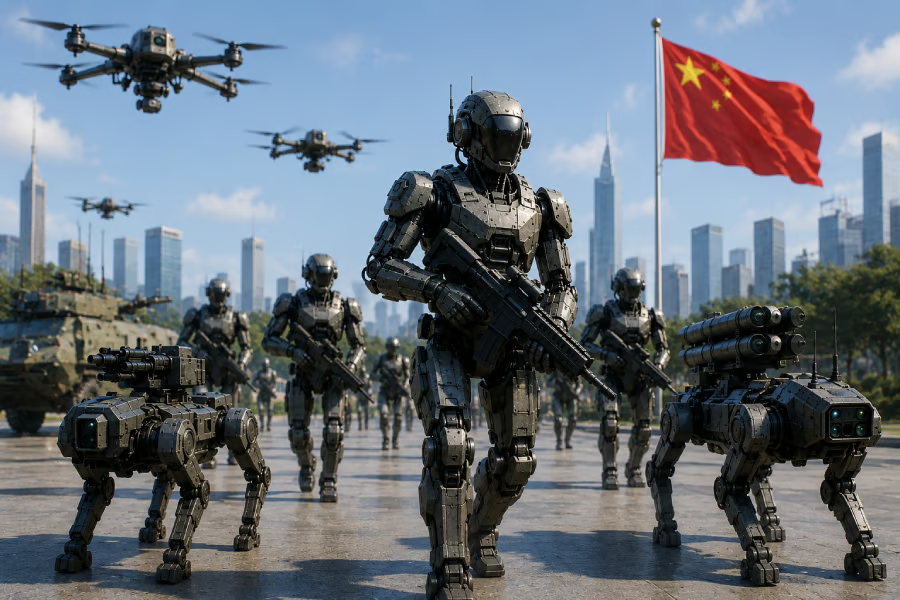
While the world’s attention has been fixed on aerial drones, a new arms race is unfolding on the ground.
China is rapidly maturing a massive ecosystem of robotic soldiers, ranging from humanoid-style machines to missile-toting quadruped dogs. And experts warn that Beijing is no longer just experimenting… they are preparing for “intelligentized warfare.”
At the World Defense Show 2026 in Riyadh, the Chinese defense sector signaled it is ready for business. A state-linked manufacturer introduced the PF-070, a four-legged combat robot armed with four anti-tank guided missiles. This isn’t a prototype; it’s a “production-ready platform” designed for international sale.
According to Forbes, the robot uses a low-profile, “acoustically quiet” chassis that can engage targets up to four kilometers away. These “robotic wolves” are being tested in “breach-and-clear drills” and have even been airdropped onto rooftops from drones.
From factories to the front line
China’s military advantage stems from its massive industrial base. According to the International Federation of Robotics, China’s operational robot stock exceeded 2 million units in 2024, a year in which it installed roughly 295,000 new robots compared to just 34,200 in the United States.
This civilian dominance fuels military progress. China is now testing wolf packs of networked machines designed to scout, supply, and support troops. A report from the Foundation for Defense of Democracies (FDD) suggests these systems are built with a Taiwan conflict in mind. In an amphibious invasion, these expendable machines could “absorb initial losses” and clear routes through dense urban terrain, according to Fox News.
Humanoids and the ‘human form factor’
Beyond the four-legged scouts, China is pushing the boundaries of humanoid robotics. These machines resemble human anatomy with torsos, heads, and limbs. Michael Hochberg, PhD, tells Popular Mechanics that the reason for this design is simple: “the human form factor is what we’ve designed the world around.”
These humanoid soldiers feature “working faces” equipped with night-vision and audio sensors. While some versions, like the Tien Kung Ultra, have won half-marathons, others are being designed to carry the same rifles and grenade launchers used by human infantry.
The cost of hyperwar
The US isn’t sitting still, but its approach differs.
While the US has sent reconnaissance robots to Ukraine to gather combat data, American systems like Ghost Robotics’ Vision 60 are often optimized for counter-drone missions rather than direct anti-armor fire. The rapid proliferation of these machines raises ethical and strategic alarms. Kanaka Rajan, PhD, a Harvard computational neuroscientist, warns that AI weapons remove the “human cost of warfare.”
“It becomes politically easier to start wars, which, in turn, may lead to more death and destruction overall,” says Rajan, per Popular Mechanics.
Technical hurdles
Despite the wolf pack hype, these robotic soldiers aren’t invincible. They remain vulnerable to:
- Electronic warfare: Jamming and cyber interference can break the link between the robot and its operator.
- Logistics: Battery life remains a significant limitation for long-term operations.
- Physical damage: Simple small arms fire or environmental smoke can blind the expensive sensors these robots rely on.
Most analysts agree that fully autonomous robot soldiers are not yet a reality. Many systems still require human operators to make weapon release decisions, and battlefield conditions remain a major challenge to reliable AI control.
Even so, the direction of change is already clear: warfare is shifting toward distributed, machine-assisted operations where robots, on land and potentially in the air, play a growing role in reconnaissance, support, and possibly direct combat. What remains uncertain is not whether robot soldiers will exist, but how quickly militaries will adapt the rules, strategies, and ethics to match them.
Related: eWeek also covered Unitree’s $650K manned mecha, a giant Chinese robot that walks, crawls, and smashes through walls.