






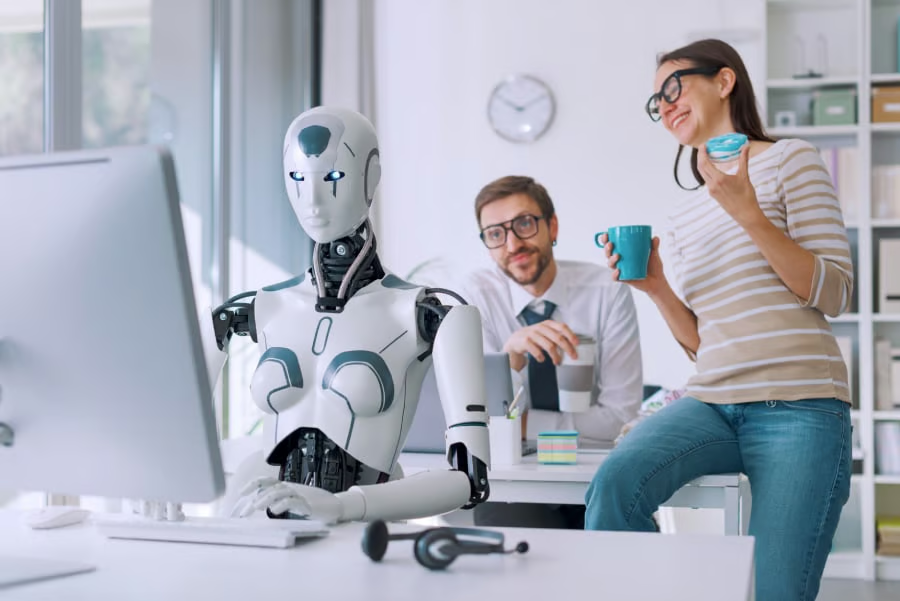


If you’ve been worried that a robot is going to take your job, you can probably relax. But you might want to prepare for your job to look very different.
According to Indeed’s AI at Work Report 2025, AI is less about full-on replacement and more about a significant reshuffling of our daily tasks. The research, which analyzed nearly 2,900 different skills required in today’s job market, stresses that this change doesn’t mean mass replacement.
It’s about transformation, not elimination.
“The real question is not whether GenAI will change jobs — it absolutely is, and will,” the report states. “The question is what kinds of jobs will be most and least changed, why, and how.”
The study also found that:
- 26% of jobs posted on Indeed in the past year are “highly transformable.”
- Over half (54%) are “moderately” exposed.
- Only 1% of skills analyzed fell into the “full transformation” category, where AI could theoretically perform the entire task without human input.
In most professions, the relationship is one of cooperation, not competition. The Indeed study describes this as “hybrid transformation,” where “human oversight will remain critical when applying these skills, but GenAI can already perform a significant portion of routine work.”
Jobs in the crosshairs
Tech and finance professionals appear to be standing closest to AI’s firing line.
“The jobs that are more likely to have a high degree of transformation are white-collar jobs,” Indeed’s Laura Ullrich said, according to CNBC.
Roles that require cognitive reasoning, like coding, analysis, or writing, are most vulnerable. By contrast, jobs that depend heavily on physical presence or emotional interaction, such as nursing, manufacturing, and construction, are less likely to be disrupted.
The report shows that 81% of software development skills fall within the “hybrid transformation” category, suggesting AI is now capable of handling much of the routine coding work.
One of the report’s model assessments explained that AI can provide “explanations, code samples, debugging help, and architectural advice,” signaling that while AI can assist, human oversight remains essential for accuracy and ethics.
The safest seats in the AI storm
At the other end of the spectrum, nursing and childcare roles remain the most shielded. These jobs rely on compassion, empathy, and human judgment — qualities still beyond AI’s reach.
“GenAI does not replace nurses, but has the potential to redistribute cognitive and administrative load, freeing time for patient-facing care,” the Indeed report said. That redistribution could ease chronic staff shortages rather than cause layoffs.
Despite growing fears, experts say the disruption is gradual. The Yale University Budget Lab recently reported that “the broader labor market has not experienced a discernible disruption since ChatGPT’s release 33 months ago.”
Still, AI is forcing companies to rethink how they organize work. Some firms are already making tough calls. Salesforce CEO Marc Benioff recently admitted to cutting thousands of customer service roles because of AI, saying, “I’ve reduced it from 9,000 heads to about 5,000, because I need less heads,” as quoted by CNBC.
However, many economists believe the greater challenge will not be layoffs, but reskilling. The Indeed report emphasizes that real-world impact depends on “how quickly workers are reskilled, and how job design evolves,” as businesses adopt AI tools. Those who learn to work with AI — not against it — are more likely to thrive in the next phase of the job market.
The Indeed report aligns with a recent Microsoft study, which shows that writing and sales positions are most vulnerable to being replaced by AI.