






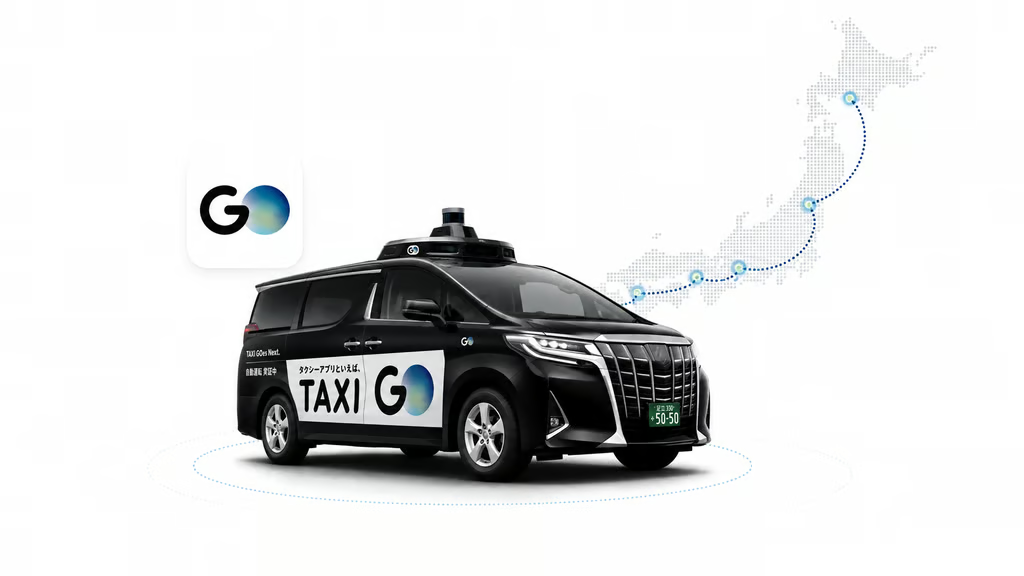


GO Inc.’s market debut is not a bet on building self-driving cars. It is a bet on the software, fleet relationships, payments, and local operating systems that could make robotaxis work in Japan.
Japan’s leading taxi-hailing app debuted on the Tokyo Stock Exchange on June 16 in an ¥88.6 billion ($553 million) IPO, the country’s largest listing of 2026 so far. GO has pointed to robotaxis and acquisitions as growth targets, but its stronger position is in the layer between autonomous vehicle technology and everyday taxi service: booking, dispatch, compliance, fleet coordination, and customer access.
Why GO is targeting robotaxi operations
GO listed on the Tokyo Stock Exchange Growth Market at ¥2,400 per share. The Wall Street Journal reported it as Japan’s biggest IPO of 2026 so far.
GO’s opportunity is not the autonomous-driving stack itself. CEO Hiroshi Nakajima has said the company will not invest in autonomous driving systems, according to Nikkei Asia reporting cited by TechCrunch. GO has also said it plans to put net proceeds toward robotaxi research and development, business expansion, and strategic mergers and acquisitions.
The relevant layer is operational: dispatch software, fleet coordination, payments, operator relationships, regulatory workflows, and remote monitoring.
GO already has the distribution foreign robotaxi platforms may need: more than 35 million app downloads and availability across all 47 Japanese prefectures.
GO has not detailed how robotaxi spending will be divided between R&D and acquisitions, nor has it announced a timeline for fully driverless commercial operations. It still has to prove those investments give it control beyond bookings.
Japan’s taxi-driver shortage gives the strategy a practical edge. Limited ride-sharing began in 2024, but the model remains tied to taxi companies, keeping fleet operators central to wider automation. The same APAC shift is pushing AI into consumer products, logistics, eldercare, and public-facing service
Japan has created a legal path for advanced automated-driving services, including Level 4 operations in limited areas, but commercial deployment remains narrow. Large-scale driverless taxis still require permits, safety validation, remote monitoring, and fleet integration. Australia’s AI data center buildout shows similar pressure around power, capacity, and approvals
What GO must defend as rivals enter Japan
In March 2026, Uber, Wayve, and Nissan announced plans for a Tokyo robotaxi pilot by late 2026 using Nissan Leaf EVs equipped with Wayve’s AI Driver and bookable through the Uber app. The pilot is expected to start with safety operators, giving Uber a route into Japan’s robotaxi market that does not depend on GO’s consumer app.
Waymo is testing in Tokyo with GO and Nihon Kotsu, one of Japan’s major taxi operators. It is not serving riders there yet, and its vehicles currently operate with trained Nihon Kotsu crew members behind the wheel while Waymo validates its technology.
GO has national app coverage, a large user base, and taxi-operator relationships that could matter as autonomous vehicles enter fleets. It does not own the autonomous-driving stack, so it must remain the local interface for AV providers rather than a booking layer competitors can bypass.
Robotaxi services will need dispatch systems, fleet management software, payments, maintenance workflows, safety monitoring, and local compliance — the same kind of operational guardrails now emerging around AI agents, including monitoring, access limits and audit trails.
GO’s next test is whether robotaxi spending gives it deeper control of dispatch, remote monitoring, fleet coordination, and taxi-operator partnerships. If it remains mainly a booking channel, overseas AV and ride-hailing companies may route around it.
Also read: Autonomous robot dogs at World Cup venues show how robotics is moving from controlled environments into public operations.