







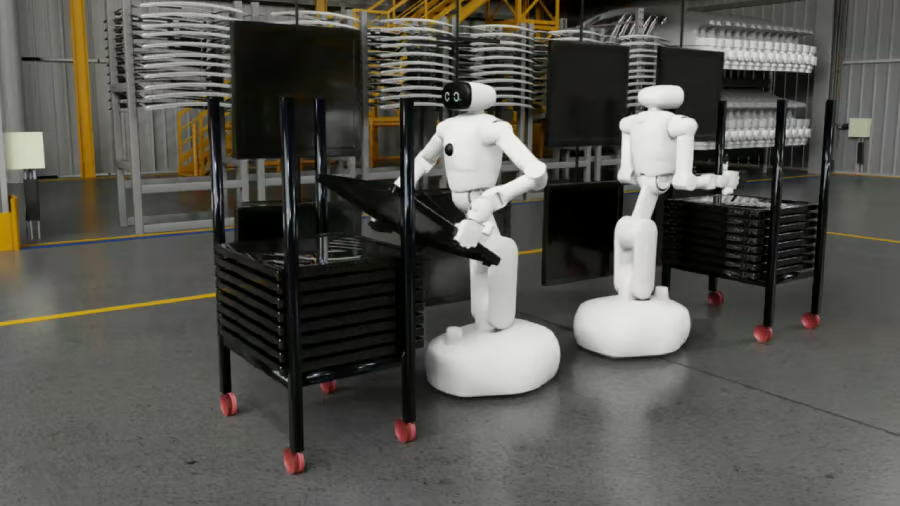
Nvidia and LG are taking AI out of the chatbot box and into the factory floor.
The companies announced a broad partnership that will bring Nvidia’s AI computing, simulation, robotics, and autonomous-vehicle platforms into LG’s manufacturing, mobility, cloud, and product-development efforts. The collaboration centers on an “AI factory” designed to support model development, robot simulation, digital twins, and industrial AI workflows.
For Nvidia, the deal reinforces its push to become the infrastructure layer behind physical AI. For LG, it offers a faster path into robotics, autonomous systems, and AI-powered manufacturing.
Inside the Nvidia-LG AI partnership
While many similar partnerships address one or a few layers, this one touches nearly every layer of the AI stack.
At the center of this deal is the development of an AI factory. This factory is expected to power some of LG’s biggest AI moves. That includes combining the development of AI models, robot simulation, and training data, as well as deploying factory-scale digital twins with localized data into a unified workflow.
Beyond that, the partnership will create an autonomous manufacturing ecosystem for LG's suite of products. Within this system, AI is expected to handle everything from procurement down to customer delivery.
The result is a collaboration where Nvidia serves as the foundation, while LG becomes the consumer-facing side.
The technologies powering the partnership
Nvidia will provide software frameworks, simulation platforms, AI models, and computing systems for use in the end products of this partnership.
Technologies such as NVIDIA Isaac Sim, NVIDIA Isaac Lab, and NVIDIA Isaac GR00T will enable LG to train and evaluate AI systems in virtual environments before deployment. For its autonomous mobility systems, Nvidia plans to make its NVIDIA DRIVE Hyperion and NVIDIA DRIVE AGX available alongside LG’s advanced driver-assistance systems (ADAS) and in-vehicle AI systems.
The company is also collaborating with LG AI Research to advance EXAONE, LG’s advanced AI model family, which has been developed using Nvidia’s hardware and software tools.
What this means for both companies
Although the monetary value of this deal remains unconfirmed, it certainly offers reciprocal benefits depending on where each party stands in the chain.
For Nvidia, the deal reinforces a shift toward becoming a foundational layer of AI systems used in real-world environments. Rather than focusing solely on its already profitable hardware sales, the company appears to be expanding its influence over how AI systems are designed and operated.
For LG Electronics, access to Nvidia’s platforms provides the infrastructure needed to accelerate its growing push into robotics and other AI-driven products. The result is a shared goal of AI systems that extends beyond software into physical and industrial applications.
The unanswered question is how quickly LG can turn this infrastructure into products and factory systems that work at scale. But the direction is clear: Nvidia is positioning itself not just as an AI chipmaker, but as the operating layer for companies trying to bring AI into machines, factories, and vehicles.
Also read: Spirit AI joined the top 10 of a physical AI ranking alongside Nvidia, Tesla, and Unitree.