






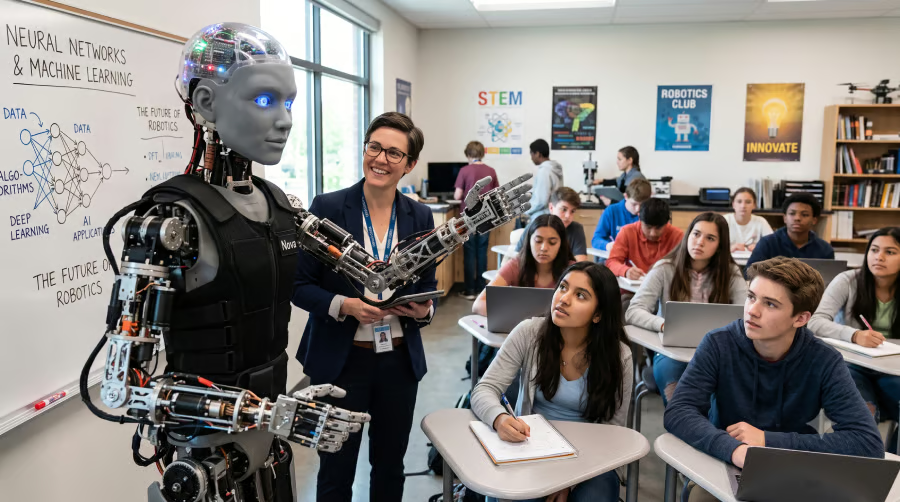


A San Diego charter school network has spent half a million dollars on two ChatGPT-powered humanoid robots, putting students face to face with a new kind of classroom AI experiment.
According to Voice of San Diego, Altus Schools is testing the Ameca robots in its in-person resource centers. The school network serves students working to recover credits and stay on track for graduation, and officials say the pilot will study how “physical AI” might work alongside students without replacing teachers.
The purchase adds a major cost question to the education AI debate as schools weigh classroom technology against tutors, counselors, and other direct services.
Ameca enters the classroom as a teaching partner
The two humanoid robots cost Altus Schools a combined $500,000 and can shift between four roles. Sage the Teacher is for academic help; Remi the Wellness Coach is for limited student support; Ari the College and Career Planner is for post-school planning; and Lexi the Translator is for language help.
ChatGPT powers the robots’ conversational responses, allowing them to answer student questions, role-play historical figures, and respond through different personas.
Ameca stands 6 feet 2 inches tall, with a gray silicone face, blinking blue eyes, a transparent skull lit from within, and exposed motors that move as it smiles, frowns, and scans the room. Cathryn Rambo, Altus’ dean of academic studies, told families the network was “researching the use of physical AI as a teaching partner.”
School officials said students are not left alone with the robots. They also said the machines do not record data and that their memory is erased after each interaction.
‘Frightening beyond all words’
An early lesson did not run smoothly.
During a demonstration, two middle school students asked the robot to respond as Nikola Tesla. Ameca interrupted a student, spoke too quickly, paused several times, and had to repeat its introduction so students could keep up with their notes. Rambo later called the lesson “clunky.”
Students also appeared unsure what to make of the machine. When asked to describe the robot in three words before and after interacting with it, “creepy” was the most common first response, though some students changed their view afterward.
Wayne Holmes, a professor of critical studies of artificial intelligence and education at University College London, told Voice of San Diego that there is “no independent evidence at scale” that these tools are effective or safe in classrooms.
He was critical of any use tied to mental health, calling the idea of AI or robots for that purpose “frightening beyond all words.”
Students needing support face the biggest tradeoff
Other schools are starting to test similar ideas.
A Massachusetts school has announced a $40,000 humanoid AI robot named Samantha, while a New York district is testing Realbotix’s Optio AI teaching assistant, and a humanoid robot pilot is expected to reach about 500 high school students in fall 2026.
Student impact may be most important in San Diego because the charter network serves students trying to recover credits, including a disproportionate number of low-income, homeless, and disabled students. For them, exposure to advanced robotics could open paths toward AI, robotics, or STEM careers.
The same students may also bear the downside if the technology gives unreliable answers or competes with funding for human support.
Across sectors, organizations are being asked to justify expensive AI bets against human-centered spending. In schools, the tradeoff is particularly sensitive because the alternatives are tutors, counselors, classroom staff, mentors, and direct student services.
Altus’ Ameca pilot brings that debate into classrooms, where the burden of proof should be higher.
Related reading: Shenzhen is preparing a hotel run entirely by robots, pushing hospitality automation into more public-facing territory.