







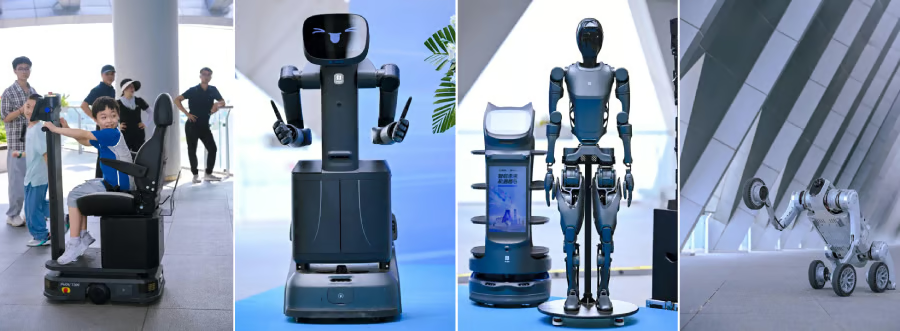
Check-in, brought to you by a robot with Wi-Fi and no small talk.
Shenzhen is building a hotel where guests, not staff, will be the only humans in the building. Pudu Robotics and Shenzhen Culture & Tourism Industry Development have signed a deal to open what they're calling the world's first hotel run entirely by robots, on the West Artificial Island that links the Shenzhen-Zhongshan bridge-and-tunnel crossing.
A trial is expected by late 2026, with a fuller opening in early 2027.
What the robots actually do
This isn't a hotel with a couple of cute delivery bots rolling around; it's meant to be the whole operation. Robots will handle check-in, luggage, room service, food delivery, cleaning, security patrols, and even companionship for guests. The property will have 44 high-end rooms, plus a restaurant and a gym, all integrated into a single system.
Specific machines are already lined up for specific jobs: the PUDU T300 hauls luggage and can carry up to 300 kg; FlashBot runs an automated minibar where guests order via their phones; and the CC1 Pro and MT1 handle cleaning with AI-based waste detection.
BellaBot Pro and KettyBot Pro, already familiar faces in Chinese cafes and restaurants, serve coffee and snacks. Tying it together is Pudu's "PuduFM 1.0" AI model and an agent platform called PuduAgent, which the company says lets every robot, regardless of shape or job, draw on the same underlying intelligence.
Pudu said, "This architecture enables robots with different physical forms and responsibilities to operate from a shared intelligence framework." The company added that the goal is a hotel where "reception robots can understand gestures and social interactions, delivery robots can autonomously optimize routes, and cleaning robots can dynamically adapt to changing environments."
Why it matters
This is less a hotel story than a manufacturing story wearing a bellhop's uniform.
Shenzhen logged 4.03 billion yuan, or about $596 million, in robot exports in the first four months of this year, accounting for a quarter of China's national total, according to China Daily. A flashy, fully autonomous hotel is effectively a showroom, proof that Shenzhen's robots can do real, sustained work, not just demos.
It also reflects how normalized service robots already are in China. Delivery bots are common in hotels nationwide, and Shanghai's Hongqiao Airport recently put a humanoid front-desk robot, the XMAN-R1, to work alongside delivery and cleaning machines. The island hotel just pushes that trend to its logical extreme.
Hospitality without the ‘hospitality’?
Calling this hotel "robot-run" is technically accurate but does some marketing heavy lifting. The actual rollout is staged and cautious: a handful of rooms and services first, full operation later, with the project itself stretching toward a 2030 vision.
If successful, it would prove that embodied AI can maintain complex, multi-variable environments, such as a commercial building, without human oversight. However, the venture introduces a clear philosophical trade-off for consumers.
Traditional hospitality is built entirely on human empathy, flexibility, and personalized care. While a machine can optimize room service routing, it cannot genuinely comfort a distressed traveler or accommodate an unusual, non-programmed request.
A fully automated hotel also removes the human judgment involved in handling the weird stuff, such as a broken pipe. Hospitality, more than retail or warehousing, runs on improvisation, and it's unclear how a robot fleet handles situations its training never anticipated. Plus, a closed-loop system creates a single point of failure.
If the local network or the central PuduAgent framework experiences a glitch, the entire hotel's infrastructure, from check-in to security and housekeeping, could simultaneously stall, leaving guests stranded without a human manager to fix the problem.
There's also the novelty problem: once the curiosity wears off, will travelers actually prefer zero human contact, or will they miss it?
Also read: AgiBot says it has built more than 15,000 embodied AI robots as China pushes automation from factory floors into more real-world settings.