






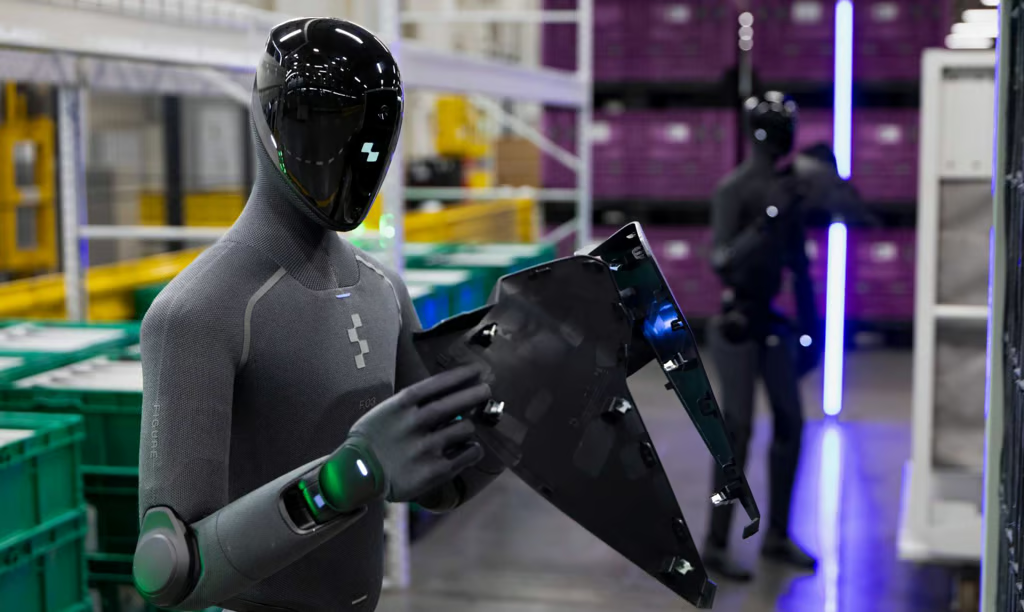


BMW is pushing humanoid robots deeper into factory work, moving the technology from controlled trials toward live production tasks at its Spartanburg plant in South Carolina.
The latest project, involving Figure 03 in logistics sequencing, builds on BMW’s earlier Figure 02 work at Spartanburg and its AEON pilot at Leipzig, Germany. Together, the projects show that factory AI will depend less on robot hardware alone and more on production data, integration standards, monitoring, safety processes, and coordination between IT and operations.
BMW expands humanoid robot work at Spartanburg
BMW said on June 25, 2026 that Figure 03 will begin work at BMW Group Plant Spartanburg on logistics sequencing applications. The company said the project will test whether humanoid robots can handle more complex intralogistics tasks in a live production environment.
The new work follows BMW’s Figure 02 deployment at Spartanburg. In that 2025 pilot, BMW said the robot supported production of more than 30,000 BMW X3 vehicles over 10 months. Figure 02 also moved more than 90,000 components and logged about 1,250 operating hours while handling sheet-metal parts for the welding process.
Leipzig remains part of the broader program, but it is not where those production figures came from. BMW’s AEON pilot at Leipzig uses a different robot platform from Hexagon Robotics and targets high-voltage battery assembly and component manufacturing.
That separation is important for evaluating the program. Spartanburg provides BMW’s most detailed public production data so far, while Leipzig shows how the company is testing humanoid robotics in a European factory with different tasks, suppliers, and operating conditions.
BMW is positioning humanoid robots as a complement to existing automation, not a replacement for all factory systems. The company says the technology could take on repetitive, physically demanding, or higher-risk tasks while supporting workers and improving production flexibility.
Factory AI depends on more than robots
Factories need the right digital foundation before humanoid robots can scale. BMW said effective AI use in production depends on a unified IT and data model, reinforcing how data readiness can affect whether AI systems work reliably outside controlled tests.
A robot working on a factory floor has to fit into production software, logistics workflows, monitoring systems, safety processes, and existing automation without becoming another isolated technology layer. That makes interface standards, data governance, monitoring, and operational ownership early buying criteria, not post-pilot cleanup work.
Similar pressure is emerging across enterprise AI, where systems are being judged by whether they can perform real-world work instead of only producing polished demos.
BMW’s Spartanburg work shows how much coordination that can require. The company said Figure 02 integration involved production IT infrastructure, occupational safety, production process management, and shop-floor logistics early in the process.
Standardized interfaces were another part of the deployment. BMW said Figure 02 was connected to its Smart Robotics ecosystem through standardized interfaces, allowing it to coexist with existing systems during production shifts.
The company has also created a Center of Competence for Physical AI in Production to collect robotics and AI knowledge across its manufacturing network. That structure could help BMW turn plant-specific lessons into repeatable guidance for other sites.
Humanoid robots will not scale in factories on hardware alone. Their broader use will depend on the data platforms, integration standards, monitoring tools, safety reviews, and governance processes that determine whether a pilot can become a repeatable production system.
Also read: For more on how robotics is expanding into new environments, see how the world’s first robot-run hotel is set to open in China by 2027.