







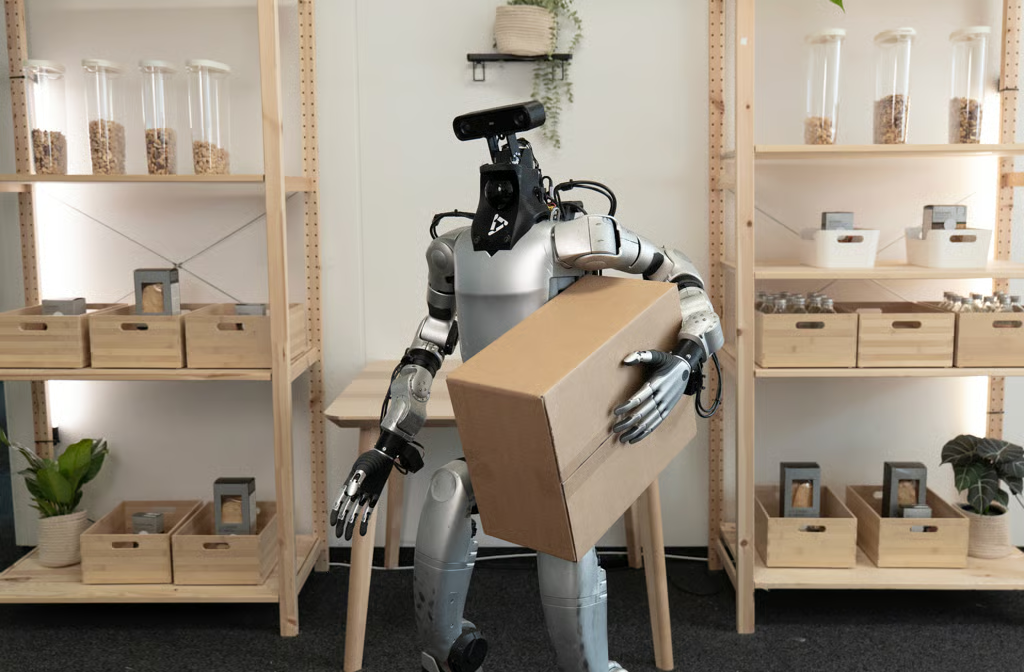
Flexion Robotics’ latest office robot demo shows the software challenge behind humanoid robotics. In a video published June 29, 2026, the company showed a modified Unitree humanoid retrieving a snack parcel, using stairs and an elevator, unpacking the box, and placing the items in a drawer from a single natural-language instruction.
The task was modest, but the technical claim was not. Flexion is arguing that humanoid robots will become useful in workplaces only if their AI systems can plan, perceive, recover from errors, and complete longer sequences of tasks without being programmed for every step.
Reflect v1.0 turns an office errand into a software test
Flexion described Reflect v1.0 as a robotics intelligence platform for long-horizon humanoid work. The company said the mission was completed autonomously, without a human operator controlling the robot.
The task required several steps: moving through multiple areas, interacting with doors, using stairs and an elevator, handling a parcel, unpacking objects, and placing them in a drawer. A failure at any point could stop the mission, which is why Flexion framed Reflect as an end-to-end autonomy stack rather than a single robot skill.
The architecture uses a custom vision-language model as the mission controller, which tracks progress, selects tools, and replans when needed. A motion layer combines a vision-language-action model with reinforcement learning-based skills, while a whole-body controller handles balance and movement. A runtime layer manages inference, logging, communication, process isolation, and safety checks.
On a 16-step mission test, Flexion said supervised fine-tuning reached 38% end-to-end completion, while reinforcement learning fine-tuning reached 90%. The figures are part of Flexion’s model-layer case, but they remain a company benchmark, not independent validation of commercial readiness.
A WIRED profile said Flexion was founded by former Nvidia robotics researchers. ABI Research analyst George Chowdhury told the publication that humanoid robotics value may lie more in AI models than in robot bodies. ABI Research estimates the robot foundation model market could reach $150 billion by 2036, according to WIRED.
The model layer becomes the deployment question
Humanoid robots will not scale in enterprise settings if every new task, office layout, or failure case requires custom programming. A software layer that transfers across objects, spaces, and instructions could reduce integration work, shorten pilot cycles, and make deployments more repeatable, especially as embodied AI companies move toward manufacturing and real-world deployment. Flexion’s demo is notable because it shows how humanoid robotics could shift from isolated task demos toward reusable autonomy platforms.
That software challenge overlaps with the broader race to build real-world AI agents. Physical robots add harder constraints: dexterity, battery life, locomotion, sensors, safety systems, and workplaces built for people.
Recent robotics research shows how architecture can affect robot performance. SpatialVLA focuses on 3D-aware spatial representations, while TraceVLA uses visual trace prompting to give models more context about prior robot movement. Those studies offer context, but they were not tests of Flexion’s office workflow or a live enterprise deployment.
Compute remains another constraint as companies move AI infrastructure plans from pilots into production. Chowdhury told WIRED that Flexion will need close hardware partnerships and will face significant competition.
Flexion also disclosed important limits. Reflect v1.0 still works within a bounded task distribution; some objects remain difficult to grasp; the mission controller can misread visual input; and recovery behaviors do not cover every failure mode.
The demo points to where humanoid robotics competition is moving, not proof that office robots are ready for broad enterprise rollout. Buyers should look for evidence that models can handle unfamiliar tasks, transfer across robot bodies, make quick decisions, and recover when conditions change.
Read more: Agility Robotics is preparing a $2.5 billion public debut to expand its Digit robot platform as humanoid robotics moves toward commercial scale.