








Bask in Agile’s Bright Light, but Don’t Be a Moth to a Flame
Every software movement since the days of punch cards (or pre-Internet/pre-smartphone, for younger people) has had its share of acolytes, many of whom over-rotated on a good idea, upset existing processes and flirted with business disaster, all for wholesale, seemingly magical technical improvement. Some of these characteristics fit the agile movement’s most fervent supporters, who urge developers to abandon everything in favor of sudden, complete change. This camp is well-intentioned but naive—existing applications that now run the backbone of businesses can’t simply be swept away like 40 years of accumulated detritus.
Embracing That Inertia is a Sure Path to Business Extinction
Equally naive and dangerous are the technical Luddites who espouse that agile is a passing fad that exposes the status quo to untenable risk. They need only look at firms in industries where digital disruption virtually killed businesses such as Blockbuster, Borders, Kodak and the Big Four music companies to see the real effect of untenable risk: extinction.
Use Agile as a Tool, Not a Religion
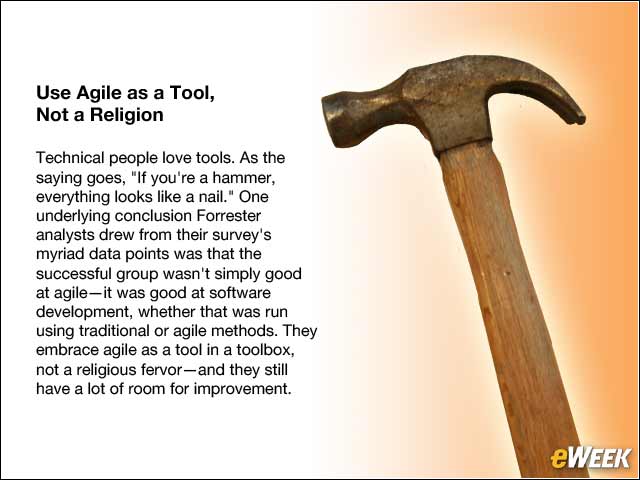
Technical people love tools. As the saying goes, “If you’re a hammer, everything looks like a nail.” One underlying conclusion Forrester analysts drew from their survey’s myriad data points was that the successful group wasn’t simply good at agile—it was good at software development, whether that was run using traditional or agile methods. They embrace agile as a tool in a toolbox, not a religious fervor—and they still have a lot of room for improvement.
Get the Help Needed to Handle Second- and Third-Order Impacts

Changing any component in an ecosystem has a ripple effect throughout the pond. If a business changes how developers work, it has to change their incentives, compensation, governance and interfaces to other groups, such as operations. Firms fail when they pull a lever in one area without regard to its impact elsewhere. They can use a trial-and-error discovery method or can hire experienced help to guide them. They should spend the money, avoid trouble and give themselves a chance at success.
The Devil Is in the Details
The trick is to apply agile in context according to the needs of the business and at the fastest pace the organization can absorb, Forrester said. While that sounds simple, Forrester said its survey results show that “there be demons” in the detail of agile execution and scale.