








How to Overcome the Top Enterprise Container Adoption Challenges
There are a number of barriers preventing wide adoption of container technologies. Here’s a look at the biggest challenges to adoption, and how enterprise can overcome them.
Networking
Networking remains a top priority for those considering containers. According to results from the 2016 Container Market Adoption Survey, networking was reported as the second largest barrier to container adoption, with 15 percent of respondents calling it out. Weave, which received $11 million in Series B funding this past spring, has risen up to try to solve this issue with a portable and reliable way to network and manage containers and microservices.
Security
In last year’s Container Market Adoption survey, security was the largest barrier to container adoption. However, in this year’s survey, security concerns lessened and it was cited as the third most challenging, behind networking and persistent storage. Twistlock is one of a few container security offerings that have emerged to provide developers with solutions for discovering and managing vulnerabilities for container images and enforcing runtime policies. Gartner analyst Jeorg Fritsch recently deemed containerized apps more secure than those running on bare metal, which could be an indicator that this challenge is primarily based on perception rather than fact.
Persistent Storage
In the early days of Docker, developers quickly realized that there is no such thing as an app without data. However, stateful containers—those that require accompanying data—do not inherently maintain the same portability and agility as stateless containers. It appears that more people are picking up on this discrepancy, and so persistent storage rose to the most oft-cited challenge to container adoption in this year’s survey, chosen by 25 percent of respondents. Container data management company ClusterHQ aims to solve this problem by making it possible to manage data for the entire life cycle of a containerized application, as well as seamlessly connect your storage back end of choice.
Orchestration
From Kubernetes to Docker Swarm to internally developed tools, there are a lot of options for container orchestration. So how does a company make the right choice? There may not be a single “right choice,” but it’s clear that Kubernetes captured most of the market attention this past year with 43 percent of survey respondents selecting it as the orchestration tool used by their organization. Though Kubernetes is one of the younger tools in the ecosystem, it is backed by the largest fully containerized company in the world, Google. That helps to make it a safe choice.
Deployment
For many people, Docker and containers are one and the same, but there are several other container options on the market outside of Docker. Currently, Docker owns the market with 87 percent of container users reportedly running Docker most frequently, followed distantly by Linux Containers at 3 percent. Typically, monopolies in the market are cause for concern, but because Docker is an open-source offering with a huge community behind it, they have been able to foster a strong ecosystem, leaving room for other companies to capitalize on the container trend by offering complementary solutions.
Infrastructure
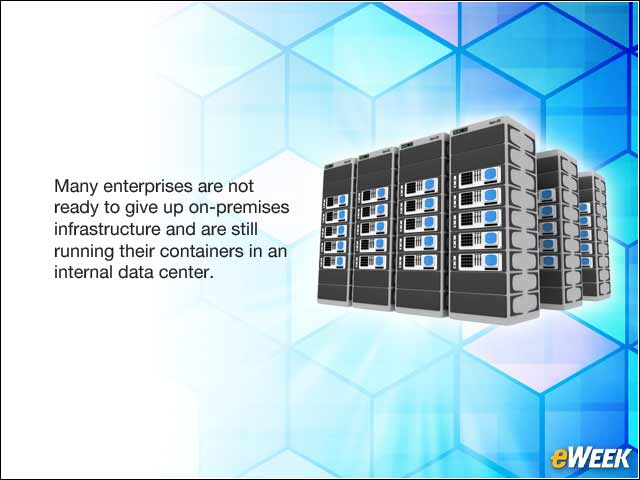
Containers are often associated with the cloud-based applications they support, but many companies are still not ready to forgo on-premises for cloud infrastructure. As companies take their time moving to the cloud, they might also think they need to put the brakes on using containers. However, while 41 percent of respondents reported running containers most frequently in Amazon Web Services (AWS), this was closely followed by almost one-third of users (28 percent) who are most frequently running containers in their internal data centers. Luckily, the benefits of containers can be enjoyed on-premises or in the cloud.
Why Shake Up Things?
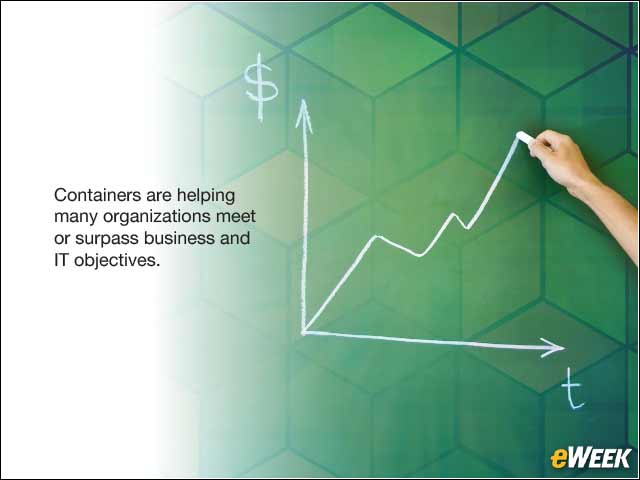
The biggest drivers of container adoption, as reported in the survey, were to increase developer efficiency (39 percent of respondents) and support microservices (36 percent), but some companies are looking for larger business and IT ROI before committing to containers. While it is still early days for measuring the overall success to be had by using containers, the survey demonstrated some clear results relating to the technology’s impact. On average, 72 percent of organizations that reported currently using containers met or exceeded their business and IT objectives. On the flip side, 63 percent of respondents who reported that their organization is not yet using containers had achieved or exceeded their business or IT goals. This 9 percent difference in success rate shows that containers are indeed driving positive results for IT teams and the overall business.