







- How Microsoft Bing Could Challenge Google in 2010
- Murdoch, Microsoft Take On Google
- Just Another Negotiation Ploy?
- Bing Dings Google
- Microsoft Disrupts Googles Dominant Search Model
- Changing the Search Engine Economy
- The Travel Industry Example
- Microsoft Applies GDS to Search to Hurt Google
- Microsoft Has Already Tried This Tactic
- The News Corp.-Microsoft Deal
- If Microsoft, News Corp. Strike a Deal, Will Others Follow Suit?
- Google Strikes Back
- Bottom Line
How Microsoft Bing Could Challenge Google in 2010
by Clint Boulton
Murdoch, Microsoft Take On Google
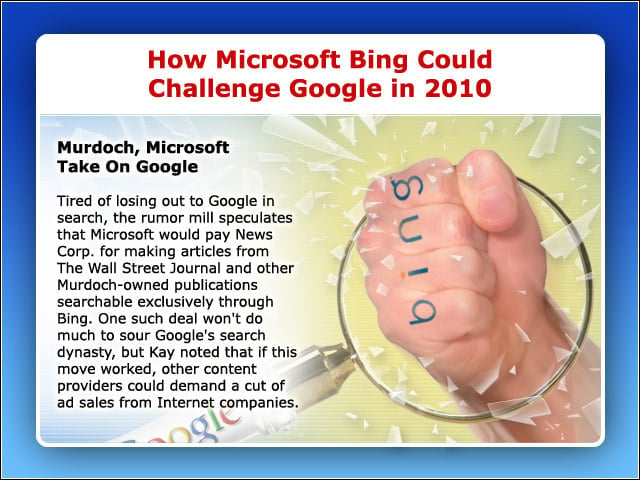
Tired of losing out to Google in search, the rumor mill speculates that Microsoft would pay News Corp. for making articles from The Wall Street Journal and other Murdoch-owned publications searchable exclusively through Bing. One such deal won’t do much to sour Google’s search dynasty, but Kay noted that if this move worked, other content providers could demand a cut of ad sales from Internet companies.
Just Another Negotiation Ploy?
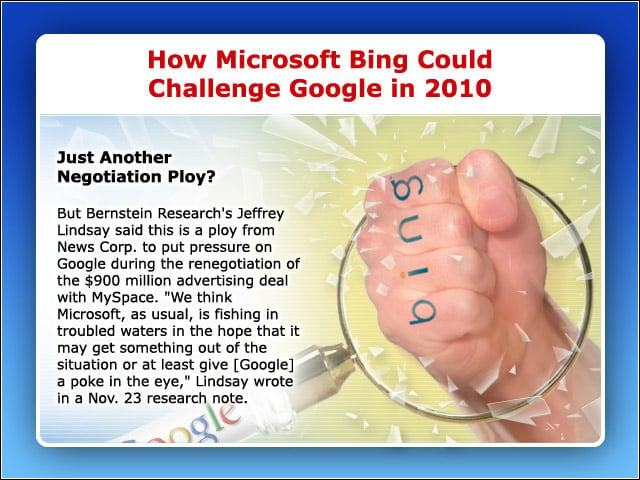
But Bernstein Research’s Jeffrey Lindsay said this is a ploy from News Corp. to put pressure on Google during the renegotiation of the $900 million advertising deal with MySpace. “We think Microsoft, as usual, is fishing in troubled waters in the hope that it may get something out of the situation or at least give [Google] a poke in the eye,” Lindsay wrote in a Nov. 23 research note.
Bing Dings Google
Still, Kay argues such a move by News Corp. and Microsoft could have broader implications in the Internet space, with content providers striking their own deals to place content with Microsoft, Yahoo, AOL and others for payment. “So the best play for Microsoft in the Web search market could be to diminish the revenue stream for everyone involved. If Microsoft could reduce the overall market value of Web searches, it could protect its own software revenue while hurting Google,” Kay wrote.
Microsoft Disrupts Googles Dominant Search Model

With this move, Microsoft could disrupt Google’s search ad market, just as Microsoft has co-opted operating systems and Web browsers. Kay said Microsoft might take ad revenue generated by Bing and pass it along to media providers, in return for exclusive arrangements to make their content available on Bing.
Changing the Search Engine Economy
Kay said Microsoft could ape the travel industry’s GDS (global distribution systems), which are used by airlines, car rental agencies and hotels to make their inventory easily available to travel agents.
The Travel Industry Example
Airlines and hotels operating in the GDS had to pass more money from airlines to travel agents to coax them to use the systems. So an airline might pass $8 per booking to its GDS, which then must pass $5 on to Expedia.com (EXPA). “Like Google, GDS centralizes great power over finding information. But unlike Google, companies that invest in the travel systems don’t keep all the profits for themselves.”
Microsoft Applies GDS to Search to Hurt Google

Microsoft could similarly redirect the flow of funds in the search market, reducing the value of Web searches for media content and changing the game Google pioneered for the rest of the industry. “Microsoft could make Internet search more like the GDS model and sap the profitability from it.”
Microsoft Has Already Tried This Tactic
Microsoft aped the GDS with Bing Cash Back, an attempt to tempt consumers to use Bing by giving them cash for purchases made by searching Bing. And it hasn’t worked. Google continues to gain search market share, according to ComScore, which pegged Google’s November share at 65.6 percent, its largest ever. Bing hovers around 10 percent.
The News Corp.-Microsoft Deal
News Corp. and Microsoft could strike an arrangement that lets the news conglomerate lock in the bulk of search ad revenue from clicks to its sites, driven by Bing. The key here, Kay argued, is exclusivity: News Corp. would be indexed by only Bing.
If Microsoft, News Corp. Strike a Deal, Will Others Follow Suit?
Kay noted that if this proves lucrative and effective for News Corp., other publishers could well strike similar deals with search engines such as Microsoft, Yahoo (which will soon be powered by Bing) and AOL. “If payments from Microsoft exceed the value of ads generated by Google-related traffic, it would make sense for other publications to delist from Google, too. As more content becomes available exclusively on Bing, users could switch away from Google search. That in turn will move market share.”
Google Strikes Back
If enough of these exclusivity deals prove lucrative for Google’s rivals, the search giant may find itself paying content aggregators for indexing privileges. This would effectively mean Microsoft and News Corp. changed the dynamics of the search engine market. Google and Microsoft would shell out to slug it out in search.
Bottom Line
Kay’s theory has merit—but only as a theory. While eWEEK believes News Corp. might be interested in going this route to make money from its paid content while avoiding Google’s search crawlers, eWEEK doubts Microsoft would dip deeper into its coffers to engage Google in this type of search guerilla warfare. Microsoft stands on the sidelines while Google targets leading Internet companies such as YouTube, Yelp and others. Why would Microsoft pay news sites to gain market share? Microsoft would have to get more than News Corp. to enlist in this effort or it would be a stark failure. We don’t see it happening.