








The creator economy has spent the last two years debating whether AI will replace creators. Adobe’s latest data suggests the more useful question is: what happens when almost every creator has a production team in their laptop?
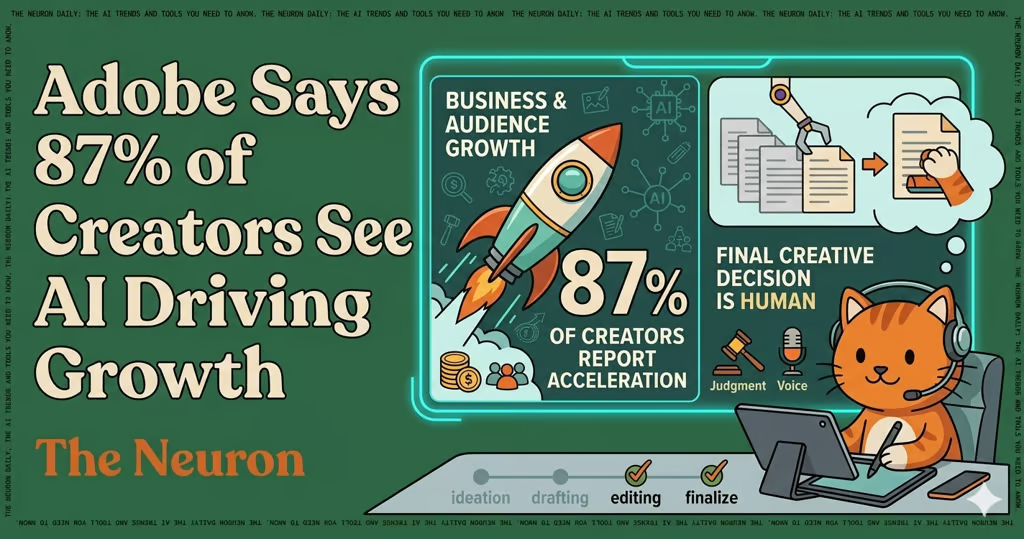
In its new 2026 Creators’ Toolkit Report, Adobe surveyed more than 16,000 creators across eight countries and found that creative AI has crossed from “interesting experiment” into daily workflow territory. Among creators who use or have tried creative AI, 87% say it has accelerated the growth of their business or audience, while 75% describe it as integrated or essential to how they work.
The downloadable report PDF is worth reading because the numbers indicate a broader shift: AI is not flattening creative work into push-button sameness. It is making the human parts of creative work more economically important.
That may sound like a neat little industry compromise. Machines do the boring bits, humans keep the soul, everyone goes home happy. Cute. Also incomplete.
The actual tension is that creative AI makes it easier to produce, but harder to stand out.
Adobe found that among creators who say standing out is harder than it was a year ago, 53% blame sheer content volume, and 42% say AI-generated content makes it harder for unique voices to break through. That is the new creator math: the tools increase your output, but they also increase everyone else’s output. The feed does not get less crowded because your thumbnail got prettier.
This is why Adobe’s most interesting finding is not speed, even though the speed number is huge. Ninety-three percent of creators say creative AI helps them produce faster. But 57% also say AI outputs usually need moderate or extensive editing before they are ready to share. Translation: the draft got cheaper. The final judgment did not.
That distinction matters because it cuts through both AI hype and AI panic. If AI were simply replacing the creator, refinement would not matter much. But the report suggests creators are using AI like a force multiplier for ideation, production, editing, and experimentation, then relying on human taste to decide what survives. Adobe’s Mike Polner frames the advantage as “voice, taste, and judgment,” and that is probably the cleanest way to understand where the market is headed.
The creator economy was already large before generative AI became the default co-worker. Goldman Sachs estimated the market could grow from about $250 billion in 2023 to $480 billion by 2027, driven by influencer marketing, platform payouts, monetization tools, and short-form video. AI pours gasoline on that, but not evenly. It helps small creators punch above their weight, which Adobe’s data supports: 58% say their ability to compete with larger teams or studios has improved since using creative AI.
That is the optimistic version of the story. A solo creator can brainstorm like a room, edit like a post team, localize like an agency, and mock up concepts before asking anyone for budget. The less romantic version is that every creator now has access to the same generic acceleration. When the baseline gets better, differentiation moves up the stack.
This is where agentic AI enters the room, wearing a headset and asking if it can “just handle that for you.”
Adobe says creators are optimistic about AI agents that can orchestrate multi-step creative tasks, but they are also very clear about the handoff. Eighty-five percent say the final creative decision should always remain with the creator. The comfort requirements are telling: 44% want the ability to review, edit, or undo at any point; 37% want transparency into what the agent is doing and why; and 34% want clear limits on what data and tools it can access.
That tracks with the broader agent conversation we’ve been having at The Neuron. In our beginner guide to AI agents, the key idea is that good agents need goals, tools, context, and guardrails. Adobe’s creator data makes the same point from the creative side: creators do not want a mysterious machine making aesthetic decisions behind a curtain. They want a controllable system that clears production drag without hijacking the work.
The winning creative agents, then, probably won’t be the ones that promise “fully automated creativity.” They’ll be the ones with strong undo, clear logs, permissions, style memory, asset provenance, and review checkpoints. Less magic wand. More studio assistant who labels the layers correctly and do not publish at 3 a.m. without asking.
The other big warning light in the report is disclosure.
Adobe found that 85% of creators say audience expectations around AI disclosure are increasing or holding steady, and 75% believe their audience can already tell when creative AI was meaningfully involved. Yet only 49% say they always or often disclose AI use, while 18% rarely or never do.
That gap will not stay harmless forever. Platforms are already building disclosure into the upload flow. YouTube, for example, requires creators to disclose AI-generated or meaningfully altered realistic content, including media that makes a real person appear to say or do something they did not do, alters footage of real events or places, or generates realistic scenes that did not happen. YouTube also says content with C2PA metadata may receive AI labels automatically.
That points to the next creator trust stack: disclosure, provenance, and copyright.
Adobe has a horse in this race through the Content Authenticity Initiative and Content Credentials, which aim to give digital media a kind of “nutrition label” showing origin and edit history. That infrastructure is useful, but it is not a magic truth machine. A 2026 independent analysis argued C2PA is promising but should not be relied on prematurely for high-stakes contexts like journalism or legal evidence. So provenance will help, but creators still need judgment, platform policy, and audience trust.
Copyright is just as messy. Adobe found that 90% of creators say it is important to obtain copyright protection for work created with creative AI assistance. The U.S. Copyright Office’s 2025 AI copyrightability report broadly supports the principle that AI-assisted work can be protected when there is sufficient human authorship, while purely AI-generated material is not protected. In other words: the creator’s contribution is not just artistically important. It may be legally important.
That is the bigger story inside Adobe’s report. Creative AI is no longer mainly about whether someone can generate an image, remix a video, or draft a caption. Those are table stakes. The next phase is about control: who made the decisions, what tools touched the work, what gets disclosed, what can be protected, and how a creator keeps a recognizable voice when the internet is flooded with infinite acceptable content.
The creators who win from here will not necessarily be the ones who use the most AI. They’ll be the ones who build the best creative operating system around it: repeatable workflows, strong taste, clear disclosure norms, reusable style systems, and agents that know when to stop.
AI made production cheaper. It did not make trust cheaper. And for creators, that may be the whole ballgame.
Editor’s note: This article originally appeared on our sister publication, The Neuron.