








You won’t believe your eyes, but in the age of generative AI, maybe you shouldn’t.
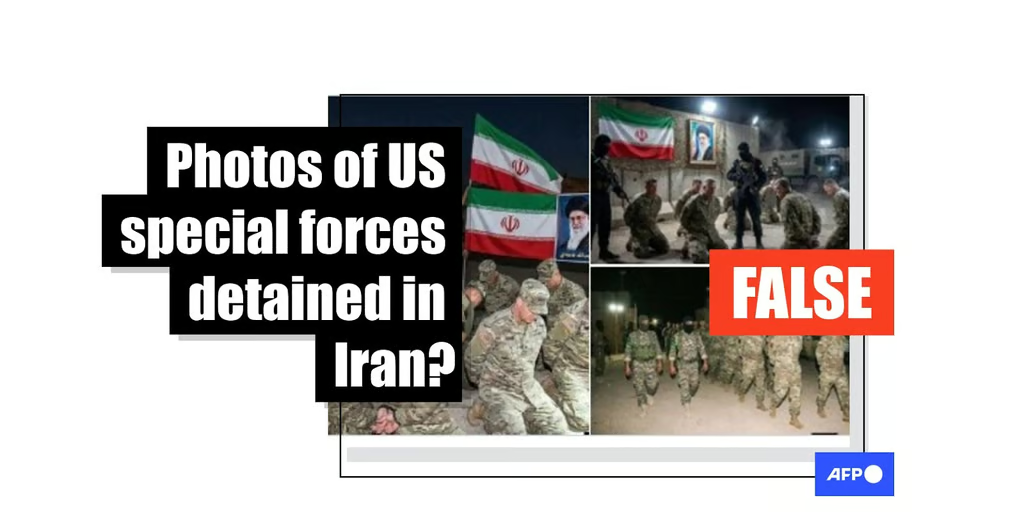
A set of viral images circulating on social media appeared to show American soldiers captured by Iran, which would be a dramatic development in the escalating conflict between the United States and Iran.
The post quickly began spreading across platforms like X and Facebook on March 5, with captions claiming “U.S. Delta Force troops” had been taken into custody. The images were shared in multiple languages, including English, Arabic, Spanish, and French, helping them reach audiences across different regions.
However, the pictures are not real. Instead, investigators and fact-checkers believe they were created using artificial intelligence.
The incident reflects a growing challenge for journalists, researchers, and everyday social media users, as AI-generated imagery and recycled media can spread widely before the truth catches up.
The giveaway signs of generative AI
Analysts examining the pictures quickly found clues revealing the images as synthetic.
Each picture contains a small sparkle-shaped watermark associated with Google’s Gemini AI image-generation tool. Reverse image searches using Google’s “About this image” tool also flagged the visuals as created with Google AI, identifying embedded SynthID digital watermarks that mark content created or edited with the company’s AI systems.
Beyond the watermark evidence, the images also contain what researchers say are classic indicators of generative AI mistakes. In several frames, the soldiers’ fingers appear distorted or malformed, their faces look blurred or inconsistent, and camouflage patterns and military patches seem mismatched.
In one image, a background figure even appears to have three arms, an anatomical error commonly produced by generative models that struggle to accurately render complex human poses.
Together, these visual inconsistencies and generative AI watermarks strongly indicate that the images were generated by AI rather than photographed in “real life”.
A tense geopolitical backdrop
The hoax emerged amid rapidly escalating tensions in the Middle East. The latest conflict occurred on February 28 after the US-Israeli strikes reportedly killed Iran’s Supreme Leader Ayatollah Ali Khamenei, and prompted a series of retaliatory strikes and military responses across the region.
Amid all of the mounting tensions, Iranian Foreign Minister Abbas Araghchi warned that any potential US or Israeli ground invasion would be “a big disaster” for those countries involved.
US President Donald Trump dismissed that possibility in an interview with NBC News the same day, saying sending American troops into Iran would be a “waste of time.” Still, the viral images appear to suggest that American forces might already be operating inside Iran.
While the Pentagon confirmed that six US troops were killed in a drone attack in Kuwait shortly after the conflict began, there is no evidence that additional American soldiers have been captured by Iranian forces.
A broader wave of wartime misinformation
The incident is just one example of the misinformation circulating online since the conflict began.
AI-generated images and recycled media are increasingly appearing alongside breaking geopolitical events. The fact-checking organization Full Fact says it has tracked at least seven AI-generated or AI-enhanced images and more than a dozen miscaptioned videos related to the conflict circulating online since the latest Middle East fighting began.
Misinformation posts can rack up thousands of interactions before being debunked. Some may even appear obviously fabricated, sometimes still carrying visible watermarks from the AI tools that generated them, yet they can still spread widely. Today, misinformation can quickly propagate in the high-speed environment of social media and can be difficult to correct once it takes off.
Among the recent examples flagged by researchers are fake images depicting Khamenei buried in rubble, as well as fabricated scenes showing the Burj Khalifa or the USS Abraham Lincoln engulfed in flames.
Old videos recycled as breaking news
Of course, misinformation in times of crisis is nothing new, and we can’t blame it all on artificial intelligence. In many modern cases, misleading posts do not rely on new technology at all; instead, they recycle older images and videos and present them as evidence of current events.
For example, a dramatic video of explosions near a building that circulated online as footage from Tel Aviv actually depicts a warehouse fire in China in 2015. The same footage has previously been miscaptioned during other global events, including Iran’s missile attacks on Israel in 2024 and Russia’s invasion of Ukraine in 2022.
Other clips circulating during the current crisis date back even further. One viral video falsely claiming to show US bases in the Gulf under attack actually originates from the beginning of the Iraq War in 2003.
These recycled clips often gain traction by looking dramatic and believable, especially when encountered out of context.
Why spotting AI fakes is getting harder
The growing accessibility of generative AI tools alongside longstanding misinformation tactics is making verification more difficult.
Visible watermarks embedded by tools like Gemini can expose some synthetic images, but these are not a foolproof safeguard. People can easily crop these watermarks from images or videos, and many AI systems do not include visible markers in their generated content.
Even the invisible SynthID watermark embedded by Google is not universal across all AI platforms, meaning the absence of such markers does not necessarily prove authenticity.
Ultimately, the viral “captured soldiers” images show how AI tools may be becoming a new front in information warfare. As generative AI models become more advanced and accessible, experts warn that the future examples of fabricated war imagery may be far harder to spot.
The flood of manipulated images and videos during fast-moving crises can overwhelm audiences and blur the line between real documentation and synthetic fabrication.
For journalists and researchers, this means that verification techniques like reverse image searches, metadata checks, and close visual analysis are becoming increasingly important.
For everyday social media users trying to verify suspicious images, the most important step may just be to slow down and fact-check before sharing dramatic images or claims.
In the age of generative AI, the first images from a breaking news event may no longer be documentation but instead fabrication.
Also read: 5 simple ways to spot AI-generated images can help readers catch visual red flags before a fake goes viral.