







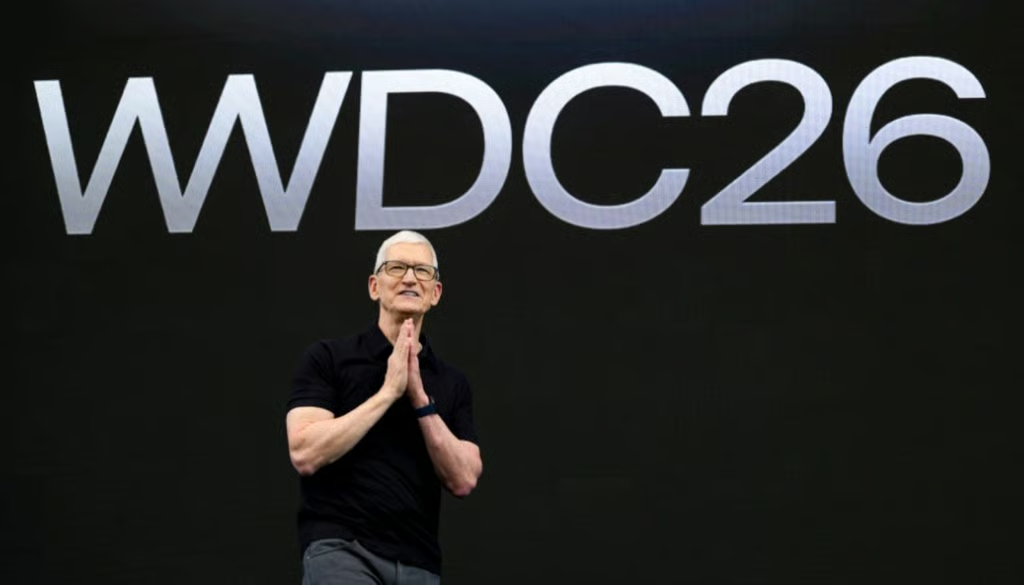
Apple’s most ambitious Siri overhaul in years is heading to millions of devices later this year, but not to iPhones and iPads in the European Union.
The company announced that its new AI-powered Siri, unveiled during WWDC 2026, will not launch on iOS 27 and iPadOS 27 in EU countries due to an ongoing dispute with European regulators over compliance with the Digital Markets Act (DMA).
Apple says it spent months trying to find a path forward but failed to reach an agreement with regulators, leaving European users without access to several of the headline AI features arriving elsewhere.
Apple blames DMA interpretation
In a statement, Apple argued that European regulators rejected every proposal it submitted to bring Siri AI to the region while maintaining privacy and security protections.
“We’re deeply disappointed that our EU users won’t have Siri AI on iPhone or iPad when we share our new software releases later this year,” said Craig Federighi, Apple’s senior vice president of Software Engineering.
“Our hope is to eventually bring Siri AI to the EU, and we will continue to engage with EU regulators on a path forward. However, their refusal to engage constructively on solutions that preserve privacy and security means we do not currently have a timeline for Siri AI’s availability on iOS and iPadOS in the EU.”
According to Apple, the European Commission’s interpretation of the DMA would require the company to grant competing virtual assistants broad access to user data and system functions if Siri AI were launched in the EU.
Apple claims this could include the ability to read and send messages, access files, make purchases, and perform actions across apps. The company argues that such requirements could expose users to greater security risks as AI systems become more capable.
Features EU users will miss
The delay affects a range of new AI-powered capabilities announced at WWDC.
Among the features unavailable to EU iPhone and iPad users at launch are the new Siri app, expanded Visual Intelligence tools, integrated writing features, Siri Mode in Camera, and other Siri AI functions tied to Apple Intelligence.
Because Siri AI on watchOS 27 depends on a paired iPhone running the technology, EU users also will not be able to access the new Siri experience on Apple Watch. However, the company noted that Siri AI will still be available to users in the region on macOS 27 and visionOS 27.
The restrictions also extend to software developers. Apple said developers based in the EU will not be able to test or integrate the new Siri AI capabilities into their iPhone and iPad applications.
Apple’s proposed compromise rejected
Apple said it attempted to address regulatory concerns through a system called Trusted System Agent.
The proposed framework would have acted as an intermediary, allowing third-party virtual assistants to access the same capabilities as Siri AI while maintaining additional safeguards around privacy and security. The company also proposed introducing Siri AI in Europe while gradually deploying the new system over 18 months.
According to Apple, both proposals were rejected by the European Commission.
Brussels bites back
European officials quickly challenged Apple’s account of events.
Speaking on behalf of the European Commission, spokesperson Thomas Regnier disputed the suggestion that EU rules prevent Apple from launching the service.
“We indeed need to set the record straight,” said Regnier, according to AP News. “The decision not to roll out Siri AI in the EU is Apple’s and Apple’s only because absolutely nothing in the DMA prohibits Apple from introducing new products in the EU.”
Regnier pushed back on Apple's proposed 18-month timeline, framing it less as a security bridge and more as an attempt to stall fair competition. He argued that instead of building a fully compliant solution from day one, Apple simply asked for an 18-month exemption.
“Guess what? That’s not an option, because it would mean that no AI agent other than Siri AI, by the way, powered by Google, would have an equal chance to be chosen by iPhone users,” Regnier told reporters in Brussels, adding that EU law is “non-negotiable.”
“The commission won’t give any exemptions, just like a police officer would not exempt a driver from respecting the speed limit,” Regnier stated.
History repeats itself
This is not the first time Apple Intelligence features have faced delays in Europe.
When Apple first introduced Apple Intelligence in 2024, the company also cited DMA-related concerns as a reason for postponing the rollout to EU users. Those features eventually arrived months later after additional discussions with regulators.
The latest standoff appears more serious. While Apple eventually brought the first wave of Apple Intelligence features to Europe, the company now says it has no timeline for Siri AI on iPhone and iPad in the region.
Also read: Apple upgraded Image Playground with photorealistic AI generation as part of its latest Apple Intelligence updates.