







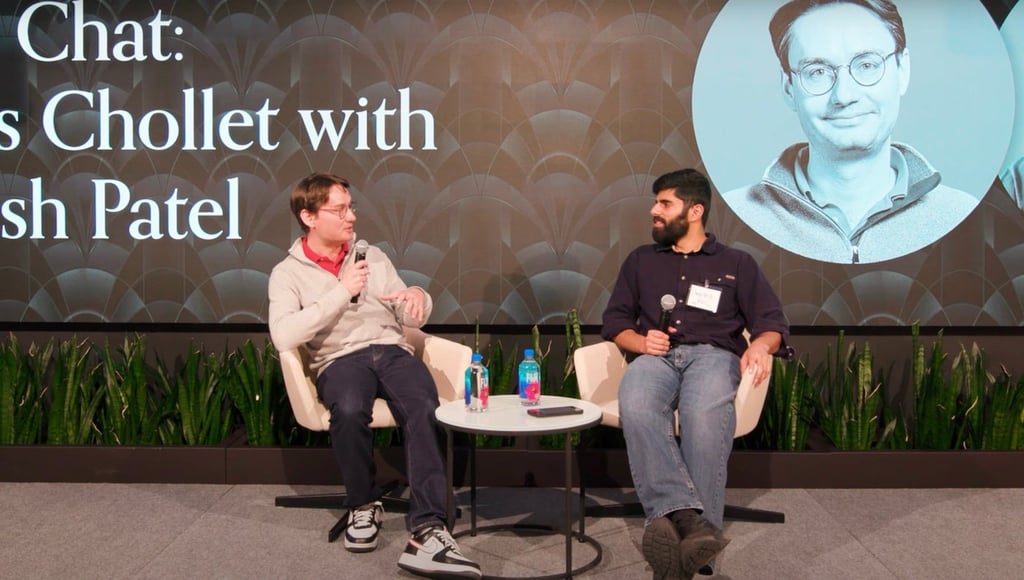
The creator of Keras and one of AI’s most influential thinkers, François Chollet, just shortened his AGI timeline from 10 years away to five. But the reason why is what’s really interesting… and it’s not about scaling bigger models.
In a new talk with Dwarkesh Patel, Chollet revealed his optimism comes from a fundamental shift in AI capabilities. For years, he argued models were stuck in a “static” loop, just memorizing and reapplying templates.
Now, he says, we finally have AIs that show real “fluid intelligence” by adapting to novel problems at test time, which is a critical step toward true reasoning. This is where his new benchmark test comes in.
New ARC-AGI-3 benchmark
ARC-AGI-3 is an “Interactive Reasoning Benchmark” that uses simple video games to measure an AI’s ability to learn on the fly. The goal is to test “skill-acquisition efficiency,” or how quickly an AI can figure things out in a totally new environment, just like a human.
What makes ARC-AGI-3 different
The benchmark is designed to be easy for humans (you should be able to pick it up in under a minute — try it yourself here) but incredibly hard for current AI.
Instead of static problems, AIs have to explore, plan, and act in about 100 unique game worlds. The AI gets dropped into a game with zero instructions, and it has to figure out the rules and goals entirely on its own through trial and error.
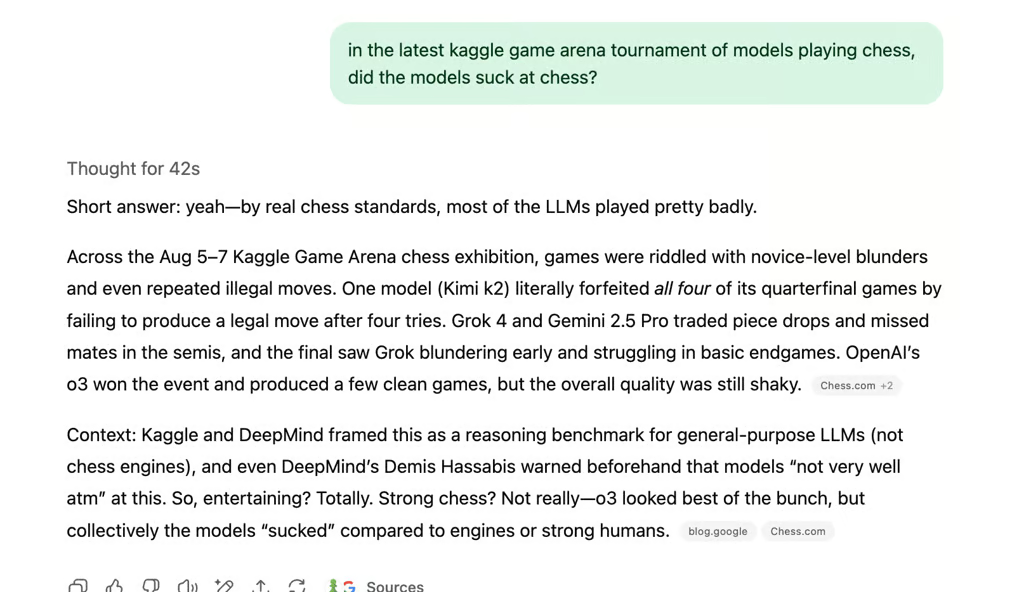
This reminds us of Google DeepMind’s Kaggle Game Arena, where you can watch AI models go head-to-head on games like chess and Go. Here’s the latest chess bracket, you can watch all the matches here, and see Chess World Champion Magnus Carlsen’s recap of the final match. From Magnus’ commentary, we got the sense the AI kinda sucked, so we asked GPT-5 to confirm.
Why does it matter if AI are good at games? As Chollet says, “As long as we can come up with problems that humans can do and AI cannot, then we do not have AGI.”
How do we close the gap?
Chollet’s answer targets the biggest problem with AI today, one famously described by his host Dwarkesh Patel: Today’s models are like a “perpetual intern on their first day.” They’re brilliant out of the box but never learn from experience.
Chollet’s proposed solution for this is basically a “GitHub for intelligence.” Instead of just performing tasks, his theoretical AGI would follow a three-step loop to achieve true, compounding learning:
- Learn a new skill: An AI agent efficiently figures out how to solve a novel task.
- Decompose the solution: It then breaks that solution down into its core, reusable parts.
- Share with the network: It uploads these new reusable parts to a global library, making them instantly available to millions of other AI agents.
The real game-changer
So the real game-changer isn’t raw intellect but collective learning. Chollet envisions a system where any skill learned by one agent becomes a permanent, instantly accessible building block for all others. While humans learn in isolation, this AGI would learn as a collective, compounding its knowledge at an incredible rate. Which as Dwarkesh said would basically be the singularity (i.e., where AI surpasses humans).
For more on this topic, read my deep dive on Chollet’s AGI timeline change and new benchmark.
Editor’s note: This content originally ran in today’s edition of the newsletter for our sister publication, The Neuron. To read more from The Neuron, sign up for its newsletter here.