







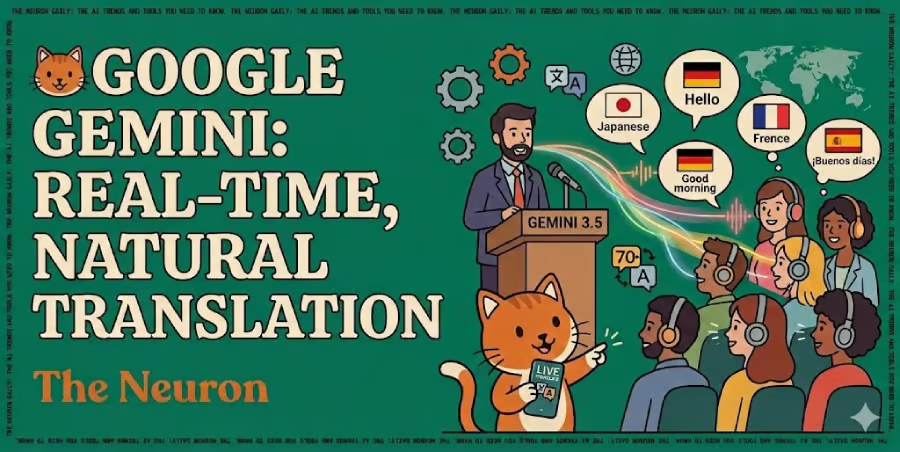
You've been living the translator nightmare. Google just ended it.
You're presenting to an international client. Half the room speaks Japanese, the other half German. Your interpreter is a $500/hour human trying to keep up while you're mid-flow. There's lag, there's lost nuance, there's someone staring at their phone.
That's the world Google just made slightly embarrassing.
Gemini 3.5 Live Translate launched on Monday, bringing near-real-time, natural-sounding speech translation across 70+ languages. No choppy pauses. No robotic monotone. It actually sounds like a person.
Here's what happened
- Google opened the Gemini 3.5 Live Translate model to developers via the Gemini API and AI Studio.
- The model handles real-time speech-to-speech translation as a continuous stream, not chunk-by-chunk.
- It auto-detects language switches mid-sentence without any manual configuration.
- It's already live in Google Translate (iOS and Android, with headphones) and rolling out in private preview for Google Meet.
- Use case demo: one speaker presents to a global room, attendees scan a QR code, and listen in their preferred language simultaneously.
Why this matters
This is a bigger deal than it sounds.
Real-time translation has been technically possible for some time, but Google's version is the first to sound conversational rather than mechanical. The model handles cross-language streaming, meaning it doesn't wait for you to finish a sentence before it starts translating. That closes the one gap that's kept live translation from being usable in real meetings.
For knowledge workers with any international exposure, the productivity unlock here is real. Think global, all-hands, client pitches, or vendor negotiations where you've historically needed an interpreter or just... hoped for the best.
Our take
The API access is the sleeper story here.
Developers can now bake real-time translation into anything: customer support tools, conferencing software, live event apps. The consumer demo is cool, but the infrastructure play is what changes industries. One open question: how well does it handle domain-specific vocabulary, legal or technical terms, for example, where a mistranslation carries real stakes?
And btw, did anyone see SemiAnalysis's thread today? They ran long coding tasks until they hit the weekly limits on both the $200/month Claude Max and OpenAI plans, and found subscribers are getting way more than the assumed ~$2,000/month in token value. So before OpenAI slashes prices… you might already be getting a pretty good deal.
Editor’s note: This article originally appeared on our sister publication, The Neuron.