







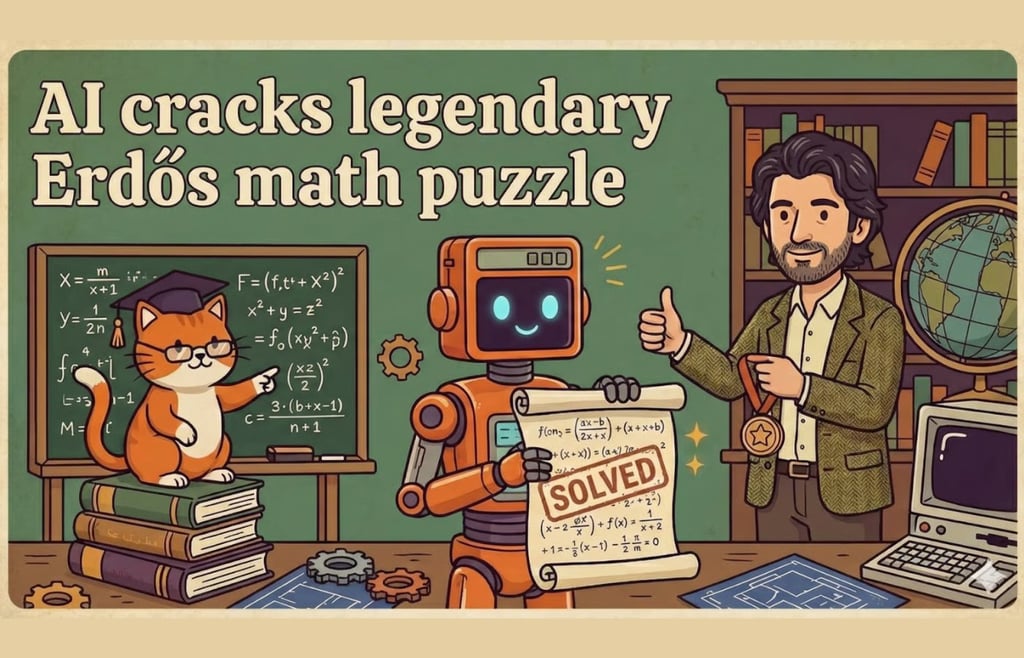
Remember those brain-teaser math problems from school that made you want to throw your pencil? Now imagine ones so hard they’ve stumped mathematicians for decades.
Paul Erdős, who published more papers than anyone in math history, left behind hundreds of these puzzles when he died in 1996. This weekend, GPT-5.2 Pro solved one.Neel Somani prompted the AI to tackle Erdős Problem #397, which asks whether infinitely many solutions exist for a specific equation involving central binomial coefficients. GPT-5.2 generated the proof, the tool Aristotle formalized it in Lean (a verification language), and Fields Medalist Terence Tao accepted it.
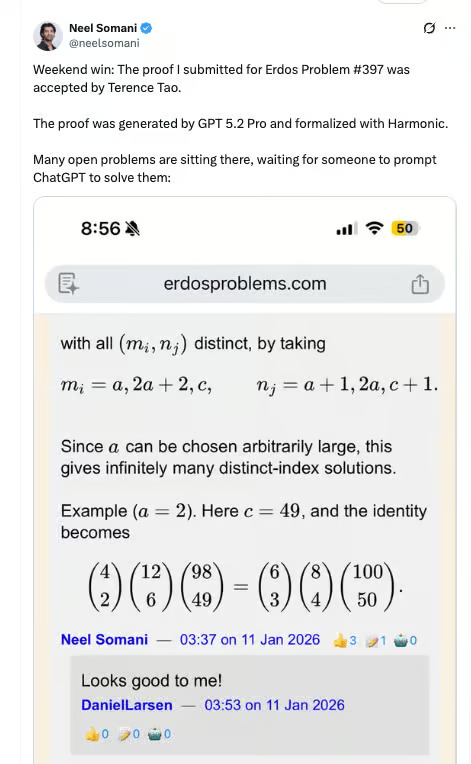
Here’s what makes this a milestone
- It’s part of a wave of autonomous solves: GPT-5.2 has now cracked Problem #728, #729, and 397.
- Verified mathematics: The Aristotle system auto-corrected gaps in proofs and produced Lean-verified code.
- Self-contained reasoning: Unlike October 2025’s GPT-5 controversy (which just found existing literature), Tao says these are original proofs.
The catch? Tao emphasizes these are “lowest-hanging fruit”; problems solvable with standard techniques, not profound breakthroughs. GPT-5.2 scores 77% on competition-level math but only 25% on open-ended research requiring genuine insight.
Why this matters
For knowledge workers, we’re watching AI transition from pattern-matching to proof-generation. When models can autonomously solve decade-old problems (even straightforward ones), expect this to accelerate across fields requiring logical reasoning: contract analysis, regulatory compliance, and engineering optimization.
Over the next 6-12 months, watch for GPT-5.3 (or whatever is next) and competing models from Google/Anthropic to systematically tackle the remaining ~660 unsolved Erdős problems.
If you work with structured problem-solving, start experimenting with how these models handle your domain’s equivalent “Erdős problems”; those nagging challenges everyone knows about, but nobody’s solved.
Editor’s note: This content originally ran in the newsletter of our sister publication, The Neuron. To read more from The Neuron, sign up for its newsletter here.