







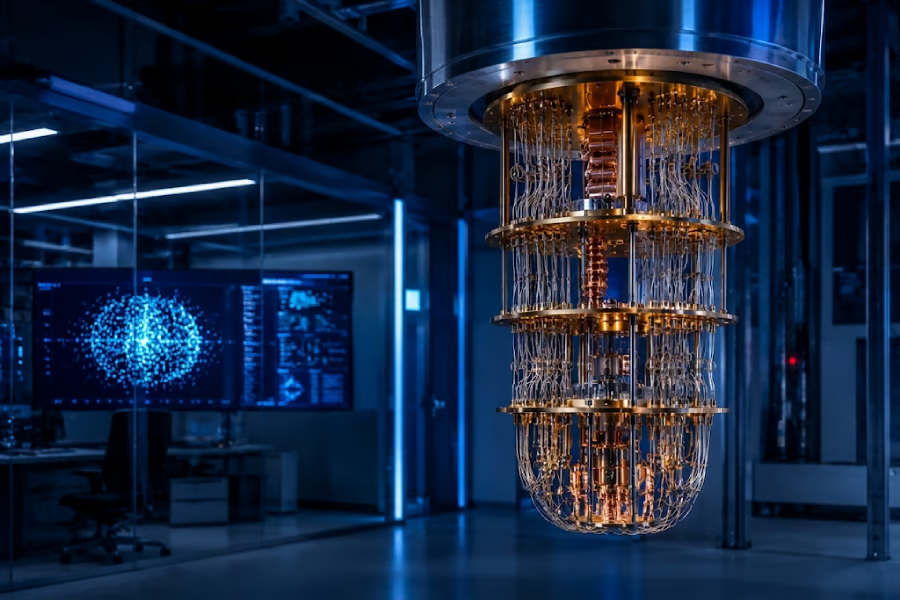
Quantum computing has a temperature problem, and IBM is building a much bigger refrigerator to solve it.
IBM has connected two modular cryogenic systems capable of reaching temperatures below 15 millikelvin, part of an infrastructure project designed to eventually link hundreds of quantum chips. The company says the milestone moves it closer to IBM Quantum Starling, the fault-tolerant quantum computer it plans to deliver in 2029.
But the important development here is not simply that IBM managed to make something extraordinarily cold. It is that quantum computing's race toward useful machines is increasingly becoming an infrastructure challenge involving cooling, wiring, chip connectivity, error correction, and enormous systems engineering.
IBM connects two giant quantum refrigerators
IBM said it successfully joined and cooled two cryogenic modules into a single environment at its Yorktown Heights research facility.
The two operational modules stand more than eight feet tall and eight feet wide when combined. During initial testing, IBM said they reached 4 Kelvin, roughly the temperature of liquid helium, in less than five days before ultimately dropping below 15 millikelvin. That is more than 180 times colder than deep space, according to the IBM announcement.
Those extreme temperatures matter because IBM's superconducting qubits need to operate near absolute zero. As quantum computers grow, however, keeping processors cold is only part of the problem.
Engineers also need room for more control wiring and connections between processors.
IBM says each new module provides up to 12 times as much wiring space as the cryogenic environments used by its most widely deployed quantum systems. Its box-shaped design also allows multiple refrigeration modules to sit alongside one another.
The company plans to use what it calls L-couplers to connect processors inside and across those modules, allowing separate quantum chips to communicate and behave as parts of a larger system. IBM explains the architecture in more detail in its quantum computing blog.
That modular approach is significant because adding more qubits to a single giant chip is not necessarily the only path to larger quantum computers. IBM is betting that multiple processors can eventually work together inside a scalable quantum system.
eWeek has tracked that broader shift toward larger quantum architectures across the industry. Microsoft, for example, recently detailed its next-generation quantum work at Microsoft Build 2026, where it presented Majorana 2 as another path toward scalable quantum computing.
What eWeek found: IBM cleared one infrastructure hurdle, not fault tolerance
The new cryogenic system is a concrete engineering achievement, but it should not be confused with IBM's demonstration of the fault-tolerant quantum computer it ultimately wants to build.
IBM's own roadmap makes that distinction clear. The company's quantum roadmap describes its future milestones as current goals and objectives that remain subject to change or withdrawal.
For 2027, IBM plans to use L-couplers to connect multiple processors into a system with at least 1,000 programmable qubits. Its much larger goal is Starling, which IBM says will arrive in 2029 with 200 logical qubits capable of running 100 million quantum gates.
Logical qubits are particularly important. Unlike simply counting physical qubits, logical qubits use groups of physical qubits plus error correction to preserve quantum information reliably enough for longer computations. That reliability problem remains one of the defining barriers separating today's quantum systems from large-scale, fault-tolerant machines.
In other words, IBM has demonstrated that its new modular refrigeration architecture can connect and reach the required ultracold environment. It has not yet demonstrated Starling itself or all of the error-corrected computing capabilities promised for 2029.
That distinction matters as vendors compete to establish quantum leadership. Microsoft has similarly argued that useful quantum computers are moving into a timeline of “years, not decades,” a prediction eWeek covered in its look at Microsoft's 2026 technology trends.
Why enterprises should pay attention now
Most enterprise technology teams are not about to install a refrigerator-sized quantum computer next to their servers.
The larger signal is where the industry is headed. IBM increasingly describes quantum computing as part of a hybrid architecture in which quantum processors operate alongside CPUs, GPUs, high-performance computing systems, and cloud infrastructure rather than replacing classical computers outright.
In March, IBM published a reference architecture for what it calls quantum-centric supercomputing, outlining how quantum and classical resources could eventually work together across data centers and cloud environments. That could make quantum computing relevant to enterprises long before organizations operate their own quantum hardware.
Potential workloads include chemistry, materials development, optimization, and other computational problems that are difficult for classical systems. At the same time, the advance of quantum computing carries security implications, particularly for encryption, an issue eWeek has previously examined in its coverage of IBM's quantum security strategy.
IBM is also putting substantial money behind the bet. In June, the company said it would invest more than $10 billion in quantum computing and claimed its quantum program had accumulated more than $1.1 billion in client contracts since 2017.
For enterprise leaders, the immediate takeaway is therefore less about buying quantum hardware and more about watching whether IBM can turn a series of individual engineering milestones into a reliable computing platform.
The refrigerator is now getting bigger. The harder test is whether the computer inside it can eventually live up to the roadmap.
Also read: The US is accelerating its own quantum push, with a new initiative targeting a research-ready quantum computer by 2028 and a federal post-quantum encryption deadline for 2031.