







Microsoft’s AI expansion is running into a physical constraint that more GPUs alone cannot solve: enough powered data-center space to put those chips to work. The pressure is already visible in Azure, where Microsoft says customer demand continues to exceed available capacity.
A Guardian report published Aug. 17 reported that Microsoft had about 2.2 million AI accelerators installed as of mid-2026, based on internal company documents. Microsoft rejected the publication’s estimates as inaccurate and based on incorrect assumptions. The report also resurfaced earlier comments from CEO Satya Nadella describing electricity and ready-to-use data-center buildings as limits on how quickly Microsoft could deploy chips.
Power and buildings are shaping Microsoft’s AI buildout
The Guardian investigation compared the reported accelerator count with estimates derived from Microsoft’s publicly discussed data-center capacity. Microsoft does not disclose how many GPUs it owns or operates, so outside estimates remain uncertain.
Microsoft is still broadening its chip options, including plans to deploy AMD’s Helios rack-scale AI platform in Azure alongside Nvidia hardware and Microsoft’s own silicon.
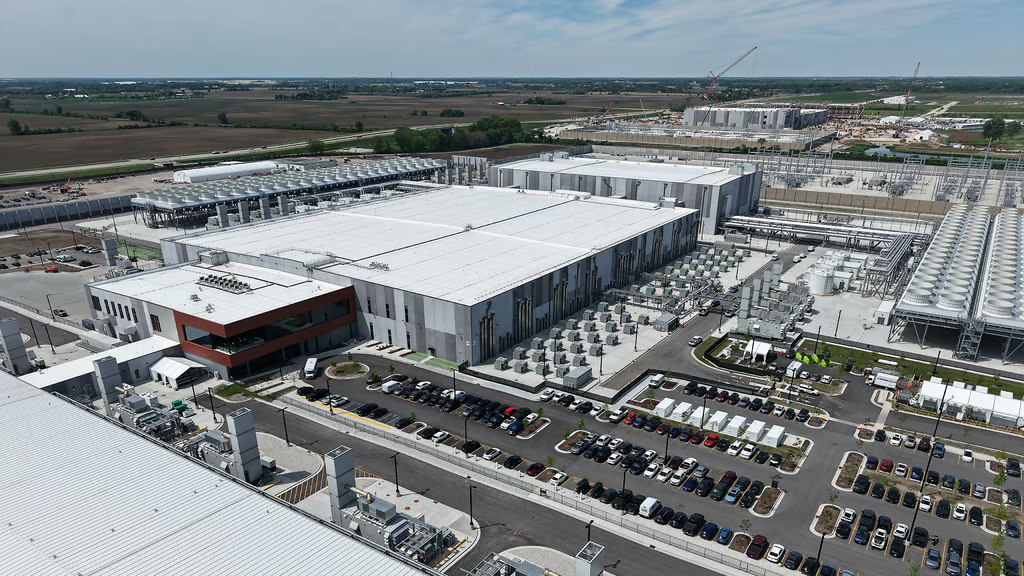
Physical capacity is expanding too. Microsoft’s first Fairwater facility in Wisconsin became fully operational in June, while a second adjacent facility is due in 2028. Its planned Pecos, Texas, campus is expected to add about 2 gigawatts of capacity and initially rely on a co-located natural-gas plant operating behind the meter before connecting to the regional grid.
The International Energy Agency projects global data-center electricity use will rise from about 415 terawatt-hours in 2024 to roughly 945 TWh by 2030, with AI the largest driver. Recent analysis of AI data-center power demand shows how transmission constraints can complicate hyperscale deployment schedules.
RAND estimates that roughly 300 GW of announced U.S. generation capacity through 2030 could translate into about 82 GW of net available capacity after accounting for project completion, retirements and reliability. Those additions may not arrive where the largest new data-center loads emerge.
Azure growth hinges on new capacity
Microsoft’s July 29 earnings call showed how closely capacity and cloud growth are linked. Azure and other cloud services revenue rose 43% year over year while demand still exceeded available capacity. Microsoft added 31 data centers during the quarter and another gigawatt of capacity, and said additional Azure capacity delivered during the quarter was quickly monetized.
Service and model availability can vary by region, while provisioned capacity can change with demand, according to Microsoft’s Foundry documentation. The company is expanding internationally as well, including an A$25 billion investment in Australia — about US$18 billion — by the end of 2029 to support digital infrastructure, cybersecurity and AI skills.
Organizations planning large AI deployments should verify model availability, regional capacity and data-residency requirements before committing workloads. Microsoft’s ability to bring chips, buildings and power online together will determine how much AI demand it can convert into usable Azure capacity.
Read more: Power is only one physical limit on the AI buildout: hyperscalers are also competing for the electricians needed to construct and operate increasingly power-dense data centers.