







Microsoft and OpenAI are not breaking up, but they are very much renegotiating the relationship.
On April 27, 2026, OpenAI announced an amended partnership with Microsoft that turns one of the most important deals in tech into something more flexible, less exclusive, and a lot less weird.
The short version: Microsoft remains OpenAI’s primary cloud partner, OpenAI products still ship first on Azure under most circumstances, and Microsoft keeps rights to OpenAI’s models and products through 2032. But Microsoft’s license is now non-exclusive. OpenAI can serve products across any cloud provider. Microsoft will stop paying OpenAI a revenue share. OpenAI will keep paying Microsoft through 2030, at the same percentage, but now subject to a total cap and no longer tied to OpenAI’s technical progress.
That last bit matters more than it sounds. For years, the Microsoft-OpenAI relationship has had this slightly surreal clause orbiting it: what happens when OpenAI declares AGI? In the October 2025 version of the deal, Microsoft’s IP rights, revenue-sharing, and AGI verification process remained central to the structure.
In a February 2026 joint statement, the companies explicitly stated that the AGI definition and processes remained unchanged.
Now the economics have been simplified around dates, caps, and non-exclusivity. In human terms: fewer “what if we invent the future?” clauses, more “here’s who pays whom and until when.”
That is a big shift.
For Microsoft, the new deal preserves the prize. It still gets access to OpenAI IP through 2032. It still owns a major stake in OpenAI; as of the October 2025 agreement, Microsoft said its investment in OpenAI Group PBC was valued at about $135 billion and represented roughly 27% on a diluted basis. And Azure still gets first shot at OpenAI products.
But Microsoft also gets something else: freedom.
The company has spent the last few years embedding OpenAI into Bing, Office, Azure, GitHub, Windows, and Copilot. That made Microsoft look like the obvious enterprise AI winner. It also made Microsoft look unusually dependent on one partner whose ambitions kept expanding from “AI lab” to “consumer platform, enterprise platform, infrastructure company, hardware company, model company, and maybe the operating system for work.”
That is a lot of eggs in one very expensive basket.
Microsoft has already been moving toward a more diversified AI posture, including deeper work with other model providers and its own frontier efforts. The new OpenAI agreement makes that posture easier to defend. Microsoft keeps a front-row seat to OpenAI’s upside, but it no longer has to operate as if OpenAI is the only road to AI dominance.
For OpenAI, the deal is even more clarifying
OpenAI’s core problem is now “can we get enough compute, power, customers, distribution, and capital to turn those models into a durable business before the bill comes due?”
That requires optionality. Lots of it.
OpenAI has already been assembling a compute empire outside the old Microsoft-only frame. Its Stargate expansion with Oracle and SoftBank put the company on a path toward nearly 7 gigawatts of planned capacity and more than $400 billion in investment over three years. Its AWS partnership added a $38 billion cloud commitment. We’ve been tracking this infrastructure arms race at The Neuron, including why OpenAI’s AWS deal was really about the power and capacity bottleneck behind AI.
Today’s amendment turns that strategy from “awkwardly permitted” into “structurally acknowledged.”
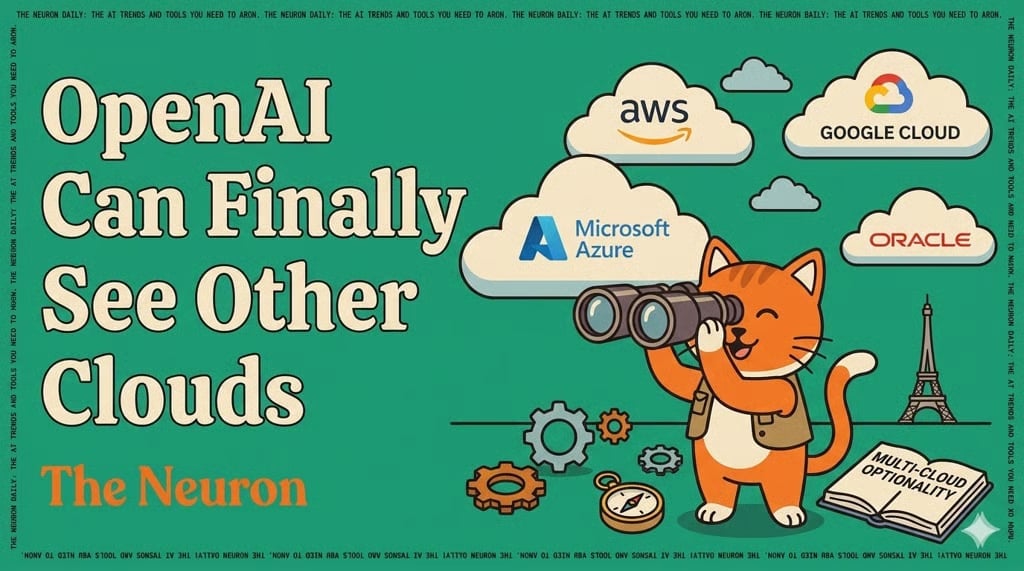
OpenAI can now serve all its products across any cloud provider. That does not mean Azure is suddenly irrelevant. It means OpenAI can match workloads, customers, geographies, products, and capacity needs to the infrastructure that supports them. In a world where frontier AI is constrained by chips, electricity, data centers, cooling, and deployment timelines, that flexibility is great survival gear.
The other big implication: OpenAI becomes easier to finance.
Investors hate ambiguity when the ambiguity involves revenue sharing, IP rights, cloud exclusivity, and an AGI escape hatch that sounds like it was drafted during a sci-fi book club. Cleaner terms make OpenAI easier to value. Capped payments make future margins easier to model. Non-exclusive licensing makes the company look less like a Microsoft dependency and more like a platform that can sell everywhere.
That does not mean OpenAI is suddenly free from Microsoft. The companies are still deeply intertwined. Microsoft remains the primary cloud partner. OpenAI products still ship first on Azure unless Microsoft cannot or chooses not to support the required capabilities. Microsoft remains a major shareholder. The companies say they will keep collaborating on data centers, silicon, cybersecurity, and other large-scale AI infrastructure. But the center of gravity has moved.
The original Microsoft-OpenAI deal was built for an era when one giant cloud partner could fund the frontier lab, host the workloads, commercialize the models, and turn the whole thing into an enterprise software advantage. That era gave rise to ChatGPT, Copilot, Azure OpenAI, and one of the fastest strategic pivots in Microsoft history.
The next era looks messier
OpenAI wants to be everywhere. Microsoft wants OpenAI’s upside without letting OpenAI define its entire AI future. Amazon, Google, Oracle, NVIDIA, Broadcom, SoftBank, and others all want a piece of the AI infrastructure stack. Enterprises want model choice. Governments want sovereign capacity. Developers want APIs that work wherever their systems already live. And everyone wants enough electricity to keep the whole machine running.
So the Microsoft-OpenAI amendment is less a divorce filing than a market signal: AI’s next phase will be multi-cloud, capital-intensive, and less exclusive by default.
The irony is that both companies may end up stronger because the partnership is looser.
OpenAI has room to scale like an infrastructure-hungry platform rather than a single-cloud appendage. Microsoft gets to keep access, equity upside, and Azure priority without pretending exclusivity is still the cleanest strategy. Customers get more paths to OpenAI products. Competitors get a clearer opening, but also a clearer warning: the biggest AI players are now structuring their partnerships around trillion-dollar infrastructure realities, not tidy software-era channel agreements.
The relationship is still consequential. It is just less romantic now.
And honestly? That may be exactly what both sides needed.
Editor’s note: This content originally ran in the newsletter of our sister publication, The Neuron. To read more from The Neuron, sign up for its newsletter here.