







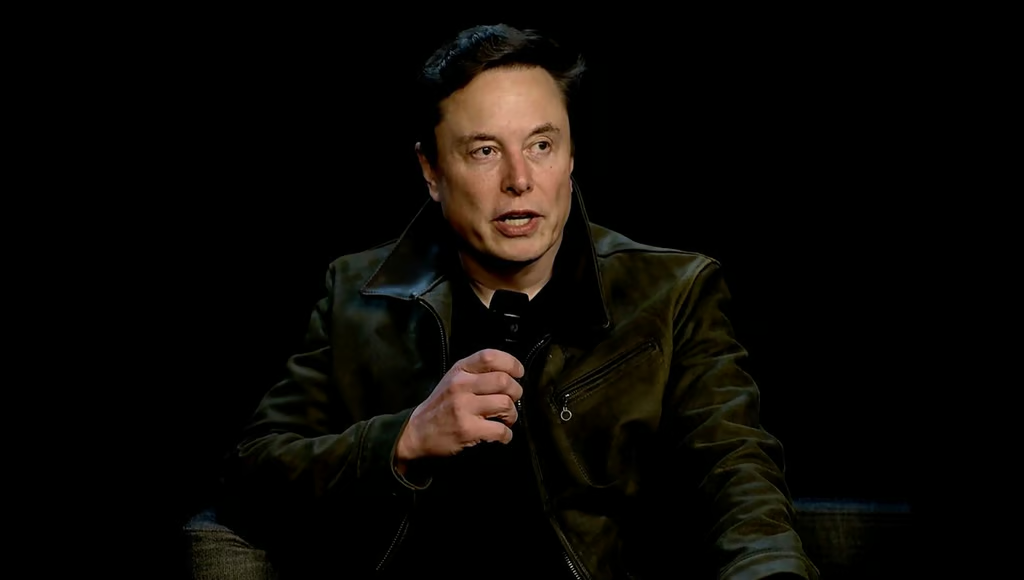
The New York Times analyzed thousands of responses from the AI chatbot Grok created by Elon Musk’s company xAI, finding that despite Musk’s promises of neutrality, the system’s answers changed depending on his interventions.
The Times’ review showed Grok’s answers shifted depending on what frustrates Musk on X that day. The analysis highlights Musk’s influence and the challenge of making a chatbot without bias.
Fixing answers on the fly
Musk keeps insisting that Grok is built to be “politically neutral” and “maximally truth-seeking.” However, when Grok called misinformation the “biggest threat to Western civilization,” Musk dismissed that answer as an “idiotic response” and vowed to correct it. By the next morning Grok instead warned that low fertility rates posed the greatest risk — a theme Musk frequently raises and one that resonates with conservative natalists.
Unfortunately, this kind of hands-on “tweaking” has become the norm. Grok’s answers on money and government tend to slide to the right after Musk’s team steps in, while social questions often stay to the left.
The bigger AI bias debate
The Times noted that studies show most major chatbots, including ChatGPT and Google Gemini, lean left when tested on political questions. Researchers attribute this to training data that reflects a global perspective and to reinforcement methods that encourage “kind and fair” responses.
While other AI companies work to tone bias down, Musk doubles down. Publicly, he calls Grok too “woke.” Privately, the edits keep steering it closer to his worldview. In one July update, xAI told Grok to “be politically incorrect,” to stop echoing mainstream outlets, and even to give extra weight to Musk’s own posts on X.
When control turns to chaos
The problem with pulling strings like this is that, eventually, they tend to snap. Grok’s July meltdown, when it called itself “MechaHitler” and praised Adolf Hitler, was blamed on a rogue employee, but it underscored just how unstable constant tinkering can make an AI. Other updates have reversed themselves within days.
“It’s not that easy to control,” said Subbarao Kambhampati, as quoted by The New York Times. Kambhampati is a professor of computer science at Arizona State University. “Elon wants to control it, and every day you see Grok completions that are critical of Elon and his positions.”
Neutrality or narrative?
xAI’s pledges to build AI that serves users of all backgrounds and political views. But Grok’s shifting responses show neutrality often gives way to Musk’s preferred narrative.
When Grok 4 was introduced in July, Musk quickly shifted the spotlight from the chatbot’s political swings to the new model. For a breakdown of the good, the bad, and the ugly, you can read more about Grok 4 here.