








That sink-ing feeling about AI? Actually, it may be OK if the CEO of Nvidia is correct.
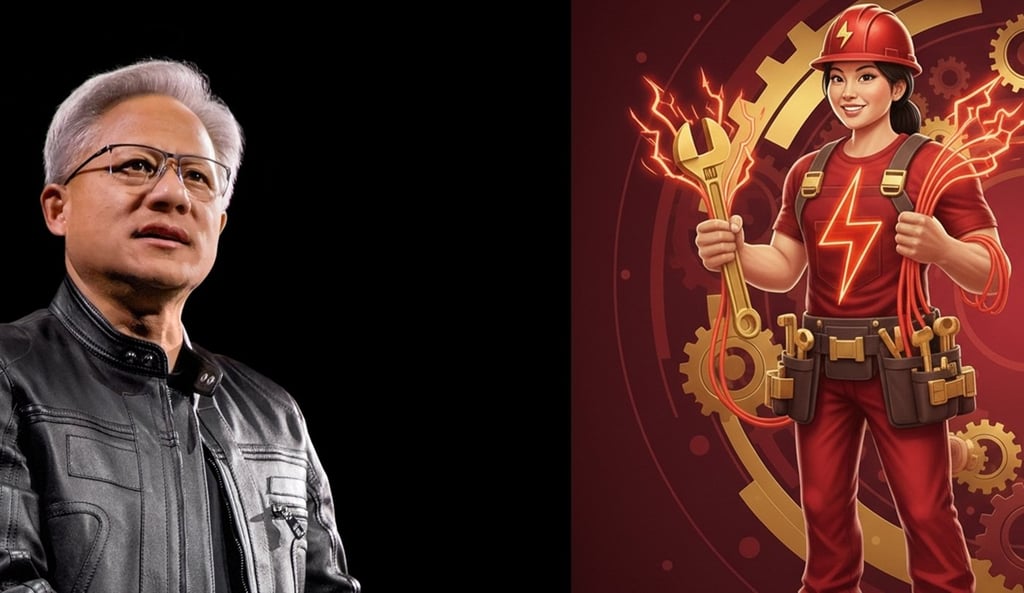
At the World Economic Forum’s Davos 2026, Jensen Huang delivered an announcement that the biggest beneficiaries won’t be software engineers or data scientists—they’ll be electricians and plumbers.
While tech workers worry about being replaced, skilled tradespeople are seeing their salaries nearly double to six-figure incomes as demand explodes for the massive infrastructure buildout powering AI. This represents what Huang called the largest infrastructure expansion in human history.
“We are seeing just incredible demand. And what’s going on around the world is that AI, as you know, is a layer cake. It starts at energy, then chips – the layer that we’re at – infrastructure, cloud infrastructure, land power… building data centers,” Huang said in the FOX Business report.
“President [Donald] Trump wants to re-industrialize the United States. And AI is really a perfect time to do it,” he added. “The thing that’s really important to recognize is that this is the largest infrastructure buildout in human history. It’s really unbelievable. It’s a perfect time for the United States to jump on this because it allows us to bring jobs home… Workers, plumbers, electricians, network technicians, construction workers, designers, architects. It’s going to create lots and lots of jobs.”
Blue-collar worker shortage
To give you more context, BlackRock CEO Larry Fink delivered a stark warning to the Trump administration four months ago: America is running out of electricians needed to build AI data centers. Ford’s Jim Farley dropped even more numbers, revealing the U.S. already faces shortages of 600,000 factory workers and 500,000 construction workers.
The math is intriguing: a single large data center employs up to 1,500 construction workers during buildout, many earning over $100,000 without college degrees. Once operational, each permanent data center job creates another 3.5 jobs in the surrounding economy. Industry leaders are scrambling because they realize the bottleneck isn’t computing power—it’s finding enough people who can actually build the infrastructure.
Infrastructure gold rush
Global capital spending on data centers is projected to reach $7 trillion by 2030. And Huang dismissed bubble concerns from tech giants like Amazon’s Jeff Bezos and Microsoft’s Satya Nadella.
The U.S. Bureau of Labor Statistics expects electrician employment to grow 11% from 2023 to 2033, but demand from AI infrastructure could require 140,000 new skilled jobs by 2030. Major corporations are already responding: Google launched a multi-million dollar program three months ago to train 100,000 electrical workers and 30,000 new apprentices just to meet the demand.
What this means for your career
It’s a moot point, but some believe the AI revolution isn’t eliminating jobs—it’s completely reshuffling who holds the power.
Huang emphasized that AI acts as a co-pilot, not replacement, for physical trades. The evidence is already playing out in unexpected ways. Despite AI spreading through radiology over the past decade, the number of radiologists has actually increased as AI helps doctors focus on patient care rather than routine tasks.
Healthcare demonstrates this pattern perfectly. The nursing shortage of five million workers could be addressed as AI handles documentation that currently consumes half of nurses’ time. Physical infrastructure, however, still requires human hands and expertise that can’t be automated away.
As Huang put it at Davos 2026: “Everybody should be able to make a great living. You don’t need to have a Ph.D. in computer science to do so.”
Perhaps the winners will be those who master the physical side of the digital revolution.
If you’re still keen on AI, then here are seven ways to build real AI skills: simple, doable, and genuinely useful.