







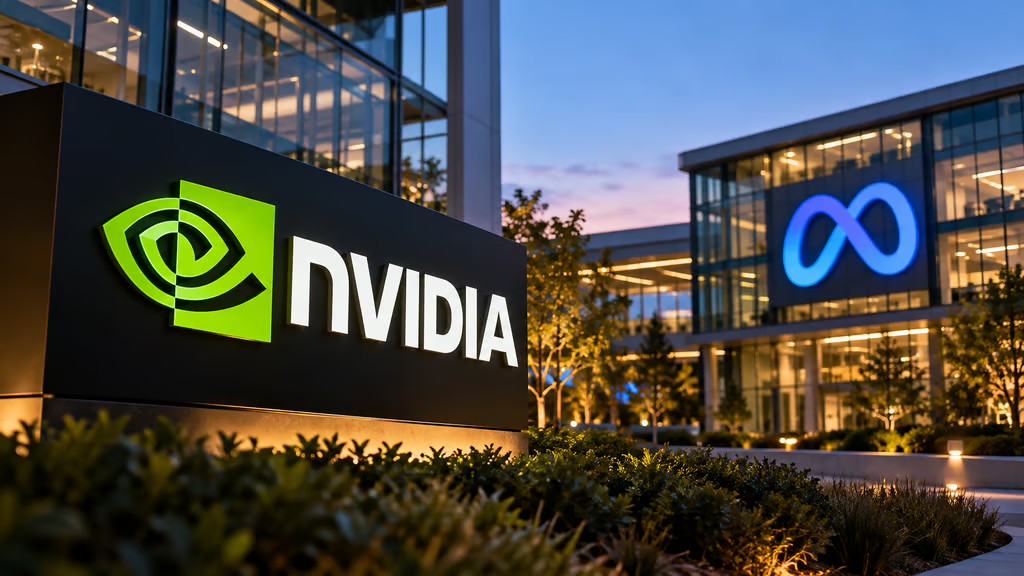
Nvidia plans to invest $3 billion in Meta as the companies expand their collaboration on Muse AI agents and models. The agreement includes work to improve model training and inference, alongside plans to deploy more Nvidia computing and networking infrastructure.
The Oct. 27 announcement comes as Meta expands its AI financing plans to $97.5 billion. Nvidia's investment is a financial commitment tied to a broader technical partnership, not the launch of a new enterprise AI product.
What Nvidia and Meta are expanding
According to Nvidia's announcement, the companies intend to optimize Muse training and inference workflows to improve performance and reduce total cost of ownership.
Meta also plans to expand its deployment of several Nvidia technologies:
- Vera Rubin and Vera CPUs: Computing infrastructure intended to support next-generation AI agents.
- Spectrum-X Ethernet: Networking technology designed to support efficient data movement across large AI clusters.
- BlueField-4: Infrastructure intended to improve network efficiency and throughput.
These plans build on a February infrastructure partnership covering Nvidia processors, networking, and large-scale GPU deployments.
Neither announcement provides Muse-specific inference benchmarks, quantified cost savings, or a schedule for completing the new infrastructure rollout.
Meta is also expanding its relationship with AMD. In a separate Oct. 27 announcement, AMD confirmed that its Helios rack-scale systems are already operating at Meta and that EPYC processors power Muse.
AMD also committed $1 billion to Meta's equity offering. The two investments total $4 billion, but neither establishes an exclusive hardware arrangement.
Nvidia and Meta are considering additional work on OpenShell, a framework for safer AI agent deployment, and Sentry, a system intended to monitor agent behavior.
That collaboration remains exploratory. Nvidia has not announced a Meta deployment of either technology.
Meta's existing use of Nvidia Confidential Computing for WhatsApp private processing is a separate, previously disclosed implementation.
What eWeek found: Three enterprise questions remain
The expansion gives Meta access to more computing capacity and engineering support from competing hardware suppliers. It does not establish that Muse is available for enterprise deployment.
Three questions remain for organizations evaluating similar AI infrastructure and agent platforms:
- Can the efficiency gains be measured? Nvidia and Meta say they intend to improve training and inference performance, but have not published comparative benchmarks, power-consumption results, or workload-level cost figures.
- Which security controls will reach production? OpenShell and Sentry are being considered, not deployed through this agreement. Enterprise security teams still need evidence of permission enforcement, monitoring, auditability, and protection against unsafe agent actions.
- Is there a commercial path to Muse? The announcement provides no enterprise pricing, API availability, service-level commitments, or named business customers.
These questions overlap with challenges surrounding GPU cluster monitoring and the controls needed to manage autonomous AI agents.
The financial arrangement also deserves scrutiny. Meta is raising capital to expand AI infrastructure while major chip suppliers are investing in the company. That creates overlapping investment and supply relationships, although the announcements do not disclose how much future hardware spending is contractually committed to either supplier.
For infrastructure buyers, the distinction is between announced capacity, deployed hardware, and demonstrated efficiency. AMD has identified systems already operating at Meta, while Nvidia's expanded Vera Rubin deployment remains a stated plan.
The next useful disclosures would be measured Muse performance, production deployment details for agent security controls, and clearer commercial terms.
Until then, the companies have confirmed a substantial investment and a broader engineering relationship, but not the operational improvements or enterprise availability needed to evaluate Muse as a business platform.
Also read: Microsoft's Project Perception is introducing dynamic permissions and risk controls intended to restrict what enterprise AI agents can do.