






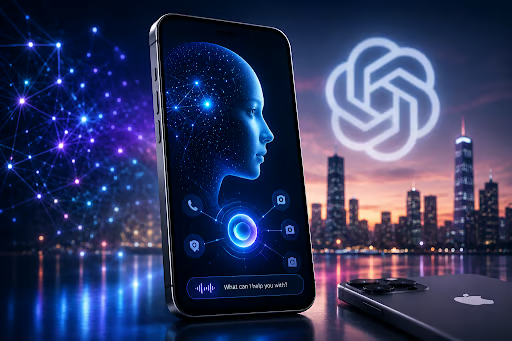


OpenAI appears to be taking a much larger step into hardware than previously expected, with reports suggesting the company is developing a smartphone built around AI agents rather than traditional app-based experiences.
The idea comes from analyst Ming-Chi Kuo, whose recent supply-chain findings point to OpenAI working with chipmakers MediaTek and Qualcomm, while manufacturing partner Luxshare could play a central role in bringing the device to life.
If the project moves ahead as expected, it would put OpenAI in direct competition with smartphone leaders, including Apple's iPhone lineup.
The concept behind the device differs from how most smartphones work today. Rather than users jumping between multiple apps to complete tasks, the goal appears to be a system where an AI agent understands context and handles actions more directly.
"Users are not trying to use a pile of apps. They are trying to get tasks done and fulfill needs through the phone," Kuo published on X.
Why OpenAI might want its own phone
According to Kuo, OpenAI has several possible reasons for creating its own hardware platform rather than relying entirely on existing phones. The first is control. Kuo argued that AI experiences could require tighter integration between software and hardware than current smartphone systems allow.
"Only by fully controlling both the operating system and hardware can OpenAI deliver a comprehensive AI agent service," he wrote.
Another factor is data and context. Smartphones already collect information tied to a user's daily activity, including communication, location, and behavior patterns.
MacRumors reported that Kuo believes smartphones are uniquely positioned because they capture a user's "full real-time state," making them highly valuable for AI systems designed to continuously understand context.
Hardware details are starting to surface
While the device remains years away, some early details have begun emerging.
Reports suggest that OpenAI could build the phone around custom processors developed in partnership with MediaTek and Qualcomm. Kuo initially identified both companies as partners, though later reports indicated MediaTek may have a stronger position as a long-term supplier.
Luxshare is reportedly expected to act as the exclusive system co-design and manufacturing partner. MacRumors also reported that the device may include separate AI processors that handle different workloads simultaneously, such as language processing and vision tasks, as well as enhanced imaging capabilities to improve real-world sensing.
The device is expected to rely on both local and cloud-based AI processing. Simpler tasks could run directly on the phone, while heavier workloads would be handled remotely. "More complex or compute-intensive tasks will be handled by cloud AI," Kuo wrote.
A different direction from earlier OpenAI plans
The smartphone report marks a sharper turn from OpenAI’s earlier hardware narrative. The company had previously been linked to screen-light or even screen-free products developed with former Apple design chief Jony Ive after OpenAI acquired io Products.
Reports have pointed to several devices under development, including smart glasses, a speaker with integrated cameras, and other AI-focused products.
OpenAI CEO Sam Altman had previously described one prototype to employees as "the coolest piece of technology that the world will have ever seen," according to MacRumors. The newly reported smartphone plans suggest OpenAI's hardware ambitions may now extend beyond companion devices into a much larger category.
Timeline still appears fluid
Launch expectations have shifted several times. Earlier projections pointed toward mass production in 2028, though later reporting suggested the timeline could move up to the first half of 2027.
Kuo expects supplier decisions to become clearer over the next year, with large-scale production depending on whether development remains on schedule.
Also read: Visa and OpenAI are bringing payment tools to ChatGPT agents, raising questions about fees, disputes, privacy, and user control.